Guided Buying is the intelligent layer within digital procurement that simplifies the purchasing experience for every employee while maintaining policy compliance and spend control for procurement teams.
It bridges the gap between user convenience and governance — enabling non-procurement users to make the right buying decisions without needing to know complex sourcing workflows, supplier policies, or approval rules.
At its core, Guided Buying uses AI, business rules, and intuitive UX to route requests, suggest preferred suppliers, and ensure every purchase aligns with budgets, contracts, and compliance policies.
Explore Zyucus’ Guided Procurement System
Why Guided Buying in Procurement Matters for Compliance and User Adoption
Modern enterprises operate with thousands of buyers and decentralized purchases. Without automation, that leads to maverick spend, duplicate suppliers, and compliance risk.
Guided Buying transforms this landscape by delivering:
- Ease of Use: Employees buy the right item or service without needing to navigate multiple systems.
- Policy Adherence: Built-in rules ensure compliance with budgets, contracts, and sustainability standards.
- Speed: AI-driven workflows cut requisition and approval cycles drastically.
- Savings: Direct users to preferred vendors and negotiated pricing.
- Transparency: Unified visibility from request to payment.
In short, it empowers employees while ensuring procurement retains strategic control.
How Guided Buying Works: A Step-by-Step Workflow
1. Need Identification
Guided Buying starts with simplicity — users describe what they need in plain language:
“Order a laptop,” “Book design services,” “Buy software licenses.”
AI interprets intent, identifies the correct category, and directs requests to the right path — catalog purchase, service requisition, or sourcing event.
Smart classification automatically applies department, budget, and policy rules, ensuring compliance from the first click.
Platforms like Zycus Merlin Intake enhance this experience through embedded AI that understands natural language, classifies spend type, and routes requests to the most cost-effective and compliant workflow — reducing friction, manual intervention, and cycle time.
2. Category & Policy Guidance
Once intent is captured, procurement policies take over silently.
Rules for preferred suppliers, spend thresholds, approval hierarchies, and ESG preferences are applied automatically.
Users only see approved items and suppliers — aligning purchases with corporate goals without slowing them down.
Built-in compliance and sustainability filters ensure every transaction supports business, ethical, and environmental priorities.
3. Smart Catalog & Marketplace Integration
Modern Guided Buying platforms unify all purchase channels — internal catalogs, supplier-hosted sites, and external marketplaces — into one governed interface.
Users compare approved products and services with real-time pricing, availability, and contract validity.
Dynamic catalog management ensures content stays accurate and policy-aligned.
In solutions like Zycus, catalogs are directly connected to supplier and contract data — so updates or expiries reflect instantly across the system.
4. Intelligent Requisition Creation
After selection, requisitions are auto-generated with complete details — supplier, cost center, GL code, tax, and project metadata.
AI validation checks for duplicates, missing data, or policy violations before submission.
This ensures first-pass accuracy, faster processing, and fewer exceptions — improving operational efficiency and governance simultaneously.
5. Automated Approvals
Approval workflows adapt dynamically based on spend, category, and risk.
Low-value or catalog items flow straight through, while high-value or non-standard requests trigger escalation.
Machine learning refines routing over time, minimizing bottlenecks and maintaining SLA compliance.
The result is faster approvals with full control, merging agility with governance.
6. Purchase Order & Feedback Loop
Approved requisitions convert instantly into Purchase Orders (POs), synced with ERP or finance systems.
Users track delivery, invoice, and payment status in one place, improving transparency.
Post-purchase feedback — on quality, delivery, or responsiveness — feeds supplier scorecards, informing sourcing and performance reviews.
Integrated ecosystems like Zycus ensure this loop stays closed and auditable across the Source-to-Pay flow.
7. Analytics & Insights
Every user action generates insight.
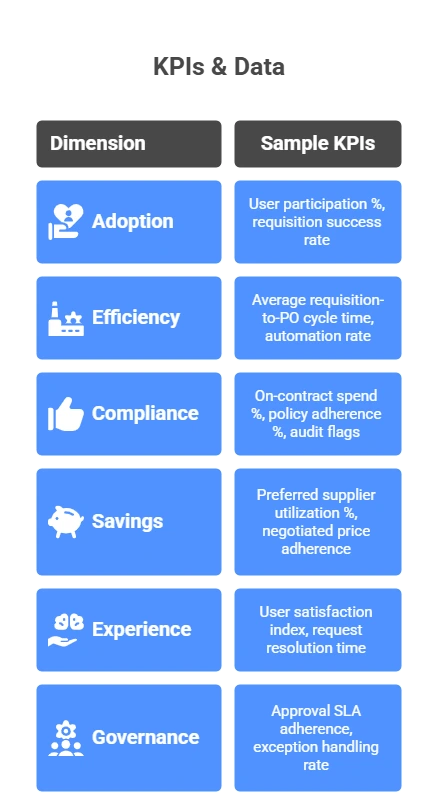
Analytics dashboards track adoption, cycle time, compliance, savings, and user satisfaction.
Procurement leaders gain visibility into buying patterns, supplier utilization, and process efficiency — enabling data-driven optimization and spend governance.
8. Scalability & Experience
Cloud-based architecture makes Guided Buying scalable across entities and geographies.
Role-based personalization tailors experiences by user type — requester, approver, or category manager.
Platforms such as Zycus Merlin Guided Buying extend this with multi-language support, real-time analytics, and AI that learns from every transaction to refine guidance and policy enforcement.
Business Impact of Guided Buying: ROI, Compliance, and User Adoption
Well-implemented Guided Buying delivers measurable value:
- 60% less maverick spend
- 3–4× higher user adoption
- Up to 50% faster requisition-to-PO cycle time
- Stronger compliance, savings realization, and supplier engagement
It transforms procurement from rule-driven oversight into an intuitive, intelligent experience — where every user action aligns with strategy, every purchase follows policy, and every insight strengthens the enterprise.
How Guided Buying Integrates Across the Source-to-Pay (S2P) Process
Guided Buying connects seamlessly with every procurement function:
- Sourcing: Routes non-catalog needs to RFx or spot-buy events.
- Contract Management: Surfaces items from active contracts and auto-enforces pricing.
- Supplier Management: Links supplier ratings and risk profiles into purchase visibility.
- Procure-to-Pay: Enables automatic PO generation and invoice matching.
- Analytics: Feeds spend, compliance, and adoption data into dashboards for continuous improvement.
Zycus delivers this integration through its Merlin AI-driven platform, ensuring every transaction flows through a unified, compliant, and data-enriched ecosystem.
Key Terms in Guided Buying
- Requisition Management: The process of capturing and approving internal purchase requests — often triggered through Guided Buying workflows.
- Approval Workflow: The rule-based system that routes requisitions to the correct approvers based on spend, category, or risk level.
- Catalog Management: The organization and governance of digital catalogs with approved items and pricing — a key foundation for guided buying.
- Maverick Spend: Purchases made outside of approved suppliers or contracts; minimized through guided buying enforcement.
- AI in Procurement: Artificial Intelligence used to interpret user intent, suggest suppliers, classify spend, and automate validations.
FAQs
Q1. What is guided buying in procurement?
Guided Buying is a digital procurement feature that helps employees purchase goods or services easily while ensuring every transaction follows company policies, budgets, and approved suppliers — without needing procurement expertise.
Q2. What are the benefits of guided buying for employees?
It simplifies the buying process, reduces errors, and speeds up approvals. Employees get clear options, compliant suppliers, and auto-filled requisitions — saving time and improving their overall experience.
Q3. How does AI enhance guided buying?
AI interprets user intent, classifies spend, and enforces policies in real time. Advanced platforms like Zycus Merlin Intake even understand natural language, guiding users to the right buying path and optimizing compliance automatically.
Q4. How does guided buying reduce maverick spend?
By routing every request through approved catalogs, suppliers, and contracts, Guided Buying minimizes off-contract purchases and ensures spend stays within negotiated frameworks.
Q5. How does guided buying connect with Procure-to-Pay (P2P)?
It acts as the front door to the P2P process. Every request captured through Guided Buying flows seamlessly into requisition, approval, PO creation, and invoicing workflows — ensuring end-to-end traceability.
References
- The Intake Advantage: Why Emerging Enterprises Need Guided Procurement
- The Power of Intuitive Procurement Software: Cost Saving Initiatives in Procurement
- Catalog Buying in B2B Procurement: Building Stronger Supplier Relationships
- Leveraging Conversational AI in Procurement
- Zycus for Achieving Spend Compliance with Procurement Technology