WHAT IS KSEF (POLAND E-INVOICING)?
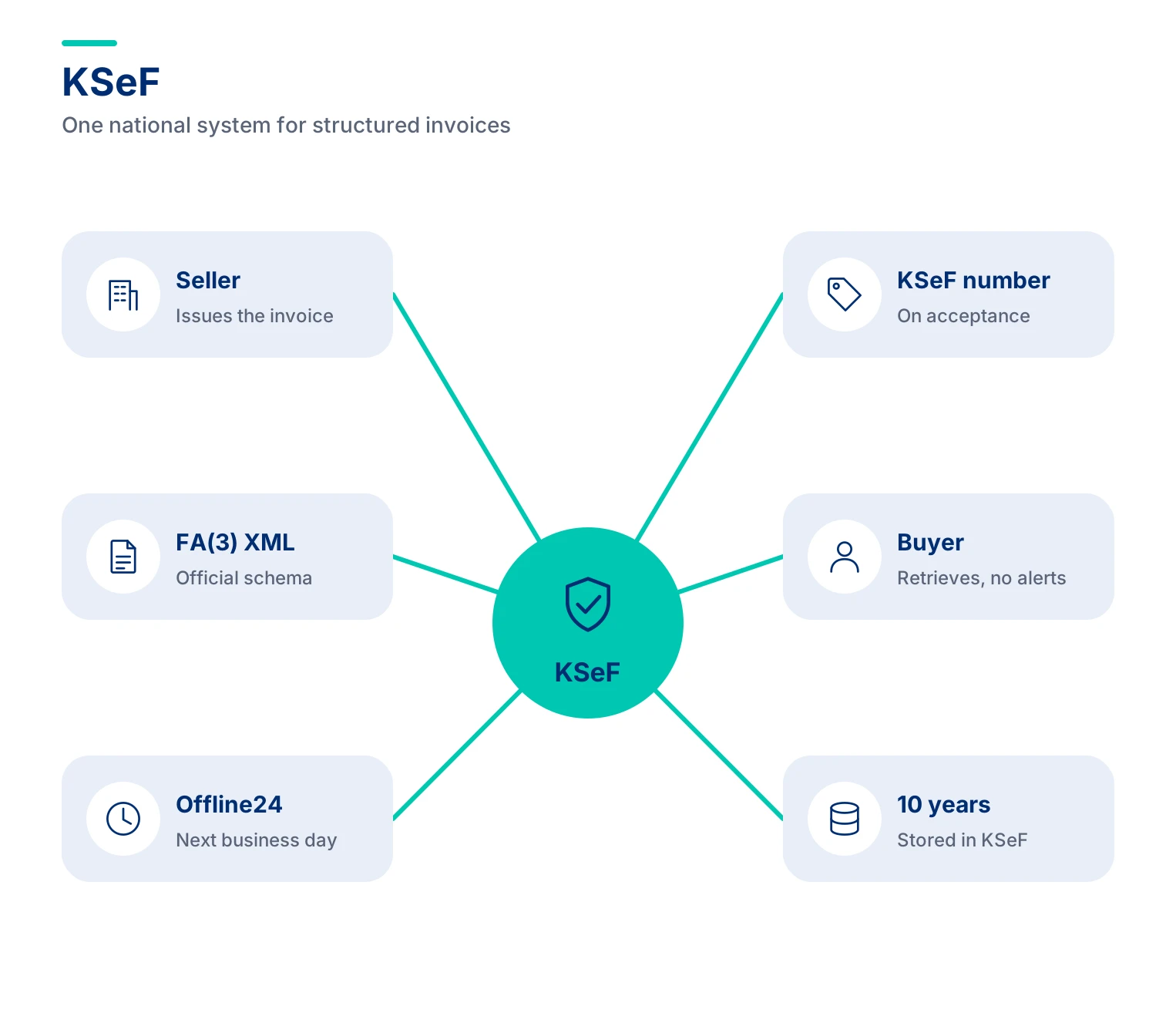
KSeF (Krajowy System e-Faktur) is Poland’s national e-invoicing system, run by the Ministry of Finance, for issuing, sending, receiving and storing structured invoices. A structured invoice is an XML file in the official format, and it counts as issued once KSeF gives it a number.
WHY IT MATTERS IN PROCUREMENT
KSeF changes where the invoice lives. The official invoice sits in a central national system, not in an email inbox or a supplier portal. From 1 February 2026, receiving invoices also goes through KSeF, so AP teams need software that can collect and process them.
The mandate started in two stages in 2026. It applied from 1 February to taxpayers whose 2024 sales exceeded PLN 200 million, and from 1 April to other taxpayers. Transitional relief runs to the end of 2026 for some small taxpayers, and some exemptions exist. Rules have been amended more than once, so confirm the current position with the Ministry of Finance or tax counsel. For wider context, see global e-invoice compliance.
THE CORE PROCESS / LIFECYCLE
Access and Permissions. The issuer authenticates to KSeF using a method set by regulation, such as a trusted profile, qualified signature or qualified seal. Taxpayers can also authorize others, such as an accounting firm.
- Building the FA(3) File. The billing system maps invoice data to the FA(3) logical structure, the XML schema that applies from 1 February 2026.
- Submission to KSeF. The file is sent through the KSeF interface. The system validates it before accepting it.
- KSeF Number Assignment. KSeF assigns a unique number. The invoice then becomes a structured invoice and is treated as received by the buyer.
- Retrieval by the Buyer. KSeF sends no notifications, so the buyer’s accounting software must check for new invoices on its own schedule.
- Matching and Archive. AP matches the invoice to the order, and KSeF keeps the invoice for ten years.
CORE COMPONENTS
The FA(3) schema defines the XML structure every structured invoice follows. The KSeF number is the identifier the system assigns on acceptance. Authentication and permissions control who can issue, view or download invoices. The API lets ERP and AP software exchange invoices with KSeF automatically. Offline modes let issuers keep invoicing when connectivity or KSeF fails. QR codes let a recipient verify an invoice in KSeF, which matters for offline invoices and for buyers who cannot log in.
KEY BENEFITS
A single national format and a single point of retrieval remove the need to read PDFs and chase attachments. Structured fields let AP match invoices to purchase orders with fewer manual touches.
The KSeF number also gives both parties one reference for the same invoice, which makes disputes and reconciliations easier to trace and supports AP compliance work. Suppliers that already produce structured data find the shift smaller than those relying on scanned documents.
COMMON PITFALLS
- Treating the PDF as the invoice. For structured invoices, the XML in KSeF is the invoice. A PDF copy is only a convenience.
- Waiting for a notification. KSeF does not alert buyers, so AP systems must poll it, or invoices go unseen until suppliers chase payment.
- Overlooking foreign counterparties. A buyer without a Polish tax number cannot log in to download invoices, so the seller must share a copy another way.
- Skipping permission design. If accountants, shared service centers and ERP connectors lack the right access, issuing and retrieval stall.
KSEF OFFLINE MODES AND WHAT THEY MEAN FOR THE BUYER
Offline invoices still end up in KSeF. Until then, the buyer holds a copy that carries QR codes for verification. Deadlines below come from Ministry of Finance guidance and may be amended.
| Mode | When it applies | Send to KSeF |
| Offline24 | The issuer chooses to issue outside KSeF, for example during internet problems | No later than the next business day |
| Planned unavailability | KSeF is down for announced maintenance | No later than the next business day after the downtime ends |
| Emergency | KSeF suffers a failure | Within 7 business days after the failure ends |
KPIs
| Dimension | Sample KPIs |
| Timeliness | Days from KSeF acceptance to AP posting; invoices retrieved per schedule |
| Accuracy | Invoices rejected on submission; supplier master data errors |
| Coverage | Polish suppliers invoicing through KSeF; offline invoices awaiting submission |
| Efficiency | Touchless match rate for KSeF invoices |
KEY TERMS
- Structured Invoice. An invoice issued as an XML file in the official format and given a KSeF number.
- FA(3). The logical structure, or XML schema, used for KSeF invoices.
- KSeF Number. The unique identifier KSeF assigns to each accepted invoice.
- NIP. The Polish tax identification number.
- Offline24. A mode that lets an issuer invoice outside KSeF and send the invoice by the next business day.
- PEF. The Polish e-invoicing platform used for public sector invoices.
- QR Code. A scannable code that lets a recipient verify an invoice in KSeF.
FAQs
1. What is KSeF in Poland’s electronic invoicing system?
KSeF (Krajowy System e-Faktur) is Poland’s National e-Invoicing System, operated by the Ministry of Finance to issue, receive, validate, and store structured electronic invoices. It uses standardized XML invoice formats and assigns unique identification numbers to accepted invoices. KSeF supports tax compliance, improves invoice transparency, and enables procurement and accounts payable teams to automate invoice processing and reconciliation.
2. How does the KSeF electronic invoicing process work?
The KSeF process begins when a supplier generates an electronic invoice using Poland’s FA(3) XML format. The invoice is submitted through KSeF’s interface or an integrated ERP system for validation. Once accepted, KSeF assigns a unique identification number and makes the invoice available to the buyer. Accounts payable teams retrieve invoices, verify transaction details, and match them against purchase orders. KSeF centrally stores accepted invoices for ten years.
3. When did KSeF become mandatory in Poland, and who must comply?
Poland introduced mandatory KSeF invoicing in stages during 2026. From February 1, businesses with 2024 sales exceeding PLN 200 million, including VAT, were required to issue invoices through KSeF. The requirement expanded to other covered taxpayers on April 1. Businesses with monthly invoiced sales not exceeding PLN 10,000, including VAT, benefit from transitional relief until January 1, 2027. Mandatory invoice receipt began February 1, 2026, subject to applicable exclusions.
4. Is KSeF mandatory for foreign suppliers doing business in Poland?
KSeF is generally not mandatory for foreign suppliers without a registered business seat or permanent establishment in Poland. Foreign businesses with a Polish permanent establishment may need to use KSeF when that establishment participates in the relevant transaction. Foreign suppliers can also use KSeF voluntarily where permitted. Businesses should assess their Polish VAT obligations, establishment status, and transaction structure before determining whether mandatory electronic invoicing applies.
5. How do buyers receive invoices through KSeF, and are PDF invoices still valid?
Buyers retrieve structured invoices directly from KSeF using authorized accounting software, ERP integrations, or the official KSeF interface. The system does not automatically notify buyers when new invoices arrive, so regular retrieval is essential. For transactions requiring KSeF, the structured electronic invoice is the official record, while a PDF copy is generally provided for convenience. Automated retrieval helps prevent missed invoices, delayed approvals, and payment disruptions.
6. Can businesses issue invoices when the KSeF system is unavailable?
Yes, Poland’s KSeF framework supports offline invoicing under specified conditions. Offline24 allows suppliers to generate structured invoices outside KSeF and submit them by the next business day. During announced maintenance, invoices must generally be submitted by the next business day after availability returns. For declared system failures, a seven-business-day deadline generally applies after recovery. Businesses must follow the applicable offline procedures, including invoice verification and QR code requirements.
7. What is the difference between KSeF and the Peppol e-invoicing network?
KSeF is Poland’s centralized national electronic invoicing system, which validates, identifies, and stores structured invoices for tax compliance. Peppol is an international network that enables businesses and governments to exchange standardized electronic documents through interoperable service providers. While KSeF fulfills Poland-specific invoicing requirements, Peppol supports cross-border document exchange. The systems serve different purposes, although certain public procurement invoicing workflows can connect them.