



Nearshore sourcing is a procurement and supply chain strategy in which an organization sources goods or services from suppliers in geographically proximate countries rather than distant offshore locations. It prioritizes proximity advantages — shorter lead times, reduced logistics complexity, cultural and time-zone alignment, and lower geopolitical risk — over the maximum cost reduction that distant offshore sourcing may offer. Nearshoring is typically positioned between onshoring (domestic sourcing) and offshoring (sourcing from distant, typically lower-cost countries) on the geographic sourcing spectrum.
Why Nearshore Sourcing Matters in Procurement
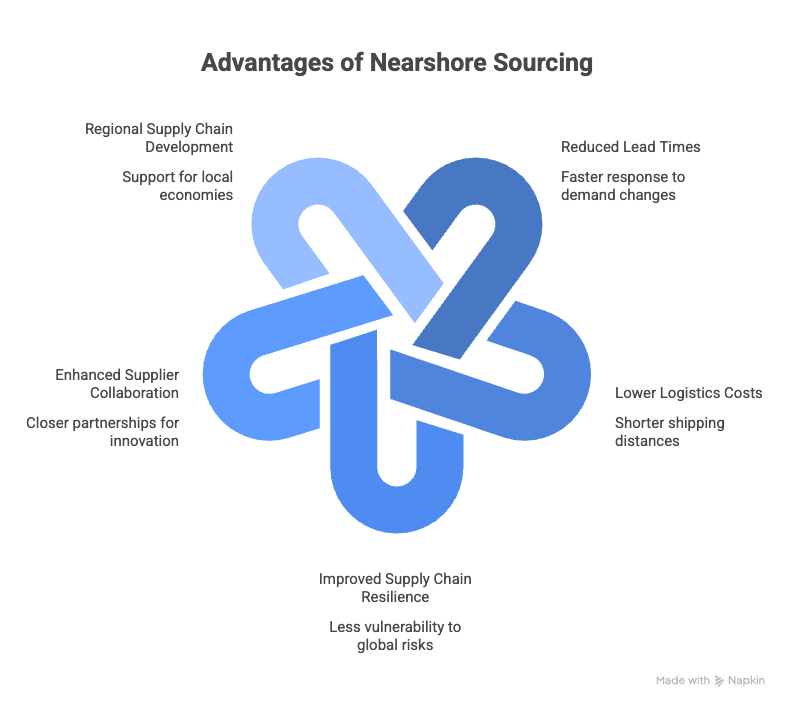
Global supply chain disruptions have exposed the risks of extended, distant supply chains. Nearshore sourcing reduces these risks without fully absorbing the cost of domestic production. For categories where lead time, quality oversight, and continuity matter as much as unit price, nearshoring provides a more resilient model — increasingly relevant as organizations reassess their geographic supply base in response to risk events and policy pressures favoring regional supply.
The Core Process of Nearshore Sourcing
- Category Assessment: Procurement identifies which categories are candidates for nearshoring by evaluating their current geographic sourcing profile, lead times, logistics costs, quality performance, and supply continuity record. Categories with long offshore lead times, quality issues, or significant transport cost components are typically prioritized for assessment.
- Nearshore Market Analysis: Procurement maps the supplier landscape in target nearshore geographies, assessing capability, capacity, cost competitiveness, and regulatory environment. The analysis establishes whether nearshore suppliers can meet quality and volume requirements at a commercially viable landed cost.
- Total Cost Comparison: The landed cost of nearshore sourcing — unit price plus freight, duties, insurance, inventory holding, and risk cost — is compared against the current offshore model. The comparison must account for the reduction in safety stock and emergency sourcing costs that nearshoring typically enables.
- Supplier Qualification and Transition: Selected nearshore suppliers are qualified through the standard procurement process — capability assessment, quality audit, financial due diligence — before a transition plan is executed. Transition management ensures supply continuity during the shift between sourcing models.
Core Components of Nearshore Sourcing
- Geographic proximity definition establishes what nearshore means organizationally — for a US buyer, Latin America or Canada; for a European buyer, Eastern Europe or North Africa. The definition drives which supplier markets are included in the analysis.
- Total landed cost analysis is the commercial foundation for nearshore decisions. Unit price alone rarely captures the full picture. Freight reduction, inventory savings, lower safety stock requirements, and reduced emergency sourcing costs must be included to assess whether nearshoring is financially justified.
- Risk profile comparison evaluates how the nearshore model compares to the current model on supply continuity, geopolitical exposure, logistics reliability, and quality consistency. Nearshoring typically improves the risk profile even when it does not achieve the lowest unit price.
- Supplier development capability assesses whether identified nearshore suppliers require development investment and whether the organization has the resources and timeline to support that development before transition.
Common Pitfalls of Nearshore Sourcing
- Comparing unit price only rather than total landed cost: Nearshore unit prices are often higher than offshore. The financial case rests on total cost, including logistics, inventory, and risk reduction. Unit-price-only comparisons consistently understate nearshore value.
- Underestimating supplier capability gaps in nearshore markets: Not all nearshore geographies have equivalent supplier capability for every category. Capability gaps require development investment that must be factored into the transition timeline and cost.
- Treating nearshoring as an all-or-nothing decision: Many organizations achieve the best outcome through a hybrid model — nearshoring critical or time-sensitive categories while maintaining offshore sourcing for stable, cost-sensitive items.
- Ignoring currency and regulatory risk in nearshore markets: Proximity reduces logistics and lead time risk but does not eliminate financial or regulatory exposure. Nearshore geographies carry their own currency, labor regulation, and political risk profiles that procurement must assess.
When Nearshore Sourcing Delivers the Most Value
- Short product lifecycles or high demand volatility. Where speed to market or demand response is critical, shorter nearshore lead times directly protect revenue and reduce inventory obsolescence risk.
- Categories with high logistics cost as a proportion of total cost. When freight represents a significant share of landed cost, the nearshore unit price premium is often more than offset by logistics savings.
- Post-disruption supply chain restructuring. Following a disruption that exposed the vulnerability of a distant sourcing model, nearshoring provides structural risk reduction that complements the immediate tactical response.
KPIs of Nearshore Sourcing
| Dimension | Sample KPIs |
| Cost Performance | Landed cost variance vs. offshore baseline, logistics cost as % of category spend |
| Lead Time | Average supplier lead time by category, lead time reduction vs. prior model |
| Supply Resilience | Stockout incidents, supply disruption frequency vs. offshore baseline |
| Quality | Defect rate, return rate, first-pass quality acceptance by nearshore supplier |
Key Terms in Nearshore Sourcing
- Offshoring: Sourcing goods or services from distant countries, typically in Asia or other lower-cost regions, primarily to reduce unit cost.
- Onshoring: Sourcing goods or services domestically, prioritizing proximity and control over cost reduction.
- Landed Cost: The total cost of a purchased good or service at the point of delivery, including unit price, freight, duties, insurance, and handling.
- Safety Stock: Inventory held above expected demand to buffer against lead time variability — typically reduced when nearshoring shortens and stabilizes lead times.
- Supply Chain Resilience: The ability of a supply chain to withstand and recover from disruptions, improved through nearshoring by reducing geographic and logistical concentration risk.
Technology Enablement
Spend analytics platforms support nearshore sourcing decisions by modeling total landed cost scenarios, comparing supplier performance across geographies, and tracking the risk and cost outcomes of sourcing model changes over time. Supplier management platforms support nearshore supplier qualification and ongoing performance monitoring once the transition is complete.
FAQs
Q1. What is nearshore sourcing?
A strategy that sources goods or services from geographically proximate countries to reduce lead times, logistics cost, and supply chain risk compared to distant offshore sourcing.
Q2. How is nearshore sourcing different from offshoring and onshoring?
Onshoring is domestic; offshoring is distant; nearshoring is the middle ground — proximate but not domestic, balancing cost with resilience and responsiveness.
Q3. Is nearshoring always more expensive than offshoring?
Unit prices are typically higher nearshore, but total landed cost — including logistics, inventory, and risk — is often comparable or lower once all factors are included.
Q4. Which categories are most suitable for nearshoring?
Categories with high logistics costs, short product lifecycles, demanding quality requirements, or significant supply continuity risk are the strongest candidates.
Q5. How long does a nearshore transition typically take?
Six to eighteen months, depending on supplier qualification complexity, volume, and supply continuity risk during transition.
References
For further insights into these processes, explore Zycus’ dedicated resources related to Nearshore Sourcing:
- The Rise of Postmodern ERP and its Impact on Procurement!
- The eSourcing User Experience: Why User-Friendly eSourcing Solutions Matter for Adoption
- Building Success Through a Solid Supplier Management Framework
- Heading: 2023 Purchase-to-Pay Agenda and Key Issues Study Results
- Be Prepared with SOX Compliance: Your Ultimate Guide by Zycus










