


OEM procurement refers to the sourcing and purchasing of components, materials, or finished goods that will be incorporated into a company’s own products and sold under its brand. OEM stands for Original Equipment Manufacturer — the company that designs and markets the final product. OEM sourcing focuses on securing the parts, sub-assemblies, and raw materials needed for production, where quality, specifications, and supply continuity directly impact the end product delivered to customers.
Why OEM Procurement Matters in Procurement
OEM procurement sits at the heart of manufacturing and product-based businesses. The components sourced become part of what the company sells, meaning supplier quality, cost, and reliability directly affect product margins, brand reputation, and customer satisfaction. Unlike indirect spend, OEM sourcing decisions are tightly linked to engineering specifications, production schedules, and product lifecycle management. For procurement teams in manufacturing environments, OEM sourcing is where strategic supplier relationships and total cost management have the most visible business impact.
The Core Process of OEM Procurement
The process begins with demand identification. Engineering and product development define the components needed, including specifications, quality standards, and volume forecasts. Procurement translates these requirements into sourcing strategies for each commodity or part family.
Supplier identification and qualification follow. Potential suppliers are evaluated against technical capabilities, quality certifications, capacity, financial stability, and geographic fit. For critical components, on-site audits and sample testing are common before approval.
Sourcing execution involves RFQs, negotiations, and contract development. OEM contracts often include detailed specifications, quality requirements, pricing mechanisms tied to volume or indices, and terms covering tooling, intellectual property, and change management.
Ongoing supplier management ensures performance meets expectations. Procurement monitors delivery, quality, and responsiveness while coordinating with production planning to align supply with manufacturing schedules. Engineering changes and product updates require close collaboration between procurement, suppliers, and internal stakeholders.
Core Components of OEM Procurement
- Specification Management: Clear documentation of technical requirements, tolerances, and quality standards that suppliers must meet for each component.
- Supplier Qualification: Rigorous assessment of supplier capabilities, certifications, and capacity before they are approved to supply production materials.
- Commodity Strategy: Long-term sourcing plans for each component category, addressing supplier mix, risk mitigation, cost reduction, and technology roadmaps.
- Tooling and Capital Equipment: Management of supplier-held tooling, molds, and fixtures required to produce components, including ownership, maintenance, and amortization.
- Quality Assurance: Incoming inspection, supplier quality metrics, corrective action processes, and certification requirements to ensure components meet specifications.
- Supply Planning Integration: Coordination between procurement, production planning, and suppliers to align material availability with manufacturing schedules.
Key Benefits of OEM Procurement
- Secures reliable supply of components critical to production and product quality.
- Reduces total cost through strategic negotiations, volume leverage, and should-cost analysis.
- Mitigates supply risk through qualification, dual-sourcing, and supplier monitoring.
- Supports product innovation by engaging suppliers with relevant technical capabilities.
- Improves time-to-market by aligning supplier capacity with product launch schedules.
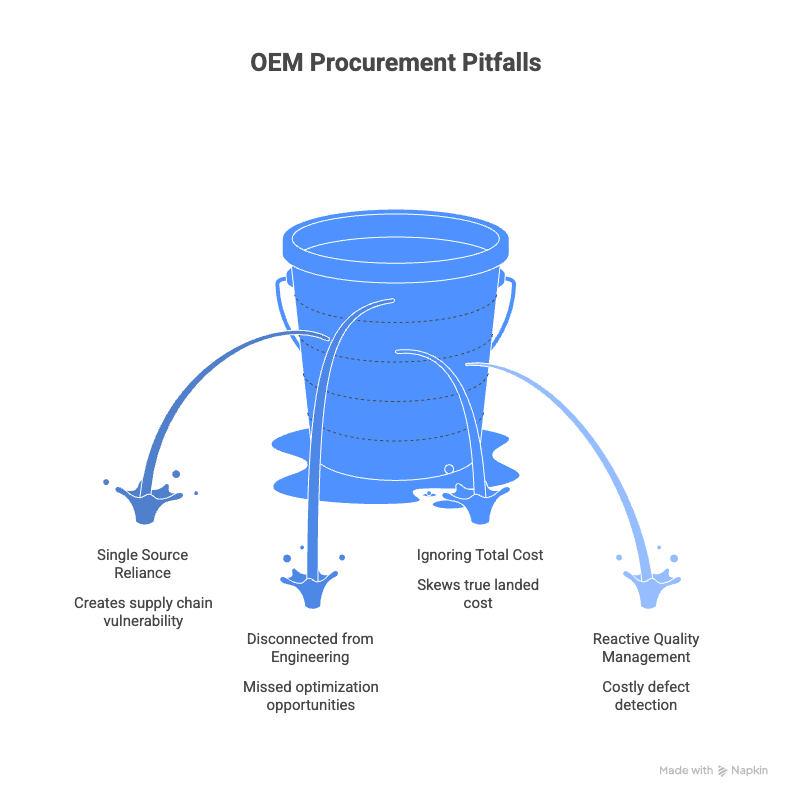
Key Considerations When Sourcing OEM Components
Specification clarity: Ambiguous specs lead to quality disputes. Ensure drawings, tolerances, and test criteria are unambiguous.
Supplier technical capability: Can the supplier meet your specifications consistently at the required volumes and quality levels?
Tooling ownership: Who owns the molds, dies, and fixtures? What happens if the relationship ends?
Change management: How will engineering changes be communicated, priced, and implemented without disrupting supply?
Capacity commitment. Does the supplier have dedicated capacity, or are you competing with other customers during demand spikes?
KPIs of OEM Procurement
| Dimension | Sample KPIs |
| Quality | Parts per million defects, supplier quality rating, first-pass yield |
| Delivery | On-time delivery rate, lead time adherence, and schedule changes |
| Cost | Year-over-year cost reduction, cost vs. should-cost target, total landed cost |
| Risk | Single-source exposure, supplier financial health, geographic concentration |
Key Terms in OEM Procurement
- OEM (Original Equipment Manufacturer): A company that designs, manufactures, and markets products under its own brand, often incorporating components from suppliers.
- Bill of Materials (BOM): A structured list of all components, sub-assemblies, and raw materials required to manufacture a product.
- Supplier Qualification: The process of assessing and approving a supplier’s capability to meet technical, quality, and delivery requirements.
- Commodity Management: Strategic oversight of a category of purchased materials, including sourcing strategy, supplier management, and cost optimization.
- First Article Inspection: Verification that the first production samples from a supplier meet all specifications before full production begins.
- PPAP (Production Part Approval Process): A standardized process for approving new or changed components, common in automotive and manufacturing industries.
Technology Enablement
Modern Source-to-Pay platforms support OEM sourcing through supplier qualification workflows, specification management, RFQ automation, and integration with PLM and ERP systems. This connects procurement decisions to engineering requirements and production planning for end-to-end visibility.
FAQs
Q1. What is OEM procurement?
The sourcing of components, materials, and sub-assemblies that are incorporated into a company’s own products sold under its brand.
Q2. How is OEM procurement different from indirect procurement?
OEM procurement focuses on materials that become part of the finished product. Indirect procurement covers goods and services that support operations but are not embedded in products sold.
Q3. Why is supplier qualification important in OEM sourcing?
Because component quality directly affects product quality, brand reputation, and customer satisfaction. Unqualified suppliers create production and market risk.
Q4. What role does engineering play in OEM procurement?
Engineering defines specifications and requirements. Close collaboration ensures procurement sources components that meet technical needs while optimizing cost and supply.
Q5. How do you manage cost in OEM procurement?
Through should-cost analysis, volume leverage, multi-year agreements, design collaboration, and total cost of ownership approaches.
Q6. What is dual-sourcing?
Qualifying and using two or more suppliers for the same component to reduce supply risk and maintain competitive pressure.
References
For further insights into these processes, explore Zycus’ dedicated resources related to OEM Procurement:
- Making Procurement Performance Count – Part 2: Resolving Procurement Woes
- How can Marketing and Procurement work better together?
- Zycus at SIG Global Executive Summit Spring 2025: Agentic AI, Intake Simplicity, and the Future of Procurement
- 4 Pillars to Accounts Payable Automation
- Zycus Horizon for Government: Keynote by Steven Harris