Purchase Order (PO) Management is the digital system that automates, controls, and tracks the entire lifecycle of purchase orders — from creation to approval to delivery confirmation and invoice matching.
It ensures that every purchase request follows organizational policies, budget limits, supplier contracts, and audit requirements, creating a transparent and fully governed buying process.
In modern procurement, PO Management Software acts as the backbone of the Procure-to-Pay (P2P) process, linking requisitions, catalogs, supplier data, budgets, contracts, and receipts into a unified, traceable workflow.
Why PO Management Matters
A purchase order is more than an instruction to buy — it is a binding commercial commitment. Poor PO control results in maverick spend, forecast inaccuracies, supplier disputes, and compliance risk.
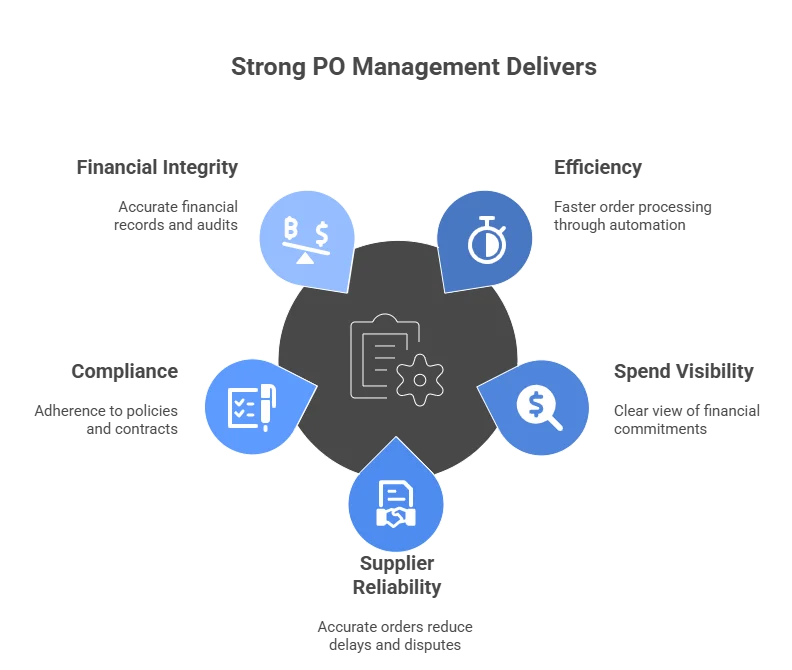
When digitized, PO management becomes a source of cost savings, reduced risk, and procurement predictability.
Read more: Purchasing Request vs Purchase Order: Demystifying the Procurement Process
The Complete PO Management Lifecycle
1. Requisition Creation & Validation
PO management begins when a user raises a purchase requisition. The system validates budget availability, checks preferred suppliers, links items to catalogs or contracts, and ensures the request follows policy.
Modern platforms, including those aligned with Zycus-style guided buying and Merlin Intake principles, streamline this step by automatically mapping user intent to the right category, supplier, or buying path.
2. Approval Routing & Governance Enforcement
Once validated, the requisition moves through multi-level approval flows based on spend limits, business units, risk category, or project code. Approvers receive contextual data: pricing, supplier status, performance history, compliance alerts, and budget impact.
Advanced systems similar to Zycus workflow automation ensure approvals move quickly while enforcing policy, role-based controls, and audit requirements.
3. PO Creation & Supplier Dispatch
After approval, the system auto-generates the PO with correct item details, pricing, delivery schedules, tax codes, and contract terms. POs are dispatched to suppliers via portal, email, or EDI.
Solutions aligned with Zycus P2P capabilities send instant PO notifications and track supplier acknowledgments to avoid miscommunication or delays.
4. PO Tracking, Changes & Control
As fulfillment begins, procurement teams track PO status, shipment progress, expected delivery dates, and supplier updates. Any change to quantity, pricing, or schedule goes through structured change-order workflows.
Platforms with Zycus-style governance preserve a complete audit trail and prevent unauthorized modifications—reducing leakage and ensuring compliance with sourcing intent.
5. Goods Receipt & GRN Linkage
When goods or services arrive, receiving teams inspect quality and quantity, then create a Goods Receipt Note (GRN) that confirms actual delivery. This updates inventory and becomes the foundation for invoice matching.
Systems aligned with Zycus receiving flows sync GRNs automatically with POs, enabling real-time stock updates and reducing mismatches in AP.
6. Invoice Matching & AP Integration
Invoices are validated through 2-way (Invoice ↔ PO) or 3-way (Invoice ↔ PO ↔ GRN) matching. Any variance triggers an exception workflow, while compliant invoices flow straight to payment.
Capabilities modeled after Zycus AP Automation apply adaptive tolerances, contract-aware validation, and smart exception routing to increase first-pass match rates.
7. Supplier Collaboration & Exception Resolution
If issues arise—partial shipments, incorrect pricing, or damaged goods—the PO becomes the anchor for resolution. Supplier portals enable clarifications, confirmations, or updates.
Zycus-style collaboration hubs simplify communication, accelerate issue closure, and give both parties transparent visibility into PO status.
8. PO Closure, Accruals & Audit Trail
A PO is closed once the invoice is paid and all related activities (receipts, exceptions, change requests) are completed. The system logs every action, maintaining full auditability for compliance and financial governance.
Platforms similar to Zycus P2P automatically generate committed-spend reports, accrual snapshots, and audit records—supporting finance reconciliation and procurement oversight.
9. Performance Feedback Loop
PO data feeds into supplier performance metrics: on-time delivery, fill rate, accuracy, and responsiveness. Category teams use these insights for future sourcing, QBRs, and negotiation strategy.
Procurement suites aligned with Zycus integrate these signals into Supplier Management and Analytics modules, producing a complete 360° view of supplier reliability.
Core Components of PO Management
Each component works together to deliver a controlled and automated buying experience.
1. Intelligent Requisitioning
User-friendly forms, guided buying paths, catalog links, and pre-populated fields streamline the request process.
Systems aligned with Zycus-style AI can recommend suppliers, items, or contracts based on context.
2. Multi-Level Approval Workflows
Dynamic workflows route requisitions based on spend, category, risk, or department.
Approvers see budget impact, supplier status, contract terms, and order justification.
3. Automated PO Generation
Validated requisitions convert into POs automatically.
Line-item details, pricing, delivery locations, tax codes, and terms populate according to contract or catalog data.
4. Supplier Communication & Acknowledgments
POs are delivered through supplier portals or EDI integrations.
Suppliers can acknowledge, accept, or request modifications, improving clarity and reducing delays.
5. Change Order Management
Controlled workflows govern modifications to quantity, pricing, or delivery dates.
Every change is logged to maintain contractual and financial compliance.
6. Delivery Tracking and GRN Integration
Real-time updates show shipment status and delivery confirmations.
Tight integration with GRN workflows ensures receipt information syncs back to POs.
7. Invoice Matching and Payment Integration
2-way or 3-way matching ensures invoices align with POs and receipts.
This reduces AP exceptions and improves payment accuracy.
8. Analytics, Visibility, and Reporting
Dashboards track:
- PO cycle time
- Committed vs actual spend
- Supplier lead times
- PO exceptions
- Budget consumption patterns
These insights inform sourcing decisions, category strategies, and spend forecasting.
Key Benefits of PO Management
- Streamlined Procurement: Reduces manual work and accelerates approvals.
- Better Spend Control: Enforces budgets, preferred suppliers, and contract pricing.
- Audit-Ready Governance: Tracks every approval, change, and communication.
- Accurate Financials: Ensures clean accruals and fewer invoice disputes.
- Supplier Confidence: Clear POs improve supplier performance and reduce cycle time.
- Reduced Maverick Spend: Users buy what they should, from who they should, at the right price.
KPIs for PO Management
| KPI | Meaning |
| PO Cycle Time | Time from requisition to PO approval |
| PO Accuracy | Percentage of POs generated without correction |
| On-Time PO Approval Rate | Approvals completed within policy-defined SLAs |
| PO Compliance Rate | % of spend backed by approved POs |
| Supplier Acknowledgment Time | Time taken to confirm POs |
| PO Change Rate | Percentage of POs requiring modification |
Key Terms in PO Management
- Purchase Order (PO): A Formal document authorizing a purchase.
- Requisition: An Internal request that initiates a PO.
- Change Order: Documented modification to an existing PO.
- 3-Way Match: Linking PO, GRN, and Invoice before payment.
- Committed Spend: Spend promised by approved POs but not yet invoiced.
FAQs
Q1. What is purchase order management?
Purchase order management is a digital system that automates the creation, approval, tracking, and closure of purchase orders, ensuring every purchase follows policy, budget limits, and supplier contract terms.
Q2. What are the benefits of PO automation?
PO automation accelerates approvals, reduces manual errors, enforces contract pricing, improves supplier communication, increases visibility into committed spend, and lowers the risk of maverick purchasing.
Q3. How does PO management improve compliance?
It enforces pre-defined rules budget checks, approval hierarchies, preferred suppliers, contract-linked pricing, and audit trails ensuring all purchases meet internal policies and external regulatory requirements.
Q4. How does PO management reduce supplier disputes?
Clear, structured POs aligned with validated data minimize misunderstandings, enabling accurate delivery, fewer change orders, and faster issue resolution through real-time supplier acknowledgment.
Q5. Why is PO visibility important for finance and procurement?
It enables accurate forecasting, tighter cash-flow planning, real-time spend tracking, and cleaner 3-way matching reducing invoice exceptions and improving the reliability of financial reporting.
References
For further insights into these processes, explore Zycus’ dedicated resources related to Purchase Order Management:
- Mastering Services Procurement: A Comprehensive Guide
- A leading sports car manufacturing enterprise reduces the invoice processing time to less than 5 days
- Horizon 2014: Look Who Will be Talking
- Demystifying Cognitive Procurement-Why it should matter to the CPOs
- Unlocking Quicker ROI with Successful AI Implementation Strategies