


What is a delegation of authority (doa) matrix?
A Delegation of Authority (DoA) matrix is a document that sets out who is authorized to approve which decisions, and up to what financial limit. In procurement it defines who can approve requisitions, purchase orders, contracts and payments, by value, category and type of spend.
Why it matters in procurement?
Without a clear DoA, approval depends on habit and on who happens to be available. Spend gets approved at the wrong level, urgent purchases slip through with little review, and nobody can show who had the authority to commit the company. Disputes after the fact then turn into arguments about who should have signed.
A delegation of authority (DoA) matrix also protects the business legally. A contract signed by someone without authority may be challenged, and auditors expect a documented, current matrix that approvals actually follow.
The core process / lifecycle
- Define Decision Types. List the decisions that need authority limits: requisitions, purchase orders, contract signature, invoice approval, payment release, supplier onboarding and exceptions.
- Set Thresholds. Finance and procurement set value bands for each decision, often varied by category, risk or contract type. Higher value or higher risk moves to a more senior approver.
- Assign Roles. Authority is assigned to roles, not named people, so it survives job changes. Each band lists the approver, any second approver and the evidence needed.
- Approve and Publish. Senior leadership or the board signs off the matrix. It is then published and loaded into the approval workflows of the procurement and finance systems.
- Apply and Monitor. Workflows route each transaction to the approver the matrix names. Reports show approvals outside limits, split orders and use of delegates.
- Review. The matrix is reviewed at least annually, and whenever the organization structure, thresholds or regulation change.
Read More About What is Call-off Contract
Core components
- Decision types state what is being approved.
- Value thresholds set the limit for each level.
- Approver roles name who holds the authority.
- Conditions add requirements such as dual approval or competitive quotes.
- Delegation rules cover who can act when an approver is absent, and for how long.
Key benefits
A clear delegation of authority matrix speeds approvals, because everyone knows who to ask. It matches scrutiny to risk, so routine spend moves quickly and large commitments get senior review. It supports audit and legal defensibility. It makes split orders easier to spot when thresholds are monitored. And it simplifies system configuration, since the approval workflow can mirror the table. It also gives new managers a clear view of their own limits.
Read More About Ways Spend Analytics Can Save Your Business Money
Common pitfalls
- Setting thresholds once and never revisiting them. Inflation, growth and new categories make old limits too tight or too loose.
- Assigning authority to named people. Approvals break and audit trails confuse when someone changes role or leaves.
- Ignoring split orders. Breaking one purchase into smaller ones to stay under a limit defeats the matrix.
- Leaving the matrix out of systems. A matrix that exists only as a document is not enforced, and approvals drift.
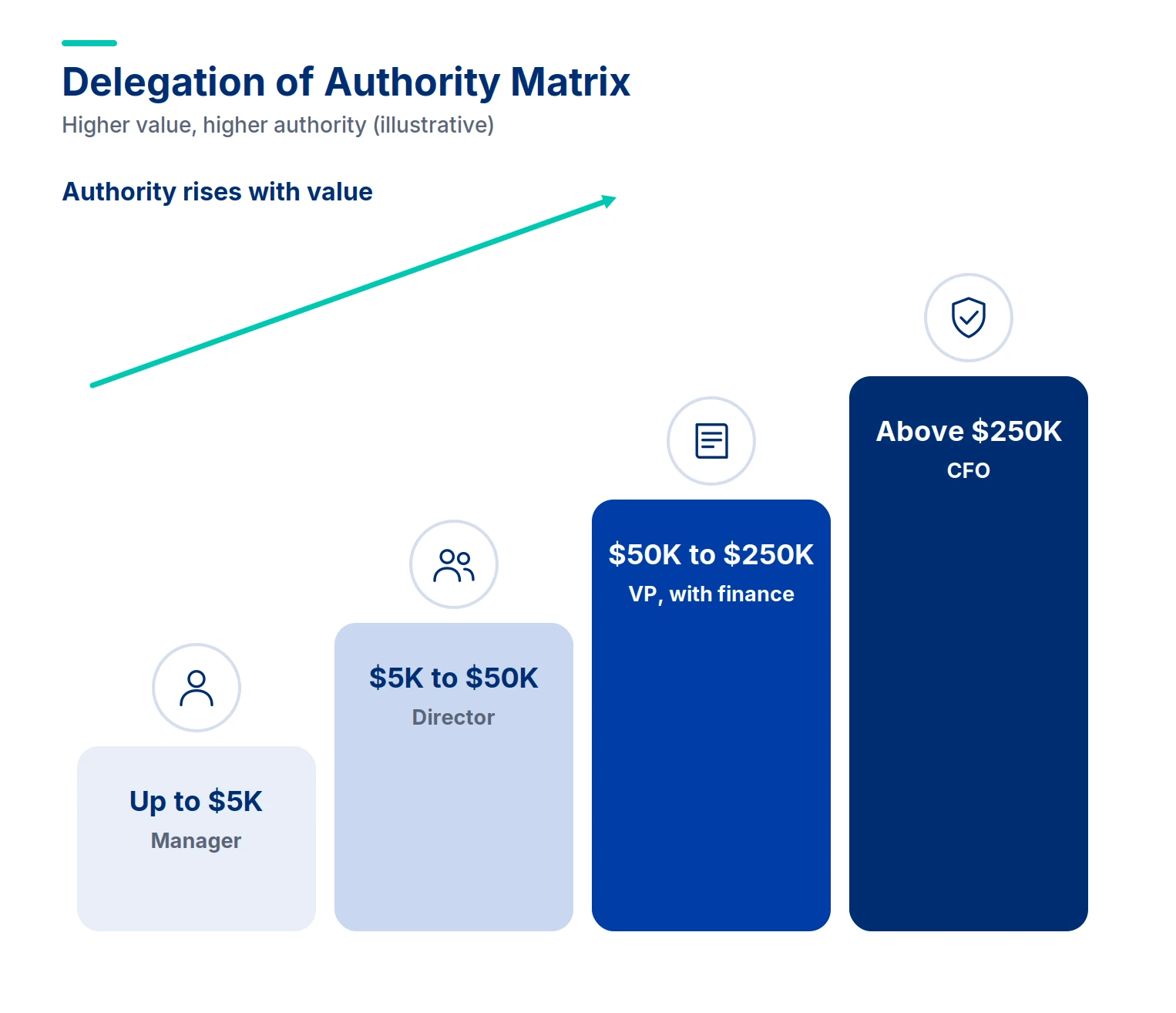
Sample DOA matrix for purchase approvals
The thresholds below are illustrative. Each organization sets its own by risk, category and size.
| Purchase value | Approver | Added requirement |
| Up to $5,000 | Department manager | None |
| $5,001 to $50,000 | Director | Budget owner confirms funds |
| $50,001 to $250,000 | Vice president, with finance review | Competitive quotes on file |
| Above $250,000 | Chief financial officer | Sourcing event and contract review |
Reading the table. Higher values and higher-risk spend move to more senior approvers and carry extra conditions. Contract signature and payment release usually have their own limits, set in separate rows.
Read More About
KPIs
| Dimension | Sample KPIs |
| Compliance | Approvals within authority; approvals outside limits |
| Speed | Approval cycle time by band; approvals escalated for absence |
| Risk | Split orders detected; delegations in use |
| Currency | Time since last matrix review; roles with no named holder |
Key terms
- Approval Limit. The maximum value a role can approve alone.
- Approval Workflow. The route a transaction follows through its approvers in a system.
- Delegate. A person authorized to approve on behalf of an absent approver for a set period.
- Split Order. Dividing one purchase into smaller ones to stay under an approval limit.
- Dual Approval. A requirement that two people approve above a set value.
- Segregation of Duties. A control that separates requesting, approving, receiving and paying.
- Contract Signatory. The person authorized to bind the company by signing a contract.
Checkout Next-Gen Contract Lifecycle Management (CLM) Software
FAQS
Q1. What is a delegation of authority (DoA) matrix?
It is a table that states who may approve which decisions, up to which limit, so that every commitment is approved at the right level.
Q2. What does a delegation of authority (DoA) matrix include?
Decision types, value thresholds, approver roles, conditions such as dual approval, and delegation rules.
Q3. How is a DoA matrix different from an approval chain?
The DoA matrix is the policy: it states who may approve what, up to which limit. The approval chain is the route a particular transaction follows to the approvers that policy names.
Q4. Who owns the DoA matrix?
Finance and procurement usually draft it, and senior leadership or the board approves it. Finance and procurement operations keep it current.
Q5. How often should it be reviewed?
At least annually, and whenever the organization, thresholds or regulation change.
Q6. How is it enforced?
By configuring approval workflows in procurement and finance systems to mirror it, then monitoring approvals outside limits.
Q7. Does a DoA matrix cover more than purchasing?
Yes. It often covers hiring, expenses, contracts and capital spend. A procurement DoA covers the buying decisions.