


What is Fourth-Party risk?
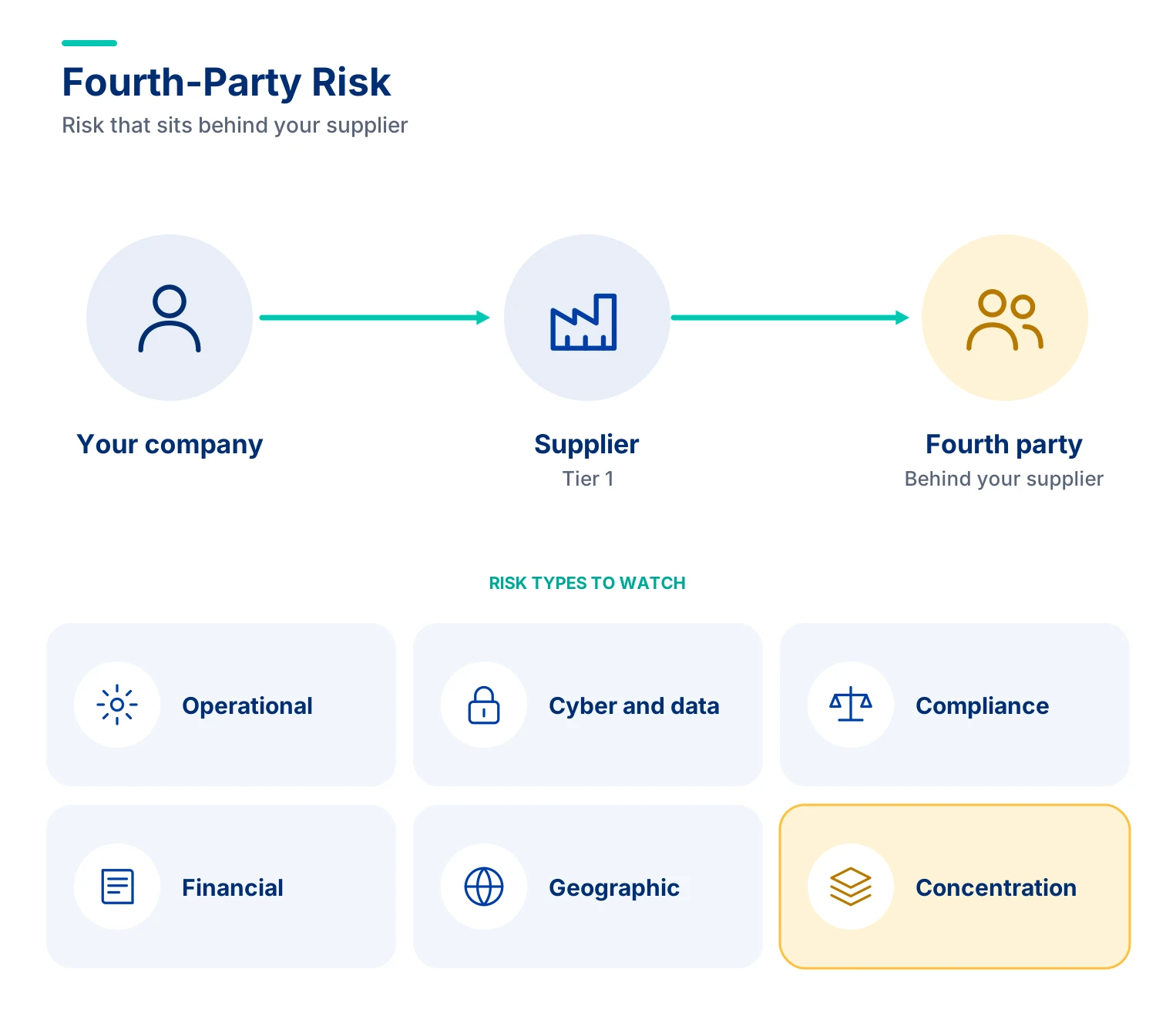
Fourth-party risk is the risk that comes from your suppliers’ own suppliers and subcontractors: the parties you do not contract with directly but still depend on. A failure, breach or compliance problem at a fourth party can disrupt your supply even when your direct supplier looks healthy.
Why it matters in procurement?
Many disruptions do not start with the supplier you can see. A fire at a component maker, a breach at a shared software provider or a labor violation deep in the chain reaches you through a supplier you trust. Without visibility, you find out when your own deliveries stop.
Regulators and customers increasingly expect companies to look beyond direct suppliers. Supply chain due diligence laws push buyers to understand risks deeper in the chain, though how far they must look varies by law. Rules such as the EU’s DORA address subcontracting by technology providers to financial firms directly.
The core process / lifecycle
- Map the Chain. Ask critical suppliers to disclose key subcontractors, sources and locations, and record them in the supplier management system.
- Identify Critical Dependencies. Highlight fourth parties that sit behind several suppliers, or that would stop supply if they failed, such as a shared hosting provider or a single-source component maker.
- Assess Exposure. Rate each dependency for financial, operational, cyber, geographic and compliance risk, using supplier answers, public data and risk intelligence.
- Set Contract Requirements. Contracts require suppliers to disclose subcontractors, pass on standards, report incidents and allow audits where justified.
- Monitor. Risk tools and supplier updates track events, ratings and news that affect fourth parties, and shared dependencies are watched across the portfolio.
- Respond and Review. When an event hits, procurement uses the mapped dependencies to assess impact quickly, activate alternates and update the map afterward.
Read More About What is Supply Risk Management and how do Supply Chain Risk Management Softwares work?
Core components
- Supply chain mapping shows who sits behind each supplier.
- Disclosure clauses oblige suppliers to share their subcontractors.
- Concentration analysis finds fourth parties that several suppliers share.
- Risk monitoring tracks events and ratings.
- Contingency plans set out what happens if a critical fourth party fails.
Key benefits
Looking past direct suppliers gives earlier warning of disruption, since problems are visible before they reach your orders. It exposes concentration risk, where several suppliers depend on the same source. It supports compliance with due diligence rules. It improves supplier conversations, because risks are named and shared. It also helps in negotiation, because requirements to disclose key subcontractors and to notify changes can be written into contracts where the risk is highest. And it speeds response, because the dependencies are already mapped.
Common pitfalls
- Trying to map everything. Full visibility into every sub-supplier is rarely achievable, so focus on critical suppliers and critical dependencies.
- Relying on questionnaires alone. Self-reported answers go stale and miss what suppliers do not know, so combine them with external data.
- Treating tier-one assurance as enough. A strong direct supplier can still depend on a weak subcontractor.
- Ignoring concentration. Several healthy suppliers that share one fourth party are one failure away from a shared outage.
Fourth-party risk types procurement should watch
- Operational. A subcontractor fails or loses capacity, and your supplier cannot deliver.
- Cyber and data. A breach at a shared software or hosting provider exposes several suppliers at once.
- Compliance and ethics. Labor, environmental or sanctions problems arise deep in the chain.
- Financial. A fourth party becomes insolvent and stops supplying your supplier.
- Geographic. Key sources sit in one region exposed to disaster, unrest or trade restrictions.
- Concentration. Many suppliers rely on the same fourth party, so one event hits them all.
KPIs
| Dimension | Sample KPIs |
| Visibility | Critical suppliers with mapped subcontractors; fourth parties identified |
| Concentration | Fourth parties shared by three or more suppliers; single-source dependencies |
| Contracts | Contracts with disclosure clauses; incident notices received |
| Response | Time to assess impact of an event; plans tested |
Key Terms
- Third Party. A supplier or partner a company contracts with directly.
- Fourth Party. A supplier or subcontractor of a third party, with no direct contract with the buyer.
- Nth Party. A general term for any party further along the chain than a fourth party.
- Concentration Risk. The risk created when many suppliers depend on the same source.
- Flow-Down Clause. A contract term that requires a supplier to pass requirements on to its own suppliers.
- Tier-One Supplier. A direct supplier to the buyer.
- Supply Chain Mapping. Documenting the suppliers, subcontractors and locations behind a product or service.
Related Reads
- Elevate Your Supplier Due Diligence: A Strategic Guide for Procurement Leaders
- Creating an Effective Supplier Risk Management Template
- What is Supply Chain Risk Matrix
- What is Supply Chain Inventory Visibility
FAQs
1. What is fourth-party risk in supply chain management?
Fourth-party risk refers to potential disruptions, security threats, or compliance issues originating from a company’s suppliers’ suppliers or subcontractors. Unlike direct suppliers, fourth parties have no contractual relationship with the buying organization but can still affect its operations. For example, a cybersecurity breach at a cloud provider used by multiple suppliers could disrupt business continuity. Managing fourth-party risk helps procurement teams identify hidden supply chain dependencies, strengthen operational resilience, and reduce exposure to unexpected disruptions.
2. What is the difference between third-party risk and fourth-party risk?
Third-party risk originates from vendors or suppliers that a company directly contracts with, while fourth-party risk comes from those vendors’ own suppliers and subcontractors. For example, a software vendor providing services to a company is a third party, whereas the cloud infrastructure provider supporting that vendor is a fourth party. Third-party risk management focuses on direct supplier relationships, while fourth-party risk management extends visibility into indirect dependencies that can affect security, compliance, and business continuity.
3. What are the most common types of fourth-party risks?
The most common fourth-party risks include operational disruptions, cybersecurity breaches, financial instability, regulatory non-compliance, geographic exposure, and supplier concentration risk. Operational risks arise when subcontractors fail to deliver critical services or materials. Cybersecurity risks emerge when shared technology providers experience security incidents. Financial risks involve subcontractor insolvency, while concentration risk occurs when multiple suppliers depend on the same fourth party. Identifying these risks helps procurement teams prioritize assessments and develop effective supply chain contingency plans.
4. How can companies identify and assess fourth-party risks?
Companies can identify fourth-party risks by mapping critical supply chain dependencies and requesting subcontractor information from direct suppliers. Procurement teams should assess fourth parties based on financial stability, cybersecurity exposure, operational importance, geographic risks, and regulatory compliance. Supplier questionnaires, contractual disclosures, external risk intelligence, and continuous monitoring can improve visibility. Organizations should prioritize fourth parties supporting critical operations or shared across multiple suppliers, as these dependencies may create significant business continuity risks.
5. Do organizations need to monitor every fourth-party supplier?
No, organizations generally do not need to monitor every fourth-party supplier. A risk-based approach focuses on subcontractors supporting critical business operations, handling sensitive information, or creating significant supply chain dependencies. Companies should prioritize fourth parties shared by multiple suppliers, single-source providers, and those operating in high-risk regions. Regular supplier disclosures, risk assessments, and external monitoring help identify emerging threats. The level of monitoring should reflect business criticality and applicable regulatory obligations.
6. How can procurement teams reduce fourth-party and supplier concentration risks?
Procurement teams can reduce fourth-party risks by improving supply chain visibility, establishing subcontractor disclosure requirements, and monitoring critical dependencies. Supplier contracts should include incident notification obligations, appropriate audit rights, and clauses requiring relevant standards to be passed to subcontractors. To address concentration risk, organizations should identify shared fourth parties and evaluate alternative sourcing arrangements. Maintaining contingency plans, testing response procedures, and regularly updating supplier dependency maps can reduce the impact of disruptions.
7. How does fourth-party risk management support regulatory compliance and supply chain due diligence?
Fourth-party risk management supports regulatory compliance by helping organizations identify operational, cybersecurity, human rights, and environmental risks beyond direct suppliers. Regulations such as the EU’s Digital Operational Resilience Act (DORA) address ICT subcontracting risks in financial services, while the Corporate Sustainability Due Diligence Directive (CSDDD) establishes risk-based obligations covering relevant business partners within the chain of activities. Procurement teams can support applicable requirements through supplier assessments, contractual safeguards, incident monitoring, documented due diligence, and corrective action tracking.