



A cost breakdown structure is a hierarchical decomposition of the total cost of a product or service into its individual components. It separates the price into elements such as raw materials, labor, overhead, tooling, logistics, and profit margin. In procurement, a cost breakdown structure enables buyers to understand how a supplier arrives at their quoted price, identify negotiation levers, and make informed decisions based on the procurement cost breakdown rather than accepting a single line-item quote.
Read more: Cost Avoidance vs. Cost Savings: What’s the Major Difference?
Why Cost Breakdown Structure (CBS) Matters in Procurement
Suppliers quote prices, but procurement needs to understand costs. Without a procurement cost breakdown, buyers negotiate in the dark — unable to distinguish between fair margins and inflated components. A cost breakdown structure shifts the conversation from haggling over price to discussing value drivers. It exposes which cost elements are fixed versus variable, where efficiencies might exist, and whether the supplier’s pricing reflects market realities. For strategic sourcing, this transparency is essential to achieving sustainable cost reductions and building fact-based supplier relationships.
The Core Process of Cost Breakdown Structure (CBS)
The process begins with requesting cost transparency from suppliers. During RFQ or negotiation, procurement asks suppliers to provide a detailed breakdown of their quoted price, specifying the categories and level of detail required.
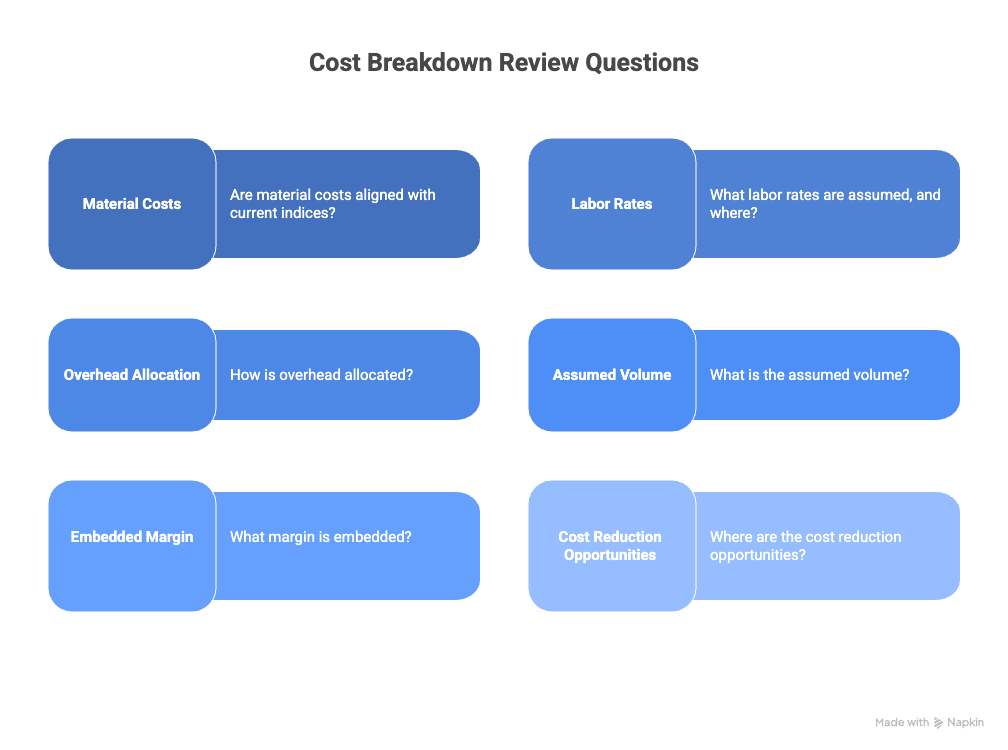
Once received, procurement analyzes the breakdown. Each cost element is reviewed for reasonableness — material costs are benchmarked against commodity indices, labor rates are compared to regional norms, and margins are assessed against industry standards.
Discrepancies or areas of concern become negotiation focal points. If material costs appear inflated, procurement may challenge the supplier with market data. If overhead allocations seem excessive, the discussion shifts to operational efficiency. The goal is to reach a price that reflects true, justifiable costs plus a fair margin.
Over time, procurement builds a library of cost models for key categories. These should-cost models serve as benchmarks for evaluating future quotes and tracking cost trends across the supply base.
Core Components of Cost Breakdown Structure (CBS)
Material Costs: The cost of raw materials, components, and sub-assemblies that go into the finished product. Often the largest single element in manufactured goods.
Labor Costs: Direct labor for production, assembly, or service delivery — typically calculated as hours multiplied by labor rates.
Overhead and Indirect Costs: Facility costs, equipment depreciation, utilities, and administrative expenses allocated across production volume.
Tooling and Setup: One-time or amortized costs for specialized tooling, molds, or setup required to produce the product.
Logistics and Freight: Transportation, packaging, and handling costs to deliver the product from supplier to buyer.
Profit Margin: The supplier’s markup above total costs, reflecting their expected return on the business.
Key Benefits of Cost Breakdown Structure (CBS)
- Enables fact-based negotiation by identifying specific cost elements to challenge or optimize.
- Reveals hidden costs and excessive margins that would otherwise be buried in a single quoted price.
- Supports should-cost modeling and benchmarking across suppliers and over time.
- Improves collaboration with suppliers by shifting discussions from price pressure to value engineering.
- Strengthens procurement credibility by demonstrating analytical rigor and market knowledge.
Common Pitfalls of Cost Breakdown Structure (CBS)
Accepting incomplete or vague breakdowns: A breakdown that lumps costs into broad categories provides little negotiation value. Push for granularity.
Lacking benchmarks to validate supplier data: Without commodity indices, labor rate data, or should-cost models, procurement cannot assess whether supplier figures are reasonable.
Focusing only on materials: Labor, overhead, and logistics often offer more negotiation leverage than raw material costs, which may be market-driven.
Using cost breakdowns punitively: If suppliers feel cost transparency will only be used to squeeze margins, they will resist sharing. Position it as a tool for mutual improvement.
KPIs of Cost Breakdown Structure (CBS)
| Dimension | Sample KPIs |
| Transparency | Percentage of spend with cost breakdown visibility, supplier response rate to cost breakdown requests |
| Negotiation | Savings achieved through cost breakdown analysis, cost elements challenged per negotiation |
| Benchmarking | Variance of supplier costs vs. should-cost models, cost trend tracking over time |
| Coverage | Number of categories with established should-cost models |
Key Terms in Cost Breakdown Structure (CBS)
- Should-Cost Model: An internally developed estimate of what a product or service should cost, based on material, labor, overhead, and margin assumptions.
- Total Cost of Ownership (TCO): The full cost of acquiring and using a product, including purchase price, logistics, maintenance, and disposal.
- Value Engineering: A collaborative process with suppliers to reduce costs by redesigning products or processes without sacrificing quality or function.
- Open-Book Pricing: A transparency model where suppliers share full cost details with buyers, often in exchange for long-term commitments.
- Bill of Materials (BOM): A detailed list of raw materials, components, and assemblies required to manufacture a product.
- Commodity Index: A published benchmark tracking price movements for raw materials such as steel, copper, or plastics.
FAQs
Q1. What is a cost breakdown structure?
A hierarchical decomposition of a quoted price into its component costs — materials, labor, overhead, logistics, and margin — enabling detailed procurement analysis.
Q2. Why do suppliers resist providing cost breakdowns?
Suppliers fear that transparency will be used solely to pressure margins. Building trust and positioning cost analysis as a partnership tool can increase willingness to share.
Q3. What is the difference between cost breakdown and should-cost?
A cost breakdown is provided by the supplier. A should-cost model is developed by procurement as an independent estimate to benchmark and validate supplier figures.
Q4. When should procurement request a cost breakdown?
For strategic categories, high-value purchases, or situations where pricing seems misaligned with market conditions.
Q5. How detailed should a cost breakdown be?
Detailed enough to identify negotiation levers. At minimum: materials, labor, overhead, tooling, logistics, and margin. More granularity is better for complex products.
Q6. Can cost breakdowns be used for services?
Yes. Service cost breakdowns typically include labor rates, hours by role, travel, technology, overhead, and margin.
References
For further insights into these processes, explore Zycus’ dedicated resources related to Cost Breakdown Structure (CBS):
- Can a Contract Management Software Drown your Business?
- (Chapter 7) Adventures of Ivan the CPO: 10 Technology Tools Every Procurement Team Needs In 2018
- Performance management in procurement – Truth or fallacy
- Supplier Management Automation
- Empowering Women in Procurement Leadership: Shaping the Future










