



Negotiation BATNA stands for Best Alternative to a Negotiated Agreement. It represents the most favorable course of action a party can take if negotiations fail and no agreement is reached. In procurement, your BATNA might be an alternative supplier, making the item in-house, or delaying the purchase entirely. Understanding your BATNA — and estimating the other party’s — is fundamental to negotiation strategy because it defines the point at which walking away becomes preferable to accepting a deal.
Read more: Mastering Negotiation in the Age of GenAI: A Playbook for Sourcing Success
Why Negotiation BATNA Matters in Procurement
Negotiation power comes from alternatives. A procurement professional with multiple qualified suppliers has leverage; one with a single source does not. Knowing your BATNA prevents accepting unfavorable deals out of desperation and provides confidence to push for better terms. Equally important is understanding the supplier’s BATNA — if they have many potential customers, they can walk away easily; if you represent significant business, they need the deal. BATNA analysis transforms negotiation from intuition to strategy.
The Core Process of Negotiation BATNA
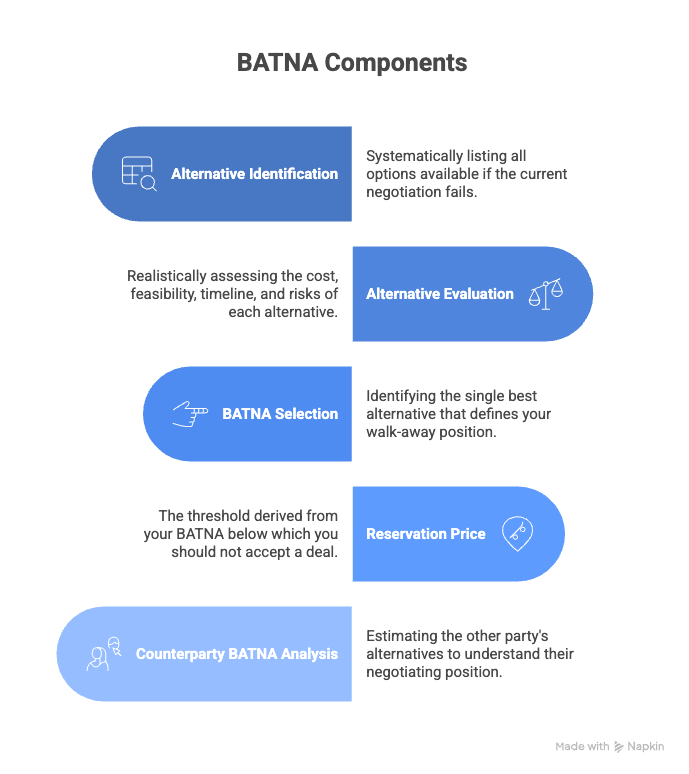
- The process begins before negotiation starts. Procurement identifies all alternatives to reaching agreement with the current supplier — other vendors, internal capabilities, substitute products, or delayed purchasing.
- Each alternative is evaluated realistically. What would it actually cost? How long would it take? What are the risks and downsides? The best of these alternatives becomes your BATNA.
- Your reservation price is determined based on your BATNA. This is the worst acceptable deal — any offer worse than your BATNA should be rejected. Knowing this prevents emotional decisions during negotiation.
- During negotiation, BATNA provides leverage and confidence. If the supplier’s offer is worse than your alternative, you can walk away. If you understand their BATNA is weak, you can push harder. Strong preparation enables strong outcomes.
Key Benefits of Negotiation BATNA
- Provides objective criteria for evaluating offers rather than relying on instinct or emotion during negotiations.
- Prevents accepting bad deals by establishing a clear walk-away point before negotiations begin.
- Increases confidence at the negotiating table by knowing you have viable alternatives if talks fail.
- Enables strategic concessions by understanding which terms matter most relative to your alternatives.
- Improves outcomes by focusing preparation time on strengthening alternatives before entering negotiations.
- Reveals when to walk away, saving time and resources on negotiations unlikely to produce acceptable results.
Read more: 6 Successful Purchasing Negotiation Tips for Every Buyer
Common Pitfalls of Negotiation BATNA
- Overestimating your BATNA. Wishful thinking about alternatives leads to walking away from acceptable deals. Be realistic.
- Ignoring the supplier’s BATNA. Understanding their alternatives is as important as knowing yours. Research their position.
- Failing to improve BATNA before negotiating. Qualify additional suppliers before major negotiations to strengthen your position.
- Revealing your BATNA carelessly. Sharing your alternatives may weaken your position. Disclose strategically, if at all.
How to Strengthen Your BATNA Before Negotiating
- Qualify additional suppliers. Even if you prefer the incumbent, having qualified alternatives creates real leverage.
- Develop internal capabilities. If you could make or do it yourself, that alternative strengthens your position.
- Explore substitute solutions. Different products or approaches that meet the underlying need expand your options.
- Extend current contracts. If you can continue with existing arrangements, time pressure decreases.
- Document alternatives concretely. Vague alternatives provide weak leverage. Specific, credible options create negotiating power.
KPIs of Negotiation BATNA
| Dimension | Sample KPIs |
| Preparation | Number of qualified alternatives per negotiation, BATNA documentation rate |
| Outcomes | Negotiated savings vs. BATNA baseline, deal acceptance rate |
| Leverage | Single-source negotiation percentage, alternative supplier qualification rate |
| Walk-away | Negotiations terminated for better alternatives, post-walk-away outcomes |
Key Terms in Negotiation BATNA
- BATNA: Best Alternative to a Negotiated Agreement — the most favorable option if current negotiations fail.
- Reservation Price: The worst acceptable deal, derived from your BATNA; offers below this should be rejected.
- ZOPA: Zone of Possible Agreement — the range where both parties’ acceptable terms overlap, making a deal possible.
- Walk-Away Point: The threshold at which you should end negotiations and pursue your BATNA instead.
- Leverage: Negotiating power derived from having strong alternatives and understanding the counterparty’s constraints.
- Anchoring: A negotiation tactic of establishing an initial reference point that influences subsequent discussion.
Technology Enablement
While BATNA is fundamentally a strategic concept requiring human judgment, Source-to-Pay platforms support it by providing spend analytics to identify alternative suppliers, supplier qualification workflows to develop viable alternatives, and market intelligence to assess supplier positions. These capabilities help procurement professionals enter negotiations with stronger, better-documented alternatives.
FAQs
Q1. What does BATNA stand for?
Best Alternative to a Negotiated Agreement — your best option if the current negotiation does not result in a deal.
Q2. Why is BATNA important in procurement?
It defines your walk-away point, provides negotiating leverage, and prevents accepting unfavorable deals.
Q3. How do I determine my BATNA?
List all alternatives if negotiation fails, evaluate each realistically, and identify the best one.
Q4. Should I tell the supplier my BATNA?
Usually not directly. Revealing weak alternatives undermines your position; strong ones may be implied strategically.
Q5. What if I have no BATNA?
You have weak leverage. Before negotiating, work to create alternatives — even imperfect ones improve your position.
Q6. How does BATNA relate to reservation price?
Your BATNA determines your reservation price — the worst deal you should accept. Anything worse, walk away.
References
For further insights into these processes, explore Zycus’ dedicated resources related to Negotiation BATNA (Best Alternative To a Negotiated Agreement):
- COVID-19: A Wake-up Call for Innovative Procurement
- Harnessing Generative AI for Invoice Processing: Revolutionizing Invoice Matching and Maximizing Cash Flow
- Real-time Procurement Benchmarking: Insights into Key Issues & KPIs for 2014 & beyond
- CPONext: 40 Procurement Leaders to Watch Out For – APAC 2nd Edition
- Zycus AppXtend: Watch Now and Customize Your Source-to-Pay










