



Goods procurement is the process of acquiring physical products, materials, and tangible items that an organization needs for its operations. The procurement of physical goods encompasses everything from raw materials and components used in manufacturing to office supplies, equipment, and inventory held for resale. Unlike services procurement, goods procurement involves tangible items that can be inspected, stored, and inventoried, requiring specific considerations around logistics, quality control, and inventory management.
Why Goods Procurement Matters in Procurement
Physical goods often represent the largest portion of organizational spend, particularly in manufacturing, retail, and distribution industries. Effective goods procurement directly impacts product quality, production continuity, and cost of goods sold. Beyond price, goods procurement must balance quality, delivery reliability, inventory carrying costs, and supply risk. For procurement professionals, mastering goods procurement fundamentals is essential because failures here — stockouts, quality defects, or supply disruptions — have immediate, visible operational consequences.
Read more: What is Procurement? A Guide to Strategies, Software & AI Solutions
The Core Process of Goods Procurement
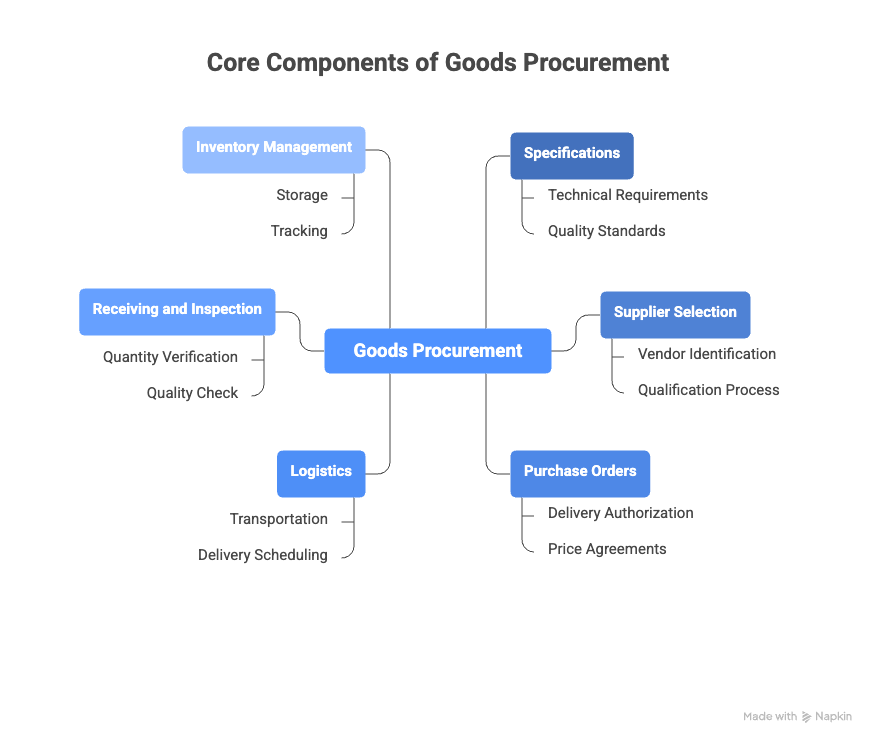
The process begins with requirements definition. Stakeholders specify what goods are needed, including technical specifications, quality standards, quantities, and delivery timing. For production materials, requirements often flow from demand planning and MRP systems.
Sourcing identifies capable suppliers. For commodity goods, this may involve competitive bidding. For specialized items, supplier qualification ensures vendors can meet quality and delivery requirements consistently.
Purchase orders are issued to selected suppliers, specifying exactly what is being ordered, pricing, delivery instructions, and terms. The PO creates a binding commitment for both parties.
Goods are received and inspected against the order. Quality checks verify that items meet specifications. Receiving documentation confirms delivery for invoice matching and inventory updates. Payment follows successful receipt and invoice validation.
Download eBook: Procurement Big Trends and Predictions
Key Benefits of Goods Procurement
- Ensures availability of materials and products needed to support operations, production schedules, and customer fulfillment.
- Controls costs through competitive sourcing, supplier negotiation, and ongoing supplier performance management.
- Maintains quality by specifying detailed requirements and inspecting received goods against defined standards.
- Reduces supply risk through supplier diversification, qualification processes, and continuous performance monitoring.
- Optimizes inventory investment by balancing material availability against carrying costs and working capital constraints.
- Creates traceability through documentation linking suppliers to specific goods, batches, and quality records.
Common Pitfalls of Goods Procurement
- Incomplete specifications: Vague requirements lead to receiving goods that do not meet actual needs. Be precise.
- Ignoring total landed cost: Unit price is not the full cost. Include freight, duties, handling, and inventory carrying costs.
- Weak receiving discipline: Accepting goods without proper inspection creates quality and payment problems downstream.
- Excess inventory: Over-ordering ties up cash and warehouse space. Balance availability against carrying costs.
Categories of Goods Procurement
- Direct materials: Raw materials and components that become part of finished products sold to customers.
- Indirect materials: Consumables and supplies used in operations but not incorporated into products, such as office supplies and cleaning materials.
- MRO goods: Maintenance, repair, and operations items needed to keep facilities and equipment running.
- Capital equipment: Machinery, vehicles, and durable assets with long useful lives and significant investment.
- Inventory for resale: Finished goods purchased for distribution or retail sale to end customers.
- Packaging materials: Boxes, labels, and protective materials used to package and ship products.
KPIs of Goods Procurement
| Dimension | Sample KPIs |
| Cost | Purchase price variance, total landed cost, cost savings achieved |
| Quality | Defect rate, inspection pass rate, supplier quality score |
| Delivery | On-time delivery rate, lead time accuracy, stockout incidents |
| Inventory | Inventory turns, days of supply, carrying cost percentage |
Key Terms in Goods Procurement
- Goods: Tangible, physical items that can be seen, touched, stored, and inventoried.
- Direct Materials: Goods that become part of the finished product sold to customers.
- Indirect Materials: Goods consumed in operations but not incorporated into products.
- MRO: Maintenance, Repair, and Operations — goods needed to support facilities and equipment.
- Landed Cost: Total cost of goods including purchase price, freight, duties, and handling.
- Goods Receipt: The process of receiving, inspecting, and documenting delivered goods.
Technology Enablement
Modern Source-to-Pay platforms support goods procurement through catalog management, purchase order automation, supplier portals for order acknowledgment and shipment tracking, receiving workflows with quality inspection steps, and three-way matching for invoice validation. Integration with inventory and ERP systems ensures seamless data flow from requisition through receipt and payment processing.
FAQs
Q1. What is goods procurement?
The process of acquiring physical products, materials, and tangible items needed for organizational operations and production.
Q2. How is goods procurement different from services procurement?
Goods are tangible items that can be physically inspected, stored, and inventoried. Services are intangible activities performed by providers.
Q3. What are direct vs. indirect goods?
Direct goods become part of products sold to customers. Indirect goods support operations but are not incorporated into finished products.
Q4. What is total landed cost?
The complete cost of goods including purchase price, transportation, customs duties, taxes, and handling charges.
Q5. Why is goods receiving important?
Proper receiving ensures delivered goods match orders in quantity and quality, identifies issues early, and supports accurate inventory and payment.
Q6. How do you manage goods procurement risk?
Through supplier diversification, detailed quality specifications, inspection processes, safety stock, and performance monitoring.
References
Explore Zycus resources to learn more about Goods Procurement:










