



A foundation model is a large-scale artificial intelligence model trained on broad, diverse datasets that can be adapted for a wide range of tasks. Rather than being designed for a single specific application, foundation models develop general capabilities — including language understanding, reasoning, and pattern recognition — that can be fine-tuned or applied through prompting to address many different use cases. In the context of procurement, foundation models underpin the AI capabilities increasingly embedded in sourcing, contract analysis, supplier risk monitoring, and spend analytics tools.
Why Foundation Model Matters in Procurement
Procurement teams are encountering foundation models through AI features in Source-to-Pay platforms, contract analysis tools, and supplier intelligence applications. Understanding how they work helps procurement professionals evaluate vendor AI claims critically, assess data privacy implications, and make informed decisions about where AI-assisted automation adds genuine value. As AI capabilities become a tool selection criterion, commercial literacy about foundation models is increasingly relevant for procurement leaders.
The Core Process of Foundation Model
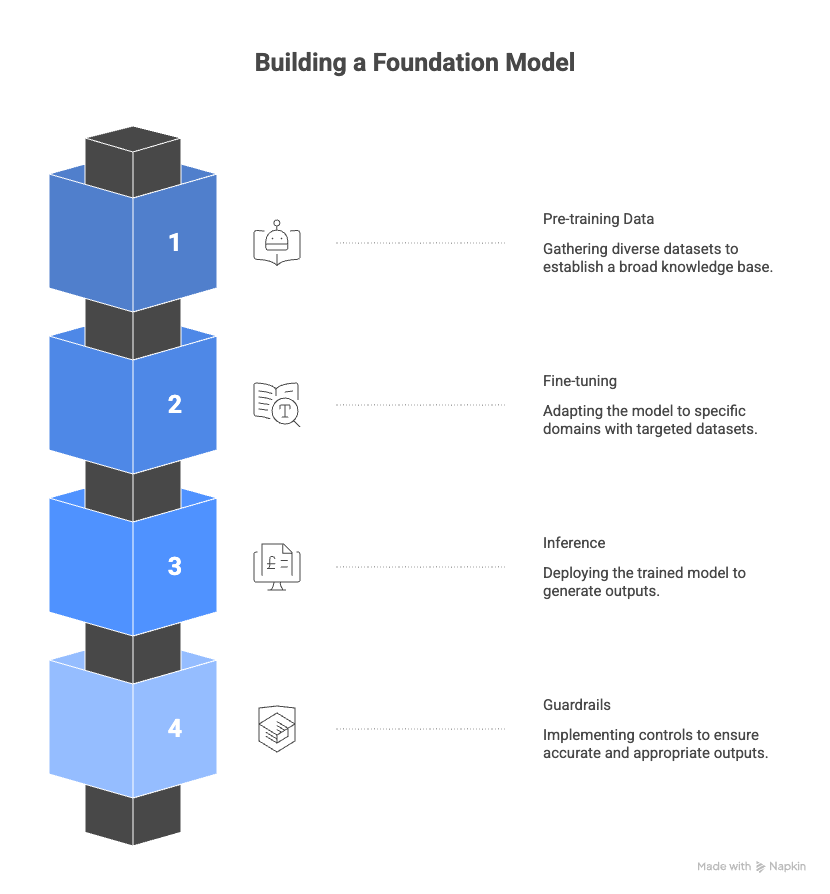
Foundation models are created through a training phase in which a large neural network processes vast quantities of text, structured data, images, or other inputs and learns statistical patterns within that data. This pre-training phase is computationally intensive and performed by AI research organizations and technology companies. The resulting model is general-purpose, capable of performing many tasks without task-specific retraining.
Adaptation occurs when the general model is fine-tuned or configured for a specific application. In a procurement context, this might involve fine-tuning a language model on contract documents, procurement regulations, or supplier communication datasets so that it performs accurately on procurement-specific tasks. Alternatively, foundation model capabilities are accessed through prompting, where instructions are provided at the point of use without changing the underlying model.
Deployment integrates foundation model capabilities into applications that procurement users interact with directly — AI-assisted contract review, automated spend classification, supplier risk summarization, or natural language query interfaces for procurement data. The user typically does not interact with the foundation model directly but through the product layer built on top of it.
Key Benefits of Foundation Model
- Enables AI-powered capabilities in procurement tools — contract review, spend classification, supplier risk analysis — without requiring organizations to build or train their own models.
- Reduces manual effort on high-volume, repetitive analytical tasks such as contract abstraction, invoice processing, and spend categorization.
- Improves the quality and speed of information synthesis, enabling faster decision-making in sourcing, risk management, and supplier engagement.
- Creates a platform for continuous capability improvement as the underlying models are updated and refined by their developers.
Common Pitfalls of Foundation Model
- Treating AI output as ground truth without validation: Foundation models can produce confident-sounding outputs that are factually incorrect. Procurement processes that rely on AI-generated content without human review carry accuracy risk.
- Underestimating data privacy implications: When procurement data is processed by external foundation models, organizations must understand what data leaves their environment, how it is stored, and whether it is used for model training.
- Assuming all AI features in procurement tools are equivalent: The quality, accuracy, and governance of AI capabilities varies significantly across vendors. Procurement should evaluate AI features with the same rigor applied to other functional criteria.
- Over-automating judgment-intensive decisions: Foundation models are well-suited to classification, summarization, and pattern recognition. Decisions requiring contextual business judgment, relationship management, or ethical reasoning should retain human oversight.
Procurement Use Cases Where Foundation Models Add Value
- Contract analysis and abstraction: Language models can extract key clauses, dates, obligations, and risks from contract documents at scale, significantly reducing manual review time.
- Spend classification: Foundation models trained on procurement taxonomy data can classify spend transactions automatically, improving coverage and consistency in spend analytics.
- Supplier risk summarization: Models can synthesize information from financial reports, news, and regulatory databases into structured supplier risk summaries for category manager review.
KPIs of Foundation Model
| Dimension | Sample KPIs |
| Accuracy | AI output accuracy rate vs. human review baseline, error rate by task type |
| Efficiency | Time saved per task through AI assistance, manual review rate |
| Coverage | % of applicable transactions processed through AI-assisted workflows |
| Governance | % of AI outputs reviewed before action, data privacy compliance rate |
Key Terms in Foundation Model
- Large Language Model (LLM): A type of foundation model trained primarily on text data, capable of generating, summarizing, and analyzing written content.
- Fine-Tuning: The process of adapting a pre-trained foundation model to a specific domain or task using a smaller, targeted dataset.
- Prompt Engineering: The practice of crafting input instructions that guide a foundation model to produce accurate and useful outputs for a specific task.
- Inference: The process of generating outputs from a trained model in response to new inputs, representing the deployment phase of model use.
- Hallucination: A phenomenon in which a language model generates plausible-sounding but factually incorrect or unsupported outputs.
Technology Enablement
Foundation model capabilities are increasingly available through Source-to-Pay platforms that embed AI features for contract analysis, spend classification, and supplier risk monitoring. Organizations evaluating these capabilities should assess model accuracy on procurement-specific tasks, data privacy commitments, the transparency of AI-generated outputs, and the degree of human oversight built into AI-assisted workflows.
FAQs
Q1. What is a foundation model?
A large AI model trained on broad datasets that can be adapted for many tasks, underpinning the AI features in modern procurement applications.
Q2. How are foundation models different from traditional AI?
Traditional AI models are designed for specific, narrow tasks. Foundation models are general-purpose and can be adapted across many applications.
Q3. Why should procurement professionals understand foundation models?
Because AI capabilities powered by foundation models are increasingly embedded in procurement tools, and evaluating them requires understanding what they are and how they work.
Q5. What are the main risks of using foundation model-powered tools?
Output inaccuracy, data privacy exposure, and over-automation of judgment-intensive decisions are the primary risks.
Q6. What is AI hallucination and why does it matter for procurement?
Hallucination is when a model produces confident but incorrect outputs. In procurement, this could mean inaccurate contract summaries, wrong supplier risk assessments, or erroneous spend classifications.
Q7. Will foundation models replace procurement professionals?
No. They automate high-volume, repetitive analytical tasks but cannot replace the business judgment, relationship management, and strategic thinking that procurement professionals provide.
References
For further insights into these processes, explore Zycus’ dedicated resources related to Foundation Model:
- Strategic Vendor Sourcing: Best Practices for Cost, Risk, and Sustainability
- 8 Unique Phases of Supplier Lifecycle Management
- Maximizing ROI Through Composable Procurement: AppXtend Case Study
- Cognitive Procurement: Marrying Human Experience and Machine Learning for Maximum Returns
- Optimizing the Supplier Onboarding Process with Zycus Support










