



Supplier integration is the process of connecting supplier systems and processes with a buying organization’s systems to enable seamless data exchange and workflow automation. Supplier systems integration encompasses electronic purchase order transmission, automated invoice submission, real-time inventory visibility, and collaborative planning capabilities. By eliminating manual data entry and enabling direct system-to-system communication, supplier integration reduces errors, accelerates transactions, and creates the foundation for more strategic supplier relationships.
Read more: Breaking Silos: A CIO & CPO Guide to Integrating Procurement, AP & Supply Chain
Why Supplier Integration Matters in Procurement
Manual processes create friction in supplier relationships. Every phone call, email, and fax introduces delay and error potential. Integrated suppliers receive orders instantly, confirm automatically, and submit invoices electronically — reducing transaction cycle times from days to hours or even minutes. Beyond efficiency gains, integration enables visibility into supplier inventory levels, production status, and shipment tracking that supports better demand planning. For procurement leaders, supplier integration transforms transactional supplier relationships into connected partnerships that deliver speed, accuracy, responsiveness, and competitive advantage.
The Core Process of Supplier Integration
The process begins with identifying integration candidates. High-volume suppliers with significant transaction activity offer the greatest return on integration investment.
Technical requirements are defined. This includes determining which transactions to automate (orders, acknowledgments, ship notices, invoices), data formats, communication protocols, and security requirements.
Integration is built and tested. Whether through EDI, supplier portals, APIs, or procurement networks, connections are established and transactions validated in test environments before going live.
Ongoing maintenance ensures continued operation. Monitoring detects failures, changes in supplier systems are accommodated, and new transaction types may be added as the relationship deepens.
Core Components of Supplier Integration
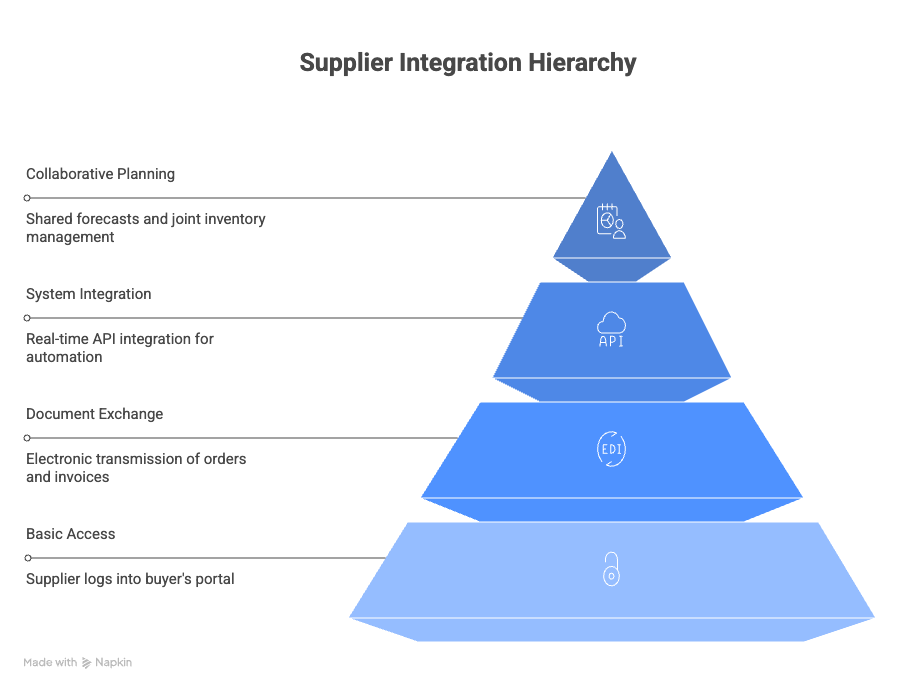
- Electronic Data Interchange (EDI): Standardized formats for exchanging business documents electronically between trading partner systems using defined transaction sets.
- Supplier Portal: Web-based interface where suppliers access purchase orders, submit invoices, and manage their ongoing relationship with the buyer.
- API Integration: Application programming interfaces enabling real-time, bidirectional data exchange between buyer and supplier enterprise systems.
- Procurement Network: Third-party platforms that connect multiple buyers and suppliers through a shared, managed integration infrastructure.
- Data Mapping: Translation between different data formats, field definitions, and coding schemes used by buyer and supplier systems.
Key Benefits of Supplier Integration
- Eliminates manual data entry for orders and invoices, reducing errors and freeing staff for higher-value procurement activities.
- Accelerates transaction cycles from days to hours or minutes through automated processing and instant data transmission.
- Enables real-time visibility into order status, shipment tracking, inventory levels, and delivery confirmations.
- Reduces invoice exceptions through automated matching of electronic purchase orders, receipts, and invoice documents.
- Improves supplier relationships by making the buying organization easier and more efficient to do business with.
- Creates foundation for advanced collaboration capabilities including vendor-managed inventory, demand sharing, and joint planning.
KPIs of Supplier Integration
| Dimension | Sample KPIs |
| Adoption | Integrated supplier percentage, electronic order percentage, portal adoption rate |
| Efficiency | Order-to-acknowledgment time, invoice processing time, touchless transaction rate |
| Accuracy | Data error rate, invoice exception rate, order accuracy percentage |
| Reliability | Integration uptime, failed transaction rate, mean time to resolve failures |
Key Terms in Supplier Integration
- EDI (Electronic Data Interchange): Standardized electronic format for exchanging business documents between organizations.
- cXML: Commerce XML — a protocol for communicating procurement data between applications and trading partners.
- Supplier Portal: Web application where suppliers interact with buyer systems for orders, invoices, and collaboration.
- ASN (Advance Ship Notice): Electronic notification sent by supplier providing details of upcoming shipment before arrival.
- Procurement Network: Multi-tenant platform connecting buyers and suppliers for electronic transaction exchange.
- Touchless Processing: Transactions that complete without manual intervention through full automation.
Technology Enablement
Modern Source-to-Pay platforms provide comprehensive supplier integration capabilities including supplier portals with self-service functionality, EDI connectivity through value-added networks, API frameworks for real-time integration, and procurement network connections. These tools enable electronic document exchange, automate transaction processing, and provide real-time visibility into supplier interactions, transaction status, and integration health.
FAQs
Q1. What is supplier integration?
Connecting supplier and buyer systems to enable automated data exchange for purchase orders, invoices, shipping notices, and other transactions.
Q2. What are the main integration methods?
EDI for traditional high-volume document exchange, supplier portals for web-based access, APIs for real-time system integration, and procurement networks for multi-party connectivity.
Q3. Which suppliers should be integrated first?
High-volume suppliers with significant transaction activity and technical capability, as they offer the greatest efficiency gains and smoothest implementations.
Q3. How long does supplier integration take?
Simple portal access can be set up immediately. Full EDI or API integration typically takes 4–12 weeks per supplier depending on complexity.
Q4. What if a supplier cannot integrate electronically?
Supplier portals provide a web-based alternative that requires no technical capability from the supplier beyond internet access.
Q5. Who pays for supplier integration?
Varies by relationship and power dynamics. Some buyers absorb all costs; others require suppliers to connect to standard networks.
References
Explore Zycus resources to learn more about Supplier Integration:










