




Active external integration is the continuous, two-way connection between an organization’s procurement systems and external parties — suppliers, marketplaces, regulators, data providers, and logistics networks — through which data flows live rather than through batch updates or manual handoffs. Where traditional integration moves information periodically (overnight files, weekly reconciliations, manual uploads), active external integration keeps internal and external systems in continuous alignment. A supplier updates a price; the catalog reflects it within minutes. An invoice is approved; the supplier’s portal shows the status immediately. A regulator updates a sanctions list; risk monitoring picks it up the same day. Active integration is what makes procurement a connected discipline rather than an island.
Why Active External Integration Matters in Procurement
Procurement decisions depend on accurate, current information about a world changing continuously. Supplier capacity shifts, prices update, regulations change, logistics conditions move — and procurement’s value depends on responding to these faster than competitors. Without active external integration, procurement operates on a perpetual lag, reacting to conditions that have already moved on. With it, procurement operates close to real time, with the data freshness needed for decisions that hold up. For leaders, active integration is the infrastructure underneath every modern capability — continuous risk monitoring, dynamic sourcing, real-time supplier collaboration, embedded compliance.
The Core Process of Active External Integration
- Integration Scope Definition. The process begins by deciding what to integrate — which suppliers, which data flows, which external parties. Not everything benefits from active integration; the scope is defined by where data freshness changes decision quality.
- Connection Architecture Design. Each integration has a technical architecture — API-based, EDI, messaging, event-driven — chosen based on the partner’s capability and the data flow characteristics. Architecture decisions shape what is possible later.
- Partner Onboarding and Testing. External parties — suppliers, marketplaces, data providers — are onboarded to the integration. Onboarding includes technical setup, test transactions, exception handling agreement, and operational go-live readiness.
- Continuous Operation and Monitoring. Active integrations run continuously, with monitoring for outages, data quality issues, throughput anomalies, and partner-side failures. Detection of degradation matters as much as detection of full failure.
- Exception Management. Integrations fail in ways that require human attention — partner system outages, schema changes, data quality drift. Exception handling processes determine whether failures get caught and resolved quickly or accumulate as silent data corruption.
- Evolution and Expansion. Integrations evolve as partner capabilities mature, business needs change, and technology improves. A roadmap of integration scope expansion keeps the procurement data ecosystem progressing rather than stagnating.
Core Components of Active External Integration
- API and connection layer provides the technical infrastructure for real-time data exchange — REST APIs, GraphQL, EDI gateways, event-streaming platforms — that move data between systems.
- Partner network is the population of external parties technically and operationally ready to integrate — suppliers with technical capability, marketplaces with documented APIs, data providers with integration-ready feeds.
- Data mapping and translation handles structural differences between internal and external data formats — converting supplier-side field names, codes, and structures into the procurement system’s data model.
- Monitoring and alerting detects integration health issues — failed transactions, latency spikes, data quality anomalies, partner outages — before they become business problems.
- Exception handling framework routes integration failures to the right resolver — technical for system issues, procurement for partner issues, supplier-facing for partner-side problems.
- Security and access controls ensure integrations move data safely — authentication, authorisation, encryption, audit logging — across organizational boundaries.
Key Benefits of Active External Integration
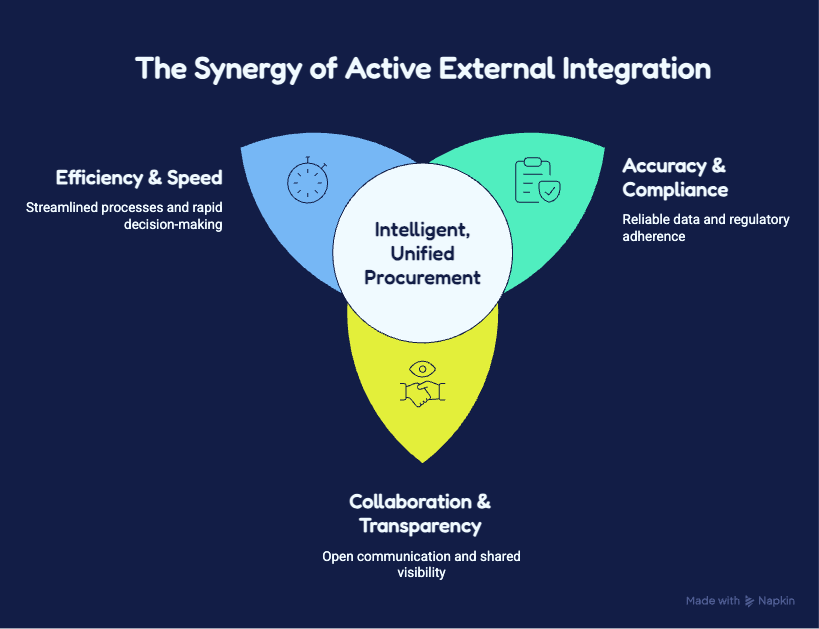
- Compresses decision cycles by replacing batch data flows with continuous integration, supporting real-time risk monitoring and dynamic sourcing.
- Reduces manual data handoffs that introduce delay and error across supplier onboarding, contract execution, and invoice processing.
- Strengthens supplier collaboration by giving suppliers visibility into status, decisions, and issues without procurement intermediation.
- Improves compliance posture by ensuring external risk and regulatory data reaches procurement systems within hours of change.
- Lays the data foundation that AI, analytics, and continuous intelligence capabilities depend on.
Common Pitfalls of Active External Integration
- Over-engineering integrations that don’t change decision quality. Active integration costs effort to build and maintain. Integrating a quarterly-changing data feed in real time delivers little value beyond a weekly batch.
- Underestimating partner readiness. Many suppliers lack the technical capability for active integration. A program that assumes universal readiness will deliver islands of integration in a sea of unchanged manual processes.
- Treating integration as a one-time project. Integrations require continuous maintenance — schema changes, partner updates, exception management. Without sustained operational ownership, integrations degrade silently.
- Ignoring the exception path. Active integration only works if exceptions are caught and resolved. Without exception management, failures accumulate as data quality problems harder to detect than visible outages.
What Active External Integration Connects
- Supplier catalog and pricing systems. Two-way feeds keeping contracted prices, item availability, and product attributes synchronised between supplier systems and the procurement catalog — no monthly refreshes, no stale prices.
- Supplier transaction status. Active visibility into PO acknowledgement, shipment status, delivery confirmation, and invoice status — replacing email threads with system-to-system updates.
- External risk and intelligence feeds. Real-time integration with sanctions lists, credit monitoring services, adverse media providers, and ESG ratings — ensuring risk signals reach procurement systems within hours of public availability.
- Logistics and transit visibility. Integration with carriers, freight forwarders, and tracking services — surfacing in-transit status, delay signals, and disruption alerts directly within procurement workflows.
- Marketplace and external catalog content. Live punchout and content syndication from marketplaces, distributor catalogs, and supplier-hosted experiences — keeping the catalog current without manual content management.
- Regulatory and compliance platforms. Active connection to e-invoicing networks, tax authority platforms, and regulatory reporting services — ensuring compliance happens in the transaction flow rather than as periodic reconciliation.
KPIs of Active External Integration
| Dimension | Sample KPIs |
| Coverage | % of critical suppliers actively integrated, % of strategic data flows in active integration |
| Reliability | Integration uptime %, mean time to detect and resolve integration failures |
| Data Freshness | Mean age of integrated data vs. source, % of integrations meeting freshness SLA |
| Business Impact | Reduction in manual handoffs, cycle time improvement attributable to integration |
Key Terms in Active External Integration
- API: Application Programming Interface — the technical contract through which two systems exchange data in real time.
- EDI: Electronic Data Interchange — a long-standing standard for structured business document exchange, still widely used in supplier integration.
- Event-Driven Integration: An architecture where systems publish and subscribe to events rather than periodically polling each other — typically more efficient and timely than batch approaches.
- Punchout: A specific integration pattern where a requester moves seamlessly from the procurement system into a supplier’s catalog, with selected items returning to the original requisition.
- Data Mapping: The process of translating between two systems’ data structures — field names, codes, formats — to enable meaningful exchange.
- Integration Hub: A central platform that manages multiple integrations rather than each running as a point-to-point connection.
Technology Enablement
Modern Source-to-Pay platforms are built with active external integration as a foundational capability — API-first architectures, supplier network integrations, marketplace connectivity, and real-time risk feed ingestion built in rather than bolted on. Platform-native integration shifts the team’s focus from connection plumbing to using the connected data ecosystem to make faster, better decisions.
FAQs
Q1. What is active external integration?
The continuous, two-way connection between procurement systems and external parties — suppliers, marketplaces, data providers, regulators — through which data flows live rather than through batch updates.
Q2. How is it different from traditional integration?
Traditional integration moves data periodically — overnight files, weekly imports, manual uploads. Active integration moves data continuously, keeping internal and external systems in alignment close to real time.
Q3. Which integrations deliver the most value?
Those where data freshness changes decision quality — risk monitoring, supplier catalog and pricing, transaction status, logistics visibility, and regulatory compliance.
Q4.Are all suppliers ready for active integration?
No. Partner readiness varies widely. Programs typically integrate strategic and critical suppliers actively, with broader populations on lighter integration models or supplier-portal interaction.
Q5. Who owns active external integration?
Joint ownership — procurement defines the business need, IT delivers the technical architecture, supplier relationship managers handle partner engagement. Without joint ownership, integrations stall.
References
Here are 3 Zycus resources related to Active External Integration:










