WHAT ARE XRECHNUNG AND ZUGFERD?
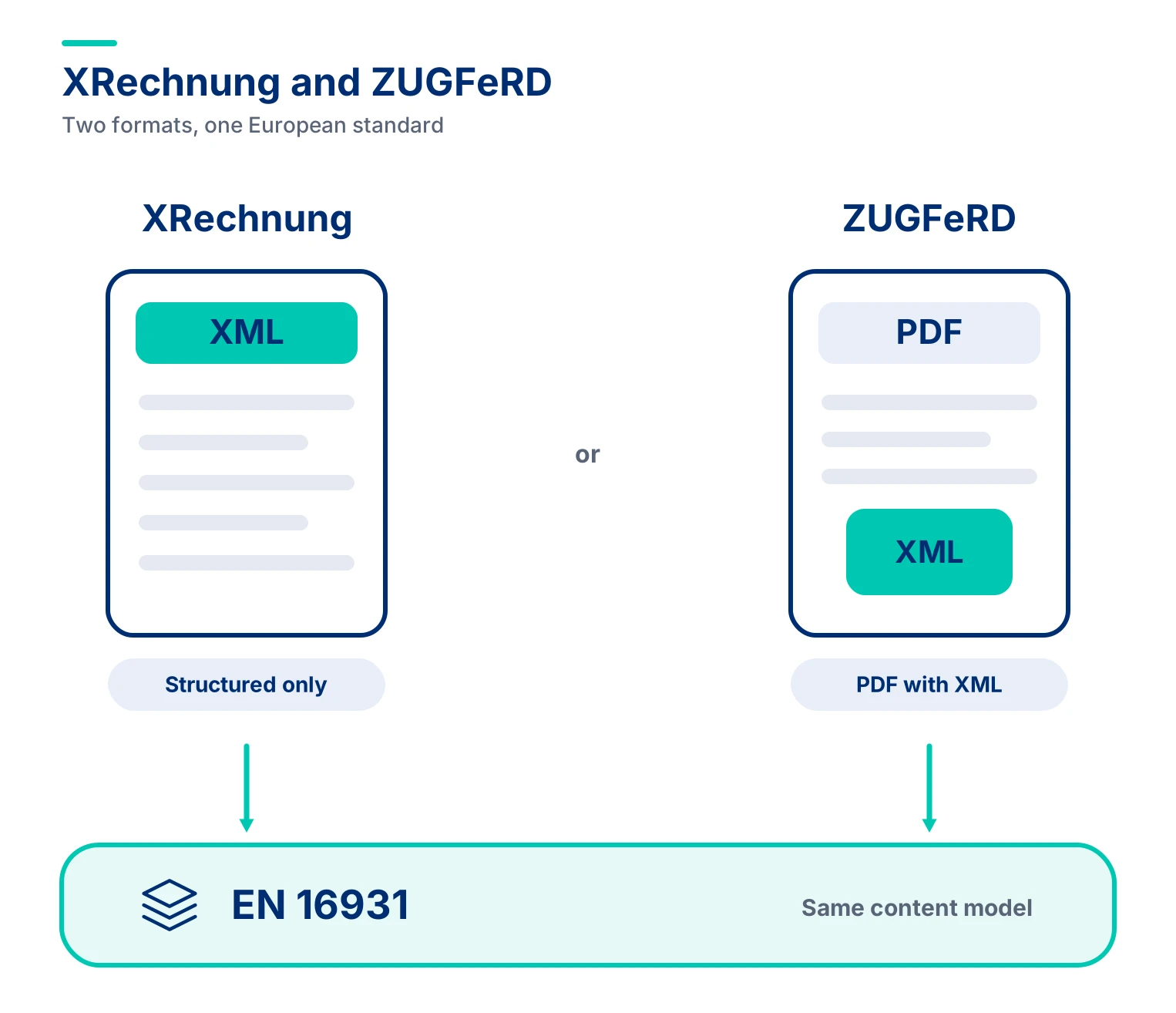
XRechnung and ZUGFeRD are the two best-known German e-invoice formats. XRechnung is a purely structured XML invoice. ZUGFeRD is a hybrid: a readable PDF/A-3 file with a structured XML invoice embedded in it. Both build on the European standard EN 16931.
WHY IT MATTERS IN PROCUREMENT
Since the Growth Opportunities Act, domestic B2B invoicing in Germany is moving to structured e-invoices. From 1 January 2025, businesses must be able to receive an EN 16931 e-invoice. A plain PDF or paper invoice no longer counts as an e-invoice.
The duty to issue is phased. Paper remains allowed until the end of 2026 (other formats with the recipient’s agreement), and until the end of 2027 for businesses with prior-year turnover up to EUR 800,000. Issuing becomes general from 2028, with some exceptions such as small invoices below EUR 250. Details sit in guidance from the Federal Ministry of Finance, so confirm current rules with tax counsel. Other markets differ, as the global e-invoicing overview shows.
THE CORE PROCESS / LIFECYCLE
- Decide Which Formats to Accept. Confirm that your systems can take XRechnung and ZUGFeRD files with the EN 16931 content. Decide how EDI and other agreed formats will coexist.
- Set Up Receiving Channels. Give suppliers a channel that can carry structured files, such as a dedicated mailbox or a network connection. Public bodies use an additional routing identifier, the Leitweg-ID.
- Validate on Arrival. Check each file against EN 16931 and the format’s rules. The XRechnung validation tools are published free of charge by KoSIT.
- Read the Structured Data. The XML is the leading part for VAT purposes. In a ZUGFeRD file, the PDF is a visual aid, so the posting must come from the embedded data.
- Match and Post. AP matches the data to the order and receipt, then posts it through its invoice workflow with little keying.
- Archive the Original. Keep the e-invoice in its structured form, because the XML is the original record.
CORE COMPONENTS
EN 16931 is the shared content model. XRechnung is a Core Invoice Usage Specification of that model, maintained by KoSIT, and it can be written in UBL or CII syntax. ZUGFeRD is the hybrid format developed by FeRD and aligned with France’s Factur-X since version 2.0. ZUGFeRD profiles range from MINIMUM to EXTENDED, and only some are complete invoices. The XRECHNUNG profile lets XRechnung data travel inside a ZUGFeRD file. The Leitweg-ID routes invoices to public-sector recipients.
KEY BENEFITS
Both formats carry the same EN 16931 content, so a buyer can accept either from a supplier without mapping two data models. ZUGFeRD also gives people a document they can read, which helps while teams adjust.
Structured receipt allows automated matching, faster approvals and fewer errors than OCR-based capture. Because both formats follow a European standard, the same work also helps with trading partners outside Germany.
COMMON PITFALLS
- Calling a PDF an e-invoice. A PDF without structured data is not an e-invoice under the rules, however professional it looks.
- Picking the wrong ZUGFeRD profile. MINIMUM and BASIC WL are booking aids, not complete invoices under German VAT law. Use the EN 16931 profile or higher.
- Validating only the visible part. The embedded XML drives processing, so errors hidden behind a clean PDF still cause failures.
- Treating the formats as identical. FeRD warns against treating XRechnung, ZUGFeRD and EN 16931 as the same when validating.
XRECHNUNG AND ZUGFERD SIDE BY SIDE
Both can satisfy EN 16931. The practical differences are in file form and typical use.
| Aspect | XRechnung | ZUGFeRD |
| File form | XML only | PDF/A-3 with embedded XML |
| Human reading | Needs a viewer | The PDF can be read directly |
| Syntax | UBL or CII | CII in the embedded XML |
| Maintained by | KoSIT, for the IT Planning Council | FeRD, jointly with France’s FNFE-MPE for Factur-X |
| Typical fit | Public sector, and other recipients that accept XML | Business exchange where a readable copy helps |
KPIs
| Dimension | Sample KPIs |
| Readiness | Share of suppliers sending EN 16931 e-invoices; share of invoices received as plain PDF |
| Quality | Files failing validation; wrong-profile ZUGFeRD files |
| Efficiency | Touchless posting rate; keying hours per invoice |
| Archive | E-invoices archived in structured form |
KEY TERMS
- EN 16931. The European standard that defines the core invoice data model.
- CIUS. Core Invoice Usage Specification, a national or community restriction of EN 16931.
- Hybrid Invoice. A PDF that carries structured XML data inside it.
- PDF/A-3. An archival PDF format that allows embedded files such as XML.
- KoSIT. The coordinating office that maintains the XRechnung standard.
- FeRD. The German forum that develops ZUGFeRD.
- Leitweg-ID. The routing identifier used to address public-sector invoice recipients.
- Factur-X. The French-German hybrid format that matches ZUGFeRD from version 2.0.
FAQs
1. What is XRechnung in Germany’s electronic invoicing system?
XRechnung is Germany’s standardized electronic invoicing format designed for exchanging structured invoice data between businesses and public authorities. It uses XML based on the European EN 16931 standard and supports UBL and CII syntaxes. Unlike traditional PDF invoices, XRechnung enables automated data validation, invoice processing, and accounting integration. It is widely used in German public procurement and can also support domestic B2B e-invoicing requirements.
2. What is the difference between XRechnung and ZUGFeRD?
XRechnung is a structured XML-only electronic invoice, while ZUGFeRD combines a human-readable PDF/A-3 document with embedded XML invoice data. Both can comply with the European EN 16931 standard. XRechnung is commonly used for government invoicing, whereas ZUGFeRD is useful when businesses need both machine-readable data and a visual invoice. The key difference lies in their file structure and how users access invoice information.
3. When do XRechnung and ZUGFeRD become mandatory for businesses in Germany?
Germany requires domestic businesses to receive compliant structured e-invoices from January 1, 2025. Mandatory issuance is phased, with businesses exceeding €800,000 in prior-year turnover generally required to issue compliant e-invoices from January 1, 2027. The requirement expands to other covered businesses from January 1, 2028. XRechnung and compliant ZUGFeRD profiles are accepted formats, but neither specific format is universally mandatory. Certain exemptions and transitional provisions apply.
4. Are PDF invoices still accepted in Germany under the 2026 e-invoicing rules?
Yes, traditional PDF invoices remain permitted during Germany’s transitional period, but they are no longer classified as structured electronic invoices. Until December 31, 2026, businesses may generally issue PDF invoices with recipient consent. Businesses with prior-year turnover up to €800,000 can continue using transitional arrangements through 2027. From 2028, covered domestic B2B transactions generally require compliant structured e-invoices. Unlike ordinary PDFs, eligible ZUGFeRD files contain machine-readable XML data.
5. Which ZUGFeRD profiles comply with Germany’s electronic invoicing requirements?
ZUGFeRD profiles that satisfy the EN 16931 requirements can qualify as compliant electronic invoices in Germany. The EN 16931 and XRECHNUNG profiles support structured invoice data required for automated processing. However, the MINIMUM and BASIC WL profiles do not contain all mandatory invoice information and therefore do not qualify as complete structured e-invoices under German VAT rules. Businesses should validate the selected profile and embedded XML before issuing invoices.
6. How can businesses process XRechnung and ZUGFeRD invoices automatically?
Businesses can automate XRechnung and ZUGFeRD processing by configuring ERP or accounts payable systems to receive, validate, and extract structured XML invoice data. The extracted information can be matched against purchase orders and goods receipts before approval and posting. Organizations should validate invoices against EN 16931 requirements, manage exceptions, and archive the original structured data. Automated processing reduces manual entry, invoice discrepancies, and approval delays.
7. Can XRechnung invoices be exchanged through the Peppol network?
Yes, XRechnung invoices can be exchanged through the Peppol network when the sender and recipient support the applicable document specifications and transmission requirements. Peppol provides standardized electronic document exchange through certified access points, while XRechnung defines the structured invoice format. German public-sector invoicing may also require a Leitweg-ID to identify the receiving authority. Businesses should verify recipient-specific requirements and supported invoice formats before transmission.