



Performance review in procurement is the structured, recurring assessment of how suppliers, categories, and the procurement function itself are performing against agreed expectations. It is the operational discipline that converts contracts, KPIs, and strategy into accountable action — where data, observation, and judgement come together to decide what is working, what is not, and what changes next. Performance review applies at three levels: supplier performance reviews assess individual supplier delivery, category reviews assess the health and trajectory of spend categories, and function reviews assess procurement’s overall contribution.
Why Performance Review Matters in Procurement
Without performance review, procurement decisions get made once at award and rarely revisited. Suppliers underperform without consequence, categories drift from strategy, and the function loses the feedback loop that distinguishes improvement from repetition. Performance review converts procurement from a sequence of one-time decisions into a managed system that compounds learning over time. For procurement leaders, the discipline is also a credibility instrument — executives and stakeholders trust functions that measure themselves honestly far more than those that surface results only when they are good.
The Core Process of Performance Review
- Scope and Audience Definition. The process begins by defining what is being reviewed and for whom. A supplier review for a category manager differs from a function review for the C-suite differs from a category review for procurement leadership. Each has different content, cadence, and depth.
- Metric and Evidence Preparation. The review is anchored on agreed metrics — supplier KPIs, category indicators, function-level outcomes — supplemented with qualitative observations. Preparation pulls together quantitative data and the narrative context that explains it.
- Performance Discussion. The review itself is a structured conversation, not one-way reporting. Strong reviews include the people closest to the work — supplier representatives in supplier reviews, business stakeholders in category reviews — and create space for honest exchange.
- Decision and Action Capture. Reviews produce decisions and actions — performance improvement plans, contract changes, category strategy adjustments, function priority shifts. Reviews concluding without decisions become administrative overhead.
- Communication and Stakeholder Alignment. Review outcomes are communicated to the audiences who need to act on them — the supplier whose performance plan was agreed, the business unit whose category direction shifted, the executive whose investment case was confirmed.
- Tracking to Next Review. Actions from this review become inputs to the next. The cycle compounds discipline only if commitments made in one review are visibly reviewed in the next.
Core Components
- Performance framework defines what is reviewed at each level — supplier KPIs, category indicators, function metrics — and how performance is calibrated against expectations.
- Data foundation is the underlying source data the review draws on — transaction records, contract terms, supplier scorecards, spend analytics. Review quality is bounded by data quality.
- Review template and structure provides the consistent format that makes reviews efficient and comparable — the same structure each cycle, varied only in content.
- Stakeholder participation model defines who attends, what they prepare, and what authority they bring — preventing reviews from becoming either rubber-stamp or unbounded discussion.
- Action tracking system captures decisions and commitments and follows them between reviews — making the cycle compound rather than reset.
- Calibration mechanism keeps performance assessment consistent across reviewers, categories, and time periods — preventing the drift where strong performance in one review would be weak in another.
Key Benefits
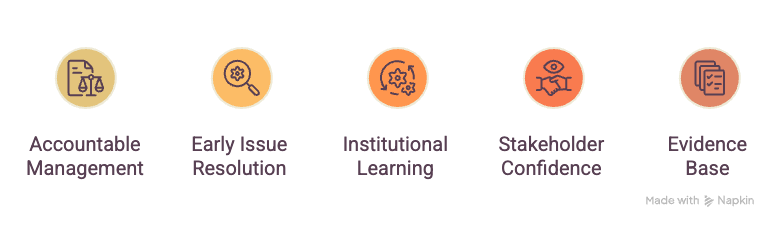
- Converts contracts and KPIs into accountable management discipline rather than documents reviewed only at exception.
- Surfaces performance issues early enough to address them constructively, before they escalate into relationship breakdown.
- Builds the institutional learning loop that distinguishes maturing procurement functions from repeating ones.
- Strengthens stakeholder confidence by demonstrating procurement measures itself with the same rigour it applies to suppliers.
- Creates the evidence base for major procurement decisions — supplier expansion, contract renewal, category strategy refresh.
Common Pitfalls
- Reviewing without acting. Reviews that produce well-documented insights but no decisions become theatre — consuming time without changing outcomes. The output of a review is what changes, not what gets written down.
- Reviewing too rarely or too often. Annual reviews miss the chance to course-correct. Monthly reviews on slow-moving categories produce noise. Cadence must match the rate at which meaningful change actually happens.
- Anchoring entirely on metrics and losing the narrative. A review that reads numbers from a dashboard without explaining the story behind them produces compliance reporting, not management discipline. Metrics need interpretation.
- Letting reviews become one-sided. Supplier reviews that procurement leads without supplier participation produce defensive responses, not joint problem-solving. Function reviews without stakeholder voice miss what stakeholders actually experience.
What a Strong Performance Review Cycle Looks Like
- Cadence matches the subject. Strategic suppliers reviewed quarterly with deeper annual assessment. Tactical suppliers reviewed annually with continuous metric monitoring. Categories reviewed semi-annually with annual strategic refresh. Function reviewed quarterly internally with annual executive review.
- Preparation is real work. Strong reviews are preceded by structured preparation — data pulled, scorecards completed, qualitative input collected from people close to the work. Reviews where preparation begins the day before deliver shallow conclusions.
- The conversation is honest. Performance review only works when participants can name what is not working without political consequence. Cultures that punish bad news end up with reviews that never surface it.
- Decisions are made in the room. Strong reviews close with explicit decisions — supplier development action, contract renegotiation, category pivot, function priority shift — captured and owned before the meeting ends.
- Actions track to next review. Every commitment becomes the opening agenda of the next review. Compounding discipline depends on visible follow-through.
KPIs
| Dimension | Sample KPIs |
| Coverage | % of critical suppliers with active performance reviews, % of categories reviewed within cycle |
| Discipline | % of reviews held on scheduled cadence, % of actions completed by next review |
| Quality | % of reviews producing concrete decisions, supplier satisfaction with review process |
| Outcome | Performance improvement in reviewed suppliers/categories vs. baseline |
Key Terms in Procurement Performance Review
- Supplier Performance Review: A structured assessment of an individual supplier’s delivery against contracted and operational expectations — typically conducted quarterly or annually depending on supplier criticality.
- Category Review: An assessment of a spend category’s health, strategy execution, and trajectory — typically semi-annually with annual strategic refresh.
- Function Review: An assessment of the procurement function’s overall performance and contribution — internal to procurement leadership, with periodic executive reporting.
- Scorecard: A structured summary of performance against defined dimensions, often used as the data anchor for a review conversation.
- Performance Improvement Plan: A formal plan agreed when supplier performance falls below expectations — with specific targets, timelines, and consequences for non-improvement.
- Calibration: The discipline of ensuring performance assessment stays consistent across reviewers, categories, and time periods.
Technology Enablement
Modern Source-to-Pay platforms support performance review through integrated supplier scorecards, category dashboards, action tracking, and the analytical layer that converts transactional data into the metrics reviews depend on. Platform-native deployment ensures reviews draw on consistent data, capture decisions in shared systems, and connect commitments made in one review to the agenda of the next.
FAQs
Q1. What is performance review in procurement?
The structured, recurring assessment of how suppliers, categories, and the procurement function itself are performing against agreed expectations — the operational discipline that converts contracts and KPIs into accountable action.
Q2. What are the different types of procurement performance review?
Three primary types: supplier performance reviews (individual supplier delivery), category reviews (spend category health and strategy), and function reviews (procurement’s overall contribution).
Q3. How often should reviews happen?
Cadence should match the rate of meaningful change. Strategic suppliers: quarterly. Tactical suppliers: annually. Categories: semi-annually. Function: quarterly internally, annually with executives.
Q4. What separates strong reviews from weak ones?
Real preparation, honest conversation, decisions made in the room, and actions tracked to the next review. Reviews that produce documents but not decisions are theatre.
Q5. Should suppliers participate in their own reviews?
Yes, for any supplier where the relationship matters. One-sided reviews produce defensive responses, not joint problem-solving. Strong reviews are conversations.
References
For further insights into these processes, explore Zycus’ dedicated resources related to Performance Review:
- Automated Intake Management: Eliminating BFSI Vendor Compliance Gaps
- Strategic Intake Management: How ESG Principles Propel Business Excellence
- Risk Management in Supply Chain Management​ for Government Organizations in Australia
- Unlock Strategic Value: Download the 2024 Pulse of Procurement Report
- Procurement Excellence with Anita Pelacchi at V-Line










