WHAT IS IBAN VALIDATION?
IBAN validation is the check that an International Bank Account Number (IBAN) has a valid country code, the correct length, a structure that fits the country and correct check digits. In supplier onboarding it catches typing errors before a payment is sent, but it does not confirm that the account exists or belongs to the supplier.
WHY IT MATTERS IN PROCUREMENT
An IBAN is a long string, and long strings get mistyped. A transposed digit can mean a rejected payment, bank fees and weeks of delay. Validation stops most of these errors at the point of entry.
Validation is often described as bank verification. It is not. The check digits show that the number is internally consistent, not that the account is real or owned by the supplier. Treat it as the first gate, then add ownership checks and bank change controls.
THE CORE PROCESS / LIFECYCLE
- Capture the IBAN. The supplier enters the IBAN in a portal field. The system removes spaces and converts letters to upper case, since IBANs are often written in groups of four.
- Check Country and Length. The first two letters are a country code. Each country has a fixed IBAN length, so a wrong length is rejected at once.
- Check the Structure. Each country defines the layout of the domestic part, including bank identifier and account number. The system tests that the format fits the country pattern.
- Run the Check Digit Test. The two digits after the country code are calculated from the rest of the IBAN. The system moves the first four characters to the end, converts letters to numbers and applies a modulo 97 test. A remainder of 1 means the check digits pass.
- Pass On or Return. A pass moves the record to the next control, such as a name check or call-back. A fail goes back to the supplier for correction.
CORE COMPONENTS
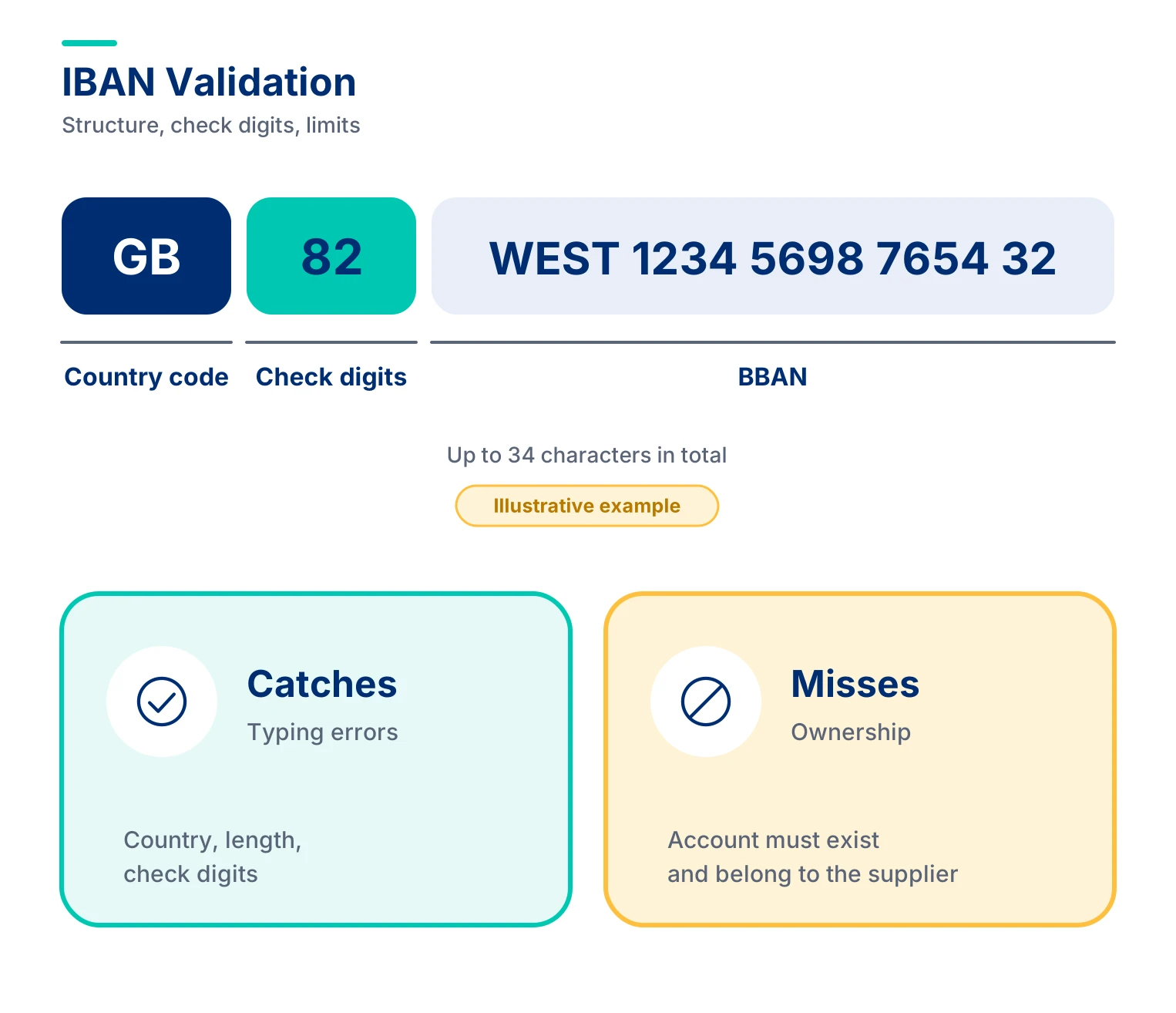
- The country code is two letters.
- The check digits are two numbers calculated from the rest of the IBAN.
- The BBAN is the domestic part, with bank identifier and account number in a country-specific format.
- The length is up to 34 characters and fixed for each country.
- The standard is ISO 13616, with SWIFT as registrar. For illustration, in GB82 WEST 1234 5698 7654 32, GB is the country code, 82 the check digits and the rest the BBAN.
KEY BENEFITS
- Validation gives the supplier instant feedback when a character is wrong, so errors never reach the master file. It cuts rejected payments, bank fees and rework.
- It also costs almost nothing to run, because it uses published rules and needs no call to the bank. It can sit in onboarding forms, supplier portals and bulk upload templates.
COMMON PITFALLS
- Believing a valid IBAN is a verified account. Check digits prove consistency only. A fraudster can supply a valid IBAN for an account they control.
- Using a validator that checks only length. Some tools skip the country structure or the check digits. Test with known good and bad examples.
- Forgetting non-IBAN countries. Some countries, including the United States, do not use IBANs for domestic accounts. Those suppliers need other fields and checks.
- Letting the rules go stale. Country formats are maintained in the official registry. Refresh your rules on a schedule.
WHAT AN IBAN CHECK CATCHES AND WHAT IT MISSES
Use this table to decide which control must follow the validation step.
| Error or risk | Caught by IBAN validation? | What catches it instead |
| Mistyped, missing or transposed characters | Usually | The check digits flag most of them |
| Wrong length or wrong country format | Yes | Fixed length and structure rules |
| Account does not exist | No | A bank check, test payment or name check |
| Account belongs to someone else | No | An ownership check against the supplier’s legal name |
| Fraudulent change request | No | Call-back and second approval |
KPIs
| Dimension | Sample KPIs |
| Quality | IBANs rejected at entry; payments returned for invalid bank details |
| Coverage | Supplier bank records validated; IBAN suppliers with a follow-up ownership check |
| Speed | Time from supplier entry to a usable bank record |
| Control | Rule updates applied on schedule |
KEY TERMS
- BBAN. Basic Bank Account Number, the domestic part of an IBAN.
- Check Digits. Two numbers inside the IBAN that let a system detect typing errors.
- Modulo 97. The calculation used to test an IBAN’s check digits.
- ISO 13616. The international standard that defines the IBAN.
- BIC. Bank Identifier Code, which identifies a bank in international payments.
- ABA Routing Number. The nine-digit bank identifier used for domestic payments in the United States.
- Registrar. The body that maintains the official list of IBAN formats, which is SWIFT.
FAQs
1. What is IBAN validation in banking and procurement?
IBAN validation is the process of checking whether an International Bank Account Number (IBAN) follows the correct country-specific format, length, structure, and check digit rules. Procurement and accounts payable teams use IBAN validation to identify incorrect supplier banking details before processing payments. It helps reduce rejected transactions, payment delays, and administrative costs. However, validation does not confirm that the bank account exists or belongs to the supplier.
2. How does the IBAN validation process work?
IBAN validation checks the country code, required account number length, country-specific structure, and mathematical check digits. The system removes spaces, rearranges the first four characters, converts letters into numbers, and applies a modulo 97 calculation. An IBAN passes the check digit test when the remainder equals 1. This automated process identifies most typing errors and invalid account formats before payment details enter supplier master records.
3. What is the correct IBAN format, and how many characters does it contain?
An IBAN contains up to 34 alphanumeric characters, with its exact length determined by the country. It begins with a two-letter country code, followed by two check digits and a Basic Bank Account Number (BBAN).
For example, GB82 WEST 1234 5698 7654 32 is a valid-format UK IBAN. Here, GB identifies the country, 82 represents the check digits, and the remaining characters contain domestic banking information.
4. What is the difference between IBAN validation and bank account verification?
IBAN validation checks whether a bank account number follows the correct structure and mathematical rules, while bank account verification uses additional methods to establish account existence or ownership. A structurally valid IBAN does not guarantee that the account is active or belongs to the intended supplier. Procurement teams should combine IBAN validation with appropriate account ownership checks to reduce payment errors and supplier fraud risks.
5. Can an IBAN be valid but still belong to a fraudulent bank account?
Yes, an IBAN can pass every structural validation check and still belong to a fraudster or an unrelated account holder. IBAN validation only confirms that the number follows the required format and check digit rules. It cannot authenticate account ownership or identify fraudulent supplier bank detail changes. Businesses should use independent supplier verification, bank account ownership checks, and dual approval controls before authorizing payments to new or modified accounts.
6. Which countries use IBANs, and does the United States use them?
IBANs are widely used across Europe and in several countries in the Middle East, North Africa, and the Caribbean. The United States does not use IBANs for domestic bank accounts, relying instead on account numbers and ABA routing numbers. Businesses making international payments should verify whether the recipient country uses IBANs and collect the appropriate banking identifiers. The official SWIFT IBAN registry maintains country-specific format information.
7. How can businesses automate IBAN validation during supplier onboarding?
Businesses can automate IBAN validation by integrating format checks into supplier onboarding portals, vendor master data systems, and payment workflows. Automated validation verifies country codes, account lengths, and check digits when suppliers enter banking details. Invalid entries are flagged for correction before approval. Organizations should also validate bulk data imports, apply updated country-specific rules, and conduct separate ownership checks before activating supplier bank accounts for payment.