


Common Procurement Vocabulary (CPV) codes are a standardized classification system for public procurement used across the European Union to describe the subject matter of public contracts. Each CPV code is an eight-digit numeric identifier that maps to a specific category of goods, services, or works. CPV codes are mandatory for contract notices published in the Official Journal of the European Union (OJEU) and are used by contracting authorities to classify procurement requirements in a consistent format that suppliers can search and filter to identify relevant opportunities.
Why Common Procurement Vocabulary (CPV) Codes Matter in Procurement
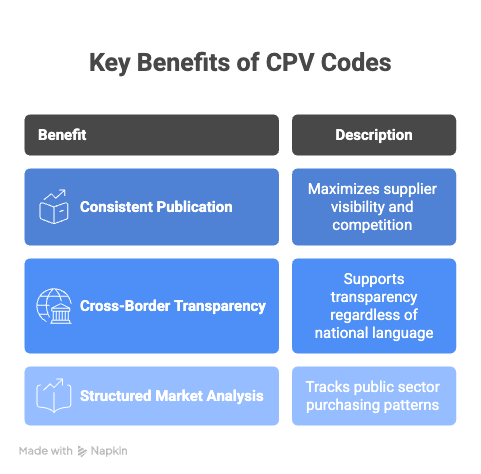
For public sector procurement teams, CPV codes are a regulatory and operational requirement. Incorrect or missing codes limit supplier visibility, reduce competition, and create audit compliance findings. For suppliers, they are the primary search mechanism for identifying relevant public contracts across EU member states. For procurement professionals, understanding CPV code selection — including the difference between main and supplementary codes — directly affects the quality and legal compliance of published notices.
The Core Process of Common Procurement Vocabulary (CPV) Codes
- Requirement Classification: When a public contract is being prepared for market, the contracting authority classifies the subject matter using CPV codes. The procurement team identifies the most precise code that describes the primary subject of the contract — the main CPV code — from the CPV taxonomy, which is organized across divisions, groups, classes, and categories.
- Supplementary Code Selection: Where a contract covers multiple types of goods, services, or works, supplementary CPV codes are added alongside the main code to provide a complete description. Supplementary codes help suppliers understand the full scope and determine whether the contract is relevant to their capabilities.
- Notice Publication: CPV codes are included in the contract notice published to the OJEU or the relevant national portal. The codes appear in the structured data fields of the notice, enabling automated filtering and search by suppliers and procurement intelligence platforms.
- Post-Award Reporting: CPV codes appear in contract award notices, enabling public bodies and market analysts to track procurement activity by category across contracting authorities over time.
Core Components of Common Procurement Vocabulary (CPV) Codes
- CPV code structure organizes the taxonomy into a hierarchy of divisions (two digits), groups (three digits), classes (four digits), categories (five digits), and the full eight-digit code at commodity level. Each level represents a progressively more specific description of the procurement subject matter.
- Main CPV code identifies the primary subject of the contract. Only one main CPV code is assigned per contract notice. It must reflect the predominant element of the contract — the goods, service, or work that defines the primary purpose of the engagement.
- Supplementary CPV codes describe secondary elements of the contract scope. Multiple supplementary codes may be applied, and they are selected from a separate supplementary vocabulary that describes characteristics such as delivery method, user group, or service attribute.
- Regulatory compliance requires that CPV codes be applied accurately and at sufficient specificity to meet the transparency obligations of the applicable procurement directive. Overbroad codes that prevent suppliers from identifying relevance can be challenged on transparency grounds.
Common Pitfalls of Common Procurement Vocabulary (CPV) Codes
- Selecting codes that are too broad. Using a high-level division or group code rather than the most specific applicable category reduces searchability and may attract responses from suppliers outside the relevant market.
- Omitting relevant supplementary codes. For contracts with mixed scope, failing to include supplementary codes leaves suppliers unable to assess the full relevance of the opportunity.
- Using CPV codes inconsistently across notices. Inconsistent code selection prevents meaningful spend analysis and makes it harder to benchmark procurement activity across time periods.
How to Select the Right CPV Code
- Drill to the most specific applicable level. Navigate down through the hierarchy to find the most precise code that accurately describes the contract subject. Avoid stopping at class or group level if a more specific category code exists.
- Review the official CPV regulation. The full taxonomy is published in Commission Regulation (EC) No 213/2008. Cross-referencing the regulation ensures code selection is defensible in audit.
- Apply supplementary codes for mixed-scope contracts. Where the contract covers goods or services across multiple CPV categories, add supplementary codes to give suppliers the complete picture of the scope.
KPIs of Common Procurement Vocabulary (CPV) Codes
| Dimension | Sample KPIs |
| Compliance | % of notices published with valid CPV codes, % at Category level (5-digit) or below |
| Notice Quality | Average supplier responses per notice by CPV category, competition rate |
| Consistency | % of similar contracts using the same CPV code across contracting periods |
| Audit Readiness | % of notices reviewed for CPV accuracy before publication |
Key Terms in Common Procurement Vocabulary (CPV) Codes
- OJEU (Official Journal of the European Union): The publication in which contract notices above EU procurement thresholds must be published, with CPV codes as mandatory structured data fields.
- Main CPV Code: The single code identifying the primary subject matter of a public contract notice.
- Supplementary CPV Code: Additional codes describing secondary elements or characteristics of the contract scope.
- Contracting Authority: A public body subject to EU procurement directives, required to use CPV codes when publishing contract notices above threshold values.
Technology Enablement
e-Procurement and contract notice publishing platforms typically include integrated CPV code search tools that allow procurement teams to find the most appropriate codes by keyword or description. Spend analytics platforms in the public sector use CPV codes as the primary spend classification dimension, enabling cross-authority benchmarking and category-level analysis of public procurement expenditure.
FAQs
Q1. What are CPV codes?
Standardized eight-digit numeric codes used to classify the subject matter of public contracts in the EU, mandatory for notices published in the OJEU.
Q2.Who is required to use CPV codes?
Contracting authorities — central and local government bodies, utilities, and other public entities — subject to EU procurement directives when publishing notices above threshold values.
Q3. How many CPV codes are there?
The CPV taxonomy contains over 9,000 codes organized in a hierarchy of divisions, groups, classes, and categories.
Q4. Can a contract notice have more than one CPV code?
Yes. Each notice has one main CPV code and may have multiple supplementary codes describing additional elements of the contract scope.
Q5. How should CPV codes be selected?
By identifying the primary deliverable, navigating the taxonomy to the most specific applicable level, and cross-referencing Commission Regulation (EC) No 213/2008.
Q6. What happens if the wrong CPV code is used?
Incorrect codes limit competition, may constitute a transparency breach, and can be challenged by unsuccessful bidders or identified in procurement audits.
References
For further insights into these processes, explore Zycus’ dedicated resources related to Common Procurement Vocabulary Codes:
- Key Procurement Objectives for 2014: Part 1 – Improving Profits
- Responsible AI in Procurement: Building Trust and Efficiency in the Supply Chain
- The CPO’s Playbook: 5 Strategic Nuances for Proactive Procurement Excellence
- 10X S2P with Generative AI: Unleashing GenAI’s Power in Procurement
- Zycus Solution Demo: Automating Procurement Savings for Maximum Efficiency