
WHAT IS RESTRICTED / DENIED PARTY SCREENING?
Restricted party screening, also called denied party screening, is the check of suppliers and other trading partners against government lists of parties that are barred or restricted in trade, such as export control, sanctions and debarment lists. It tells a company who it may not deal with, or may deal with only under a license.
WHY IT MATTERS IN PROCUREMENT
Sanctions screening mainly asks whether you may pay or transact with a party. Restricted party screening asks a wider question: may you send this party items, software or technical data, or involve it in a shipment? The lists overlap, and the rules behind them differ.
Procurement meets the issue when it ships design files or materials to a contract manufacturer, uses a distributor or accepts goods through a freight forwarder. The U.S. Bureau of Industry and Security (BIS) says list restrictions apply to a listed party in any role, including purchaser and consignee. Rules vary by country and by item, so confirm with trade compliance counsel.
THE CORE PROCESS / LIFECYCLE
- Define Parties and Roles. List every party in a transaction: the supplier, its owners, intermediaries, freight forwarders, banks and the final destination. A listed party in any role can matter.
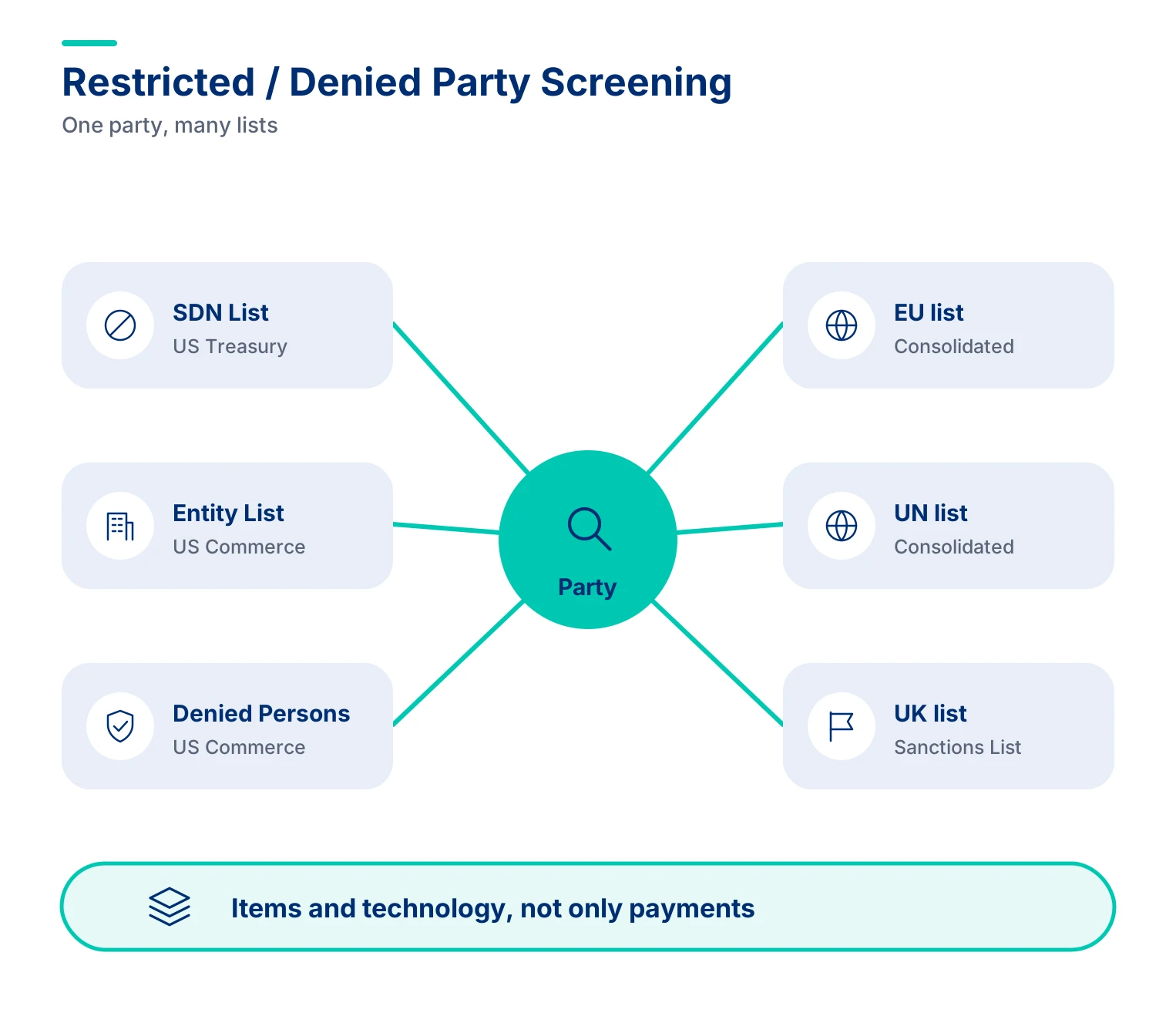
- Select the Lists. Trade compliance picks lists by where the company operates and ships. U.S. companies often start with the Consolidated Screening List, and others add EU, UN and UK lists.
- Screen at Onboarding and Before Shipment. Run names and addresses at supplier setup, then again before a shipment or a transfer of technical data. Fuzzy matching helps with transliterated names.
- Review and Verify Matches. Compare each hit with the official list entry. The screening tool is an aid. A match calls for further due diligence, and the source agency’s list is the reference.
- Decide, License and Record. Compliance decides whether to stop, seek a license or proceed, and documents the reason. The effect of a match can be a prohibition, a license requirement or a question about end use.
- Rescreen on a Cycle. Lists change, so rescreen the supplier base and open transactions regularly and when supplier details change.
CORE COMPONENTS
Government lists come from several agencies and bodies. A consolidated search tool lets users query many lists at once. Party data includes names, aliases, addresses and countries. Screening rules set match thresholds and the lists in use. Transaction context covers the item, the destination and the end use, which decide whether a match matters. Records show who reviewed each hit and what was decided.
KEY BENEFITS
Screening prevents shipments and technology transfers to restricted parties, and it supports export compliance programs. Catching a listed party at onboarding is far cheaper than finding it after goods have shipped.
A single process also saves effort. One workflow can cover sanctions, export control and debarment lists, with shared records, instead of separate checks by finance, logistics and legal. Strong supplier risk management practice depends on this kind of shared view.
COMMON PITFALLS
- Using only a sanctions list. Export control lists, such as the BIS Entity List, can restrict transactions that sanctions lists do not cover.
- Screening the supplier but not the shipment chain. Consignees, forwarders and end users can be listed even when the supplier is clean.
- Treating a tool’s result as final. The U.S. Consolidated Screening List notes that users should verify against the agencies’ official lists before acting.
- Ignoring address and alias data. Listings often rest on addresses and alternate names, so poor supplier data weakens screening.
WHERE RESTRICTED PARTY LISTS COME FROM AND WHAT THEY SIGNAL
Verify current scope on each issuer’s site before relying on this summary. Lists and rules change.
| List | Issuer | What a match generally signals |
| SDN List | U.S. Treasury (OFAC) | Blocked party, dealings generally prohibited for U.S. persons |
| Entity List | U.S. Commerce (BIS) | License requirements for covered items sent to the listed party. Ownership rules may extend this to majority-owned affiliates, so check current status |
| Denied Persons List | U.S. Commerce (BIS) | Party denied export privileges for items under U.S. export rules |
| Unverified List | U.S. Commerce (BIS) | BIS could not verify the party. No license exceptions, and a statement is needed |
| EU consolidated list | European Union | Party subject to EU financial sanctions |
| UN Consolidated List | UN Security Council | Party subject to Security Council measures |
| UK Sanctions List | UK government | UK designations. It replaced the separate OFSI list in January 2026 |
KPIs
| Dimension | Sample KPIs |
| Coverage | Share of suppliers and logistics partners screened; shipments released without screening |
| Alert quality | False-positive rate; hits cleared with a recorded reason |
| Timeliness | Time to review a hit; open hits past the service level |
| Data | Records with complete address and alias data; days since last list refresh |
KEY TERMS
- Consolidated Screening List. A U.S. government search tool that combines several agencies’ restricted party lists.
- Entity List. A BIS list of parties subject to specific license requirements for covered items.
- Denied Persons List. A BIS list of parties denied export privileges.
- End User. The party that ultimately uses the item or technology.
- Consignee. The party that receives a shipment.
- Export License. Government authorization to export an item or share technology.
- Debarment. Exclusion of a party from certain government contracts or activities.
- Fuzzy Matching. Matching that finds near spellings, not only exact ones.
FAQS
1. What is restricted or denied party screening in procurement?
Restricted party screening, also called denied party screening, is the process of checking suppliers, customers, and trading partners against government lists of individuals or organizations subject to trade restrictions. These include export control, sanctions, and debarment lists. Procurement teams use screening to identify prohibited transactions, potential licensing requirements, and compliance risks before engaging suppliers, shipping goods, or transferring sensitive technology.
2. What is the difference between restricted party screening and sanctions screening?
Restricted party screening covers a broader range of trade restrictions, including export controls, denied export privileges, sanctions, and debarment. Sanctions screening focuses primarily on identifying parties subject to financial restrictions, asset freezes, or prohibited dealings. For example, a supplier may appear on the U.S. BIS Entity List without being subject to comprehensive financial sanctions. Both processes help organizations avoid unauthorized transactions and maintain regulatory compliance.
3. Which government lists are used for restricted party screening?
Common restricted party screening lists include the U.S. Treasury’s OFAC Specially Designated Nationals (SDN) List, the BIS Entity List, Denied Persons List, and Unverified List. Organizations may also screen against EU, UN, and UK sanctions lists. The U.S. Consolidated Screening List combines multiple government lists into one searchable resource. Procurement teams should select applicable lists based on transaction locations, trading partners, products, and regulatory jurisdictions.
4. How does restricted party screening work during supplier onboarding?
During supplier onboarding, procurement teams collect supplier names, addresses, aliases, ownership information, and other identifying details. These records are screened against applicable government restricted party lists using exact or fuzzy matching. Potential matches are reviewed against official records to confirm identity and determine applicable restrictions. Suppliers with unresolved compliance concerns should undergo additional due diligence before approval. Screening results and decisions should be documented for audit purposes.
5. Does a match on a restricted party list always mean a supplier is prohibited?
No, a restricted party screening match does not automatically mean a supplier is prohibited. A potential match may be a false positive or indicate restrictions requiring further investigation. Depending on the relevant list, transactions may be prohibited, require an export license, or involve additional end-use verification. Compliance teams should confirm the supplier’s identity, review official government records, and determine the applicable restrictions before authorizing transactions.
6. Do companies need to screen international suppliers and shipping intermediaries?
Yes, companies may need to screen international suppliers, freight forwarders, distributors, consignees, and end users, depending on applicable trade regulations. Restricted party obligations can extend beyond direct supplier relationships to other participants in a transaction. For example, an approved supplier may use a restricted freight forwarder or ship controlled technology to a prohibited end user. Screening relevant transaction parties helps procurement teams identify hidden compliance risks before shipment.
7. How often should restricted party screening be performed, and can software automate it?
Restricted party screening should occur during supplier onboarding, before relevant shipments or technology transfers, and whenever supplier information changes. Organizations should also rescreen existing suppliers periodically because government lists are updated. Automated screening software can monitor list changes, identify potential matches using fuzzy matching, and generate compliance alerts. However, qualified reviewers must investigate flagged results and document decisions before restricted transactions proceed.









