



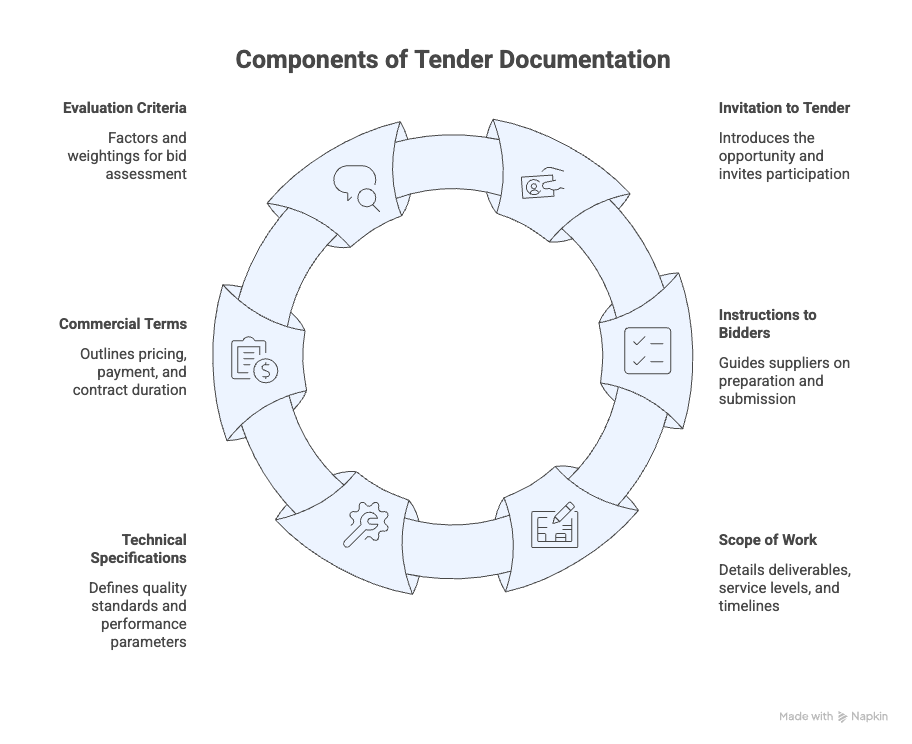
Tender documentation is the formal package of documents issued by a buying organization to invite suppliers to submit bids for a contract. Also known as bid documentation, it includes the invitation to tender, scope of work, technical specifications, commercial terms, evaluation criteria, and submission instructions. Tender documents define exactly what is being procured, how responses should be structured, and how the winning bidder will be selected, forming the foundation for a fair and transparent competitive process.
Read more: Mastering Open Tendering: A Comprehensive Guide to Public Procurement Success
Why Tender Documentation Matters in Procurement
The quality of tender documentation directly impacts the quality of bids received. Ambiguous specifications produce inconsistent proposals that are difficult to compare. Missing evaluation criteria leave suppliers guessing about what matters most. Incomplete terms create contract disputes later. Well-crafted bid documentation ensures suppliers understand requirements, respond consistently, and compete on a level playing field. For public sector procurement, comprehensive tender documents are also a legal requirement for transparency and fairness.
The Core Process of Tender Documentation
The process begins with requirements gathering. Procurement works with stakeholders to document what is being purchased — technical specifications, service levels, delivery requirements, and any mandatory qualifications suppliers must meet.
The tender package is assembled. This includes the invitation letter, instructions to bidders, specification documents, pricing templates, draft contract terms, and evaluation criteria with weightings.
Documentation is reviewed for completeness and clarity. Legal, technical, and commercial stakeholders verify that requirements are accurate, terms are appropriate, and nothing critical is missing.
The tender is published and distributed to potential suppliers. A defined period allows bidders to review documents, ask clarifying questions, and prepare their submissions according to the specified format and deadline.
Key Benefits of Tender Documentation
- Ensures all suppliers receive identical information, creating a fair and competitive bidding environment.
- Produces comparable responses by specifying exactly how bids should be structured and what must be included.
- Reduces post-award disputes by documenting requirements and terms clearly before contract execution.
- Supports defensible selection decisions through transparent evaluation criteria communicated upfront.
- Improves bid quality by giving suppliers clear guidance on what is expected and how they will be judged.
- Meets regulatory requirements for public procurement transparency and equal treatment of bidders.
Common Pitfalls of Tender Documentation
- Vague specifications. Ambiguous requirements produce inconsistent bids. Be specific about what you need and how you will measure it.
- Hidden evaluation criteria. If the criteria are not disclosed, suppliers cannot optimize their responses, and selection appears arbitrary.
- Overly complex documents. Excessive length discourages participation and buries critical information. Keep documents focused.
- Insufficient response time. Rushed timelines yield low-quality bids. Allow adequate time for thoughtful, complete responses.
Essential Elements of Complete Bid Documentation
- Clear scope definition: Exactly what is being purchased, with boundaries clearly stated to avoid scope disputes.
- Technical requirements: Specifications detailed enough for suppliers to propose solutions and price accurately.
- Pricing template: Standardized format ensuring all bids present costs comparably for fair evaluation.
- Evaluation methodology: Criteria, weightings, and scoring approach disclosed so suppliers know what matters most.
- Submission requirements: Format, deadline, delivery method, and required documents clearly specified.
- Draft contract terms: Proposed contractual terms so bidders can factor legal and commercial conditions into their response.
- Q&A process: Defined channel and timeline for bidders to ask questions and receive clarifications.
KPIs of Tender Documentation
| Dimension | Sample KPIs |
| Participation | Number of bids received, bid response rate, supplier participation diversity |
| Quality | Compliant bid rate, clarification questions per tender, bid disqualification rate |
| Efficiency | Tender preparation time, evaluation cycle time, time to award |
| Outcomes | Post-award disputes, contract amendment rate, supplier satisfaction with process |
Key Terms in Tender Documentation
- Tender: A formal offer or bid submitted by a supplier in response to an invitation to participate in a competitive process.
- Invitation to Tender (ITT): The formal document inviting suppliers to submit bids for a defined requirement.
- Scope of Work (SOW): The detailed description of deliverables, activities, and performance expectations for the contract.
- Bid Bond: A financial guarantee that the bidder will honor their proposal if selected.
- Prebid Conference: A meeting where potential bidders can ask questions and receive clarifications about tender requirements.
- Compliant Bid: A submission that meets all mandatory requirements specified in the tender documentation.
Technology Enablement
Modern Source-to-Pay platforms provide tender management capabilities including document templates, online distribution, secure bid submission portals, automated compliance checking, and collaborative evaluation tools. These features streamline the tender process while maintaining transparency and audit trails.
FAQs
Q1. What is tender documentation?
The formal package of documents issued to invite and guide supplier bids, including specifications, terms, and evaluation criteria.
Q2. What is the difference between a tender and an RFP?
Tender is common in public sector and formal contexts; RFP is typical in private sector. Both solicit competitive proposals.
Q3. Who prepares tender documentation?
Procurement leads the process with input from technical, legal, and business stakeholders who define requirements.
Q4. How long should suppliers have to respond?Typically 2–6 weeks depending on complexity, with more time for complex technical or high-value procurements.
Q5. Can tender documents be changed after issue?
Yes, through formal addenda distributed to all bidders with extended deadlines if changes are significant.
Q6. What happens if a bid is non-compliant?
It may be disqualified or, for minor issues, the bidder may be asked to clarify. Major non-compliance typically means rejection.
References
For further insights into these processes, explore Zycus’ dedicated resources related to Tender Documentation:
- The Changing Role Dynamics of a CPO!
- The Imperative of Responsible Sourcing for Sustainable Business
- Transforming Financial Workflows: Generative AI in Order to Cash and Procure to Pay
- Procurement AI: Bridging the gap between promise to realization
- Scripting S2P Success: Mastering Procurement Success Strategies