


What is encumbrance accounting?
Encumbrance accounting is a method of reserving budget when a purchase is committed, not when it is paid. When a purchase order is issued, the amount is set aside, so the budget shows what has been spent and what is already promised.
Why it matters in procurement?
Budgets that track only payments overstate what is available. A PO issued today may not be invoiced for weeks, so the money looks free when it is already committed. Teams then overspend without knowing. Finance sees the problem only when invoices arrive, and by then the commitment cannot be undone.
Encumbrance accounting closes that gap. It is standard in public sector, grant and fund accounting, where overspending a budget can breach rules, and it is useful in any organization that wants early control of commitments. It also gives procurement a say before the money is committed, not after.
The core process / lifecycle
- Budget Setup. Finance loads the approved budget by department, project or fund. This is the starting amount available to commit. Funds are often split by period, so each commitment lands in the right year.
- Pre-Encumbrance. Some systems reserve the estimated cost at requisition. The amount is held tentatively while the purchase awaits approval.
- Encumbrance. When the PO is approved, the reservation becomes a firm encumbrance at the PO value. Available budget drops by that amount.
- Receipt and Invoice. When goods are received and invoiced, the encumbrance is released and the actual cost is recorded as an expenditure. Available budget does not change in the swap.
- Adjustment. If the invoice differs from the PO, the difference is adjusted. Cancelled or reduced POs release their encumbrance back to the budget. Finance reviews variances so the encumbrance always reflects the latest expected cost.
- Year-End Treatment. Open encumbrances are reviewed. Depending on policy, they lapse or carry over into the next period to cover goods still to arrive.
Core components
The budget is the approved amount. Encumbrances are open commitments from POs and contracts not yet paid. Expenditures are costs actually incurred. The available balance is budget minus expenditures minus encumbrances, and funds checking tests each requisition against it. A control rule can block commitments that would exceed it. Reports show the three numbers side by side for every cost center.
Key benefits
Encumbrance accounting gives up-to-date visibility of available budget. It prevents overspending because commitments count before invoices arrive. It improves forecasts, since open POs show future cash needs. It supports compliance where spending limits are legally binding. It shows budget owners the true effect of each approval, which changes how they plan. Cancelled orders free budget immediately. And it reduces year-end surprises from invoices for work ordered months earlier.
Common pitfalls
- Leaving stale encumbrances open. Cancelled or completed POs that are never closed lock up budget that could be used.
- Encumbering at the wrong value. A PO raised at an estimate, not the agreed price, makes the available budget inaccurate.
- Ignoring contracts and blanket orders. Commitments outside the PO flow are missed, and the budget looks healthier than it is.
- Mixing up encumbrance and expense. An encumbrance is a commitment, not a cost. Reporting it as expense overstates spending.
How available budget changes at each stage?
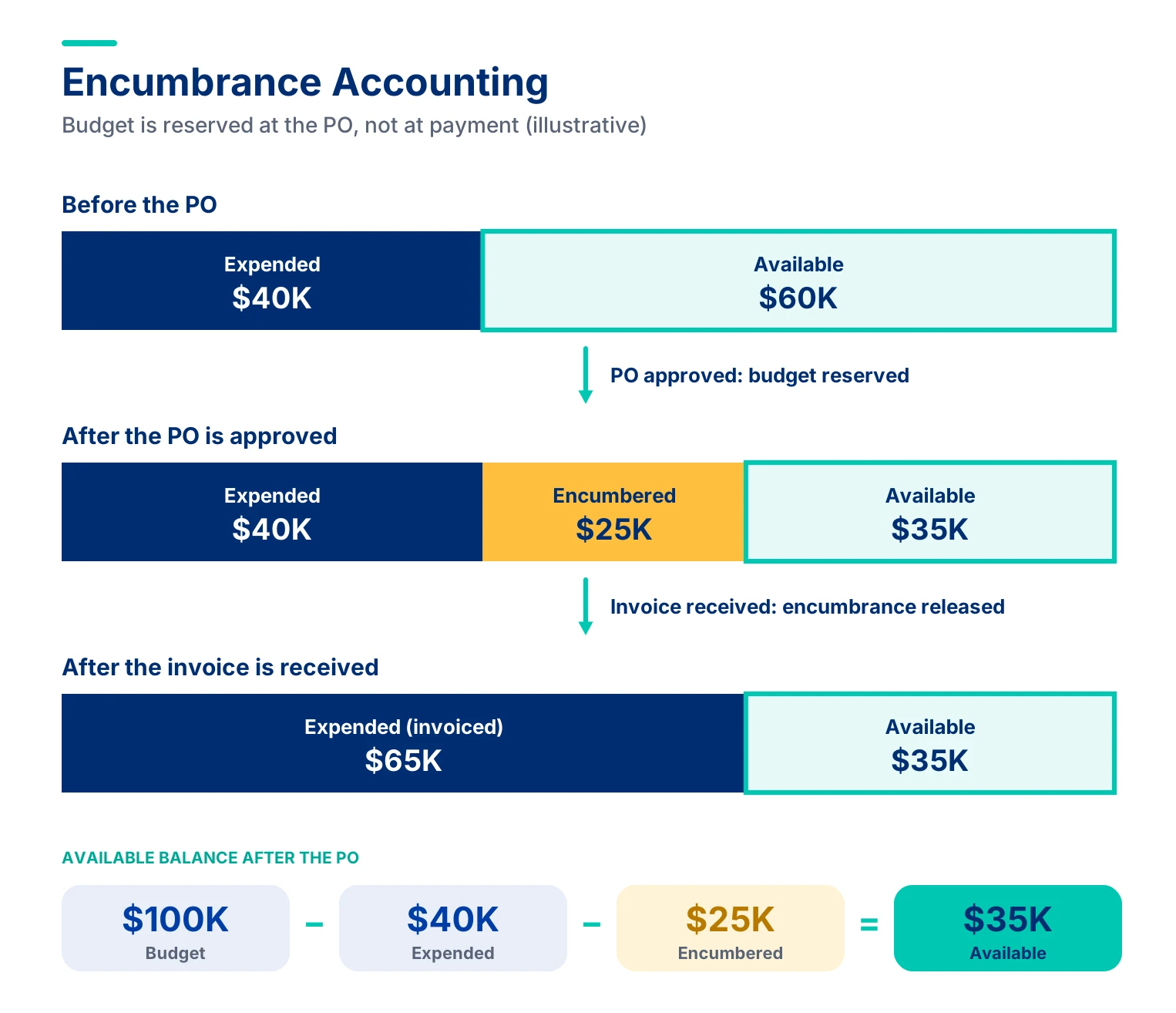
Available balance = Budget − Expenditures − Encumbrances. The example below is illustrative, with a $100,000 budget.
- Starting position. Budget of $100,000 with $40,000 already spent leaves $60,000 available.
- PO approved for $25,000. The amount is encumbered. Available budget falls to $35,000, even though no money has left.
- Invoice received for $25,000. The encumbrance is released and the cost becomes an expenditure. Spent rises to $65,000 and available budget stays at $35,000.
- PO cancelled instead. The encumbrance is released and available budget returns to $60,000.
KPIs
| Dimension | Sample KPIs |
| Budget | Available balance; encumbered share of budget |
| Hygiene | Stale encumbrances; encumbrances older than 90 days |
| Control | Commitments blocked by funds checking; overrides |
| Accuracy | PO value versus invoice variance; year-end carryover amount |
Key terms
- Encumbrance. A reservation of budget for a purchase that has been ordered but not yet paid. It is usually not an expense or a liability under US GAAP, and governmental funds report it within fund balance.
- Pre-Encumbrance. A tentative reservation made when a requisition is raised, before PO approval.
- Expenditure. A cost that has been incurred and recorded against the budget.
- Available Balance. Budget minus expenditures and encumbrances.
- Funds Checking. A system test that confirms enough budget exists before a commitment is approved.
- Fund Accounting. An accounting approach, common in government and nonprofits, that tracks money by restricted purpose.
- Carryover. Moving an open encumbrance into the next period.
FAQS
Q1. What is encumbrance accounting?
It is a method of reserving budget for purchases at the commitment stage, usually when the PO is approved.
Q2. What is an encumbrance?
A reserved amount for a PO or contract that has been committed but not yet invoiced or paid.
Q3. How is an encumbrance different from an expense?
An encumbrance is a commitment to spend. An expense is a cost already incurred.
Q4. When is an encumbrance released?
When the invoice is recorded, or when the PO is cancelled or reduced.
Q5. Who uses encumbrance accounting?
Public sector bodies, nonprofits and grant-funded programs most often, plus companies that want tight budget control.
Q6. How does it differ from budget management?
Budget management covers planning, approval and tracking of budgets overall. Encumbrance accounting is the specific method of reserving budget at the PO stage.
Q7. What happens to encumbrances at year end?
Policy decides. Some lapse, and others carry over so the budget covers goods still to arrive.