



WHAT IS A PROCUREMENT CENTER OF EXCELLENCE?
A procurement center of excellence (CoE) is a central team that holds specialist procurement expertise, standards, tools and methods, and shares them with the rest of the organization. It sets how procurement is done and supports the teams that do it, rather than running every purchase itself.
WHY IT MATTERS IN PROCUREMENT
In larger organizations, procurement skills are spread across business units and regions. Each team builds its own templates, uses its own methods and buys separately. A CoE brings the best practice together, so a new buyer can use proven sourcing playbooks, contract templates and analytics, instead of starting from scratch.
A CoE is not the same as the procurement team. The team carries out sourcing and buying, while the CoE builds the methods, trains people and supports complex projects. It also differs from an enterprise procurement function, which is the full organization. The CoE is often one part of it, and its design depends on the operating model, which may be centralized, federated or hybrid.
THE CORE PROCESS / LIFECYCLE
- Define the Mandate. Leadership agrees what the CoE is responsible for, which services it offers, how it is funded, for example by central budget or chargeback, and how it differs from category teams and regional buyers.
- Set the Operating Model. The CoE chooses its structure, roles, funding and governance, and how it works with category managers and business stakeholders.
- Build Standards and Playbooks. The team writes sourcing methods, contract templates, policies and decision guides that others can reuse.
- Provide Expertise and Support. Specialists support complex sourcing events, negotiations and analysis, and train category and regional teams.
- Enable Tools and Data. The CoE selects and manages procurement systems, data standards and reporting so teams work from one view.
- Measure and Improve. The CoE tracks adoption and results, gathers feedback and updates its methods.
CORE COMPONENTS
- Mandate and governance state what the CoE owns and who decides.
- Methods and playbooks define how sourcing, contracting and supplier management are done.
- Specialist expertise covers areas such as strategic sourcing, analytics, risk and contract negotiation.
- Technology and data provide the common systems and reporting.
- Capability building includes training, mentoring and communities of practice.
- Performance management measures how well the CoE serves the organization.
KEY BENEFITS
A CoE raises the quality and consistency of procurement. Standard methods and templates reduce effort, shorten sourcing cycles and cut contract risk. Specialists can be shared across projects, which is more efficient than keeping rare skills in every unit.
It also speeds learning. Lessons from one sourcing event feed into the playbook for the next, and shared data gives a clearer view of spend and savings.
COMMON PITFALLS
- Becoming a bottleneck. If every decision must pass through the CoE, business teams slow down and bypass it.
- Writing playbooks that nobody uses. Methods that ignore how buyers work are not adopted, so the CoE needs user input and clear support.
- Unclear mandate. Overlap with category teams and regional buyers causes conflict about who decides.
- No measures of value. Without adoption and results data, the CoE is hard to justify at budget time.
TYPICAL COE SERVICE CATALOG
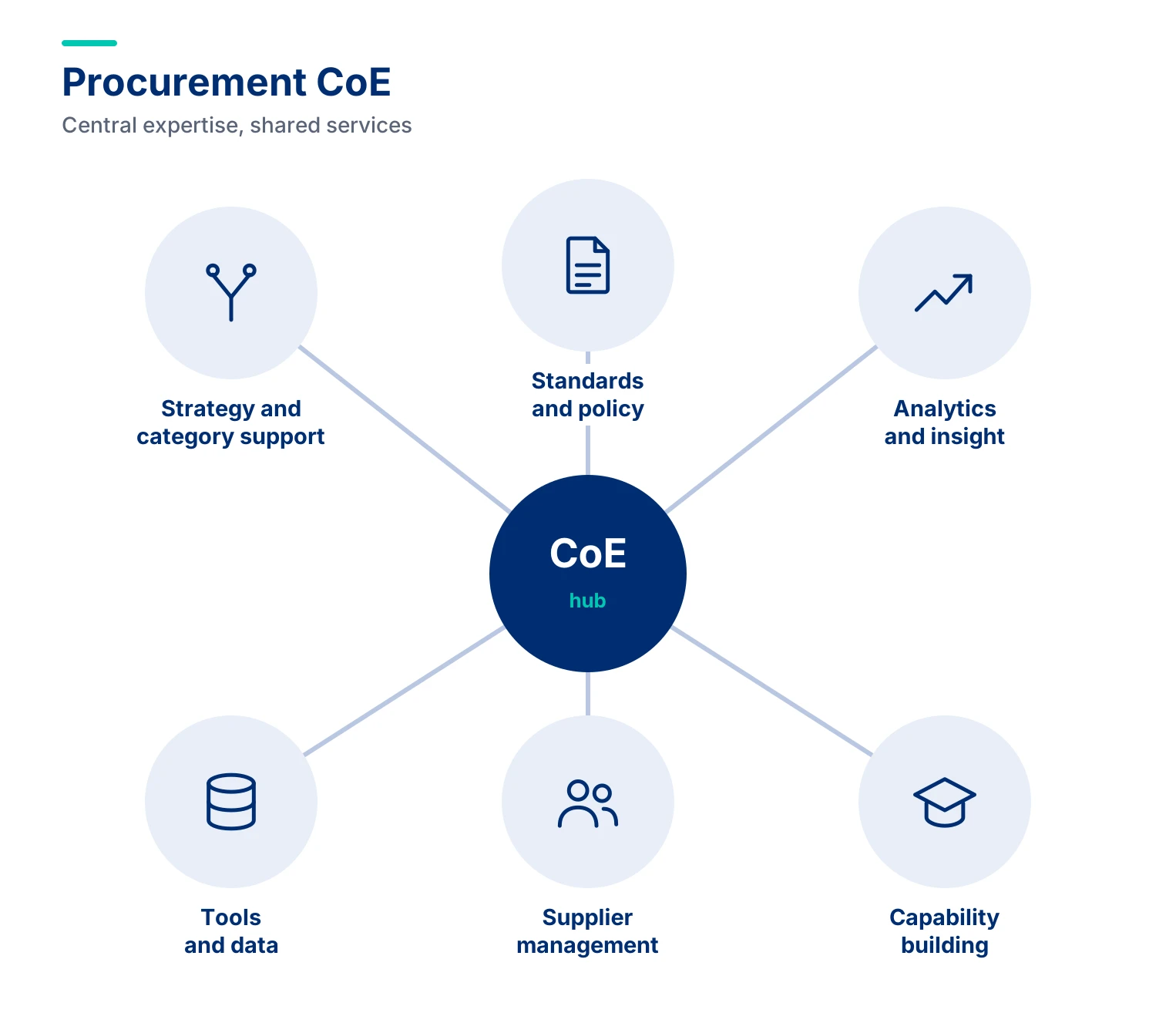
CoEs differ by organization, but most offer a similar range of services to category teams and business units.
| Service | Examples |
| Strategy and category support | Category strategies, sourcing playbooks, complex negotiations |
| Standards and policy | Procurement policy, contract templates, approval rules |
| Analytics and insight | Spend analysis, savings tracking, market intelligence |
| Tools and data | Procurement platform ownership, data standards, reporting |
| Supplier management | Supplier segmentation, performance and risk frameworks |
| Capability building | Training, certification, communities of practice |
KPIs
| Dimension | Sample KPIs |
| Adoption | Teams using standard playbooks and templates; share of spend following policy |
| Value | Savings supported by CoE projects; cycle time of supported events |
| Service | Requests handled on time; stakeholder satisfaction |
| Capability | Buyers trained or certified; skills gaps closed |
KEY TERMS
- Operating Model. The way procurement is organized, such as centralized, federated or hybrid.
- Centralized Procurement. A model in which one central team carries out most sourcing.
- Federated Procurement. A model in which units buy locally within shared central rules.
- Sourcing Playbook. A guide that describes how to run a sourcing process.
- Category Manager. A role that owns the strategy and results for a group of related purchases.
- Community of Practice. A group that shares knowledge across teams on a common topic.
- Shared Services. Central teams that provide standard support to several units.
- Governance. The decision rights and oversight rules that guide a function.
FAQs
1. What is a Procurement Center of Excellence (CoE)?
A Procurement Center of Excellence (CoE) is a centralized team that establishes procurement best practices, standardizes processes, and provides specialized expertise across an organization. It supports sourcing strategies, contract management, supplier relationships, analytics, and technology adoption. Rather than managing every purchase directly, a procurement CoE equips regional and business procurement teams with standardized tools, policies, and frameworks to improve efficiency, reduce costs, and strengthen procurement performance.
2. What is the difference between a Procurement CoE and a traditional procurement team?
A traditional procurement team manages daily purchasing activities, supplier negotiations, sourcing events, and purchase orders. A Procurement Center of Excellence focuses on developing standardized processes, providing specialist expertise, improving procurement technology, and building organizational capabilities. While procurement teams execute purchasing operations, the CoE establishes best practices and governance frameworks that improve consistency across departments. Both functions work together to strengthen sourcing efficiency, supplier management, and procurement outcomes.
3. What are the key functions of a Procurement Center of Excellence?
A Procurement Center of Excellence typically manages six key functions: strategic sourcing support, procurement policies and standards, spend analytics, procurement technology, supplier management frameworks, and employee capability development. It creates reusable sourcing playbooks, contract templates, performance dashboards, and training programs. These centralized resources help procurement teams improve decision-making, standardize supplier evaluations, accelerate sourcing activities, and maintain consistent purchasing practices across business units.
4. How do you establish a successful Procurement Center of Excellence?
Establishing a Procurement Center of Excellence begins with defining its objectives, governance structure, funding, and responsibilities. Organizations should identify procurement capability gaps, appoint specialists, develop standardized sourcing frameworks, and implement shared technology and analytics tools. The CoE must also establish collaboration processes with regional procurement teams and business stakeholders. Tracking adoption, sourcing efficiency, stakeholder satisfaction, and measurable savings helps demonstrate value and support continuous improvement.
5. How does a Procurement CoE support centralized and decentralized procurement models?
A Procurement Center of Excellence supports centralized, decentralized, and hybrid procurement models by providing shared standards, expertise, and governance. In centralized organizations, it strengthens common sourcing processes and analytics. In decentralized or federated structures, it helps regional teams maintain consistent policies while retaining local purchasing flexibility. This approach enables organizations to combine enterprise-wide procurement visibility with business-specific sourcing requirements, improving coordination without creating unnecessary approval bottlenecks.
6. When should an organization establish a Procurement Center of Excellence?
Organizations should consider establishing a Procurement Center of Excellence when procurement activities are distributed across multiple regions or business units, processes lack consistency, or specialized expertise is difficult to access. A CoE becomes particularly valuable when companies need stronger spend visibility, standardized supplier management, improved technology adoption, or better sourcing capabilities. Centralizing procurement knowledge and governance helps reduce duplicated efforts and enables more consistent purchasing decisions.
7. How do you measure the success of a Procurement Center of Excellence?
Procurement CoE performance can be measured using KPIs covering process adoption, cost savings, sourcing efficiency, service quality, and employee capabilities. Common metrics include percentage of spend following procurement policies, adoption of standardized sourcing playbooks, sourcing cycle time, savings from supported projects, and stakeholder satisfaction. Organizations should also track procurement professionals trained, service requests resolved on time, and capability improvements to evaluate the CoE’s overall effectiveness.