



eForms are digital versions of structured data collection forms used within procurement and business processes to capture, validate, and route information electronically. They replace paper-based or unstructured email-driven requests with standardized, system-integrated templates that collect required data fields, enforce completion rules, and automatically trigger downstream workflows. In procurement, eForms are most commonly used for purchase requisitions, supplier registration, expense claims, contract requests, and approval submissions.
Why eForms Matter in Procurement
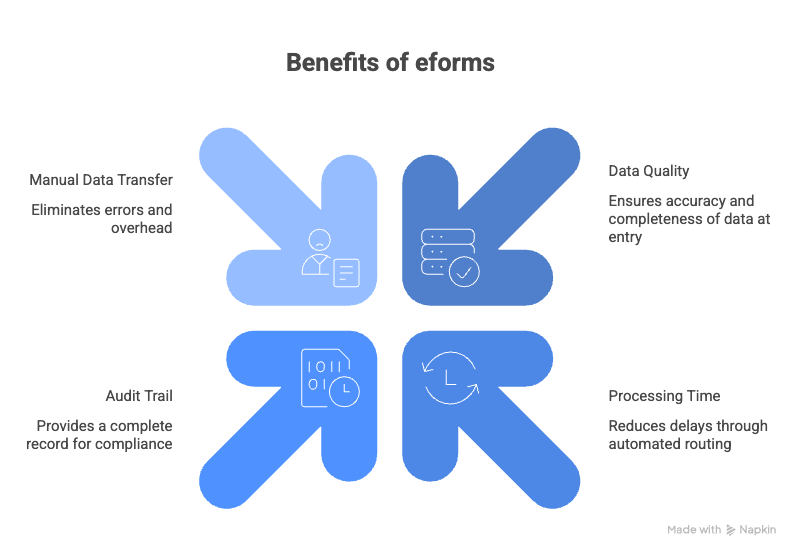
Procurement processes that depend on unstructured requests — emails, phone calls, or paper forms — create data quality problems and process delays from the outset. Information arrives incomplete, inconsistent, or in formats that cannot feed downstream systems without manual rekeying. eForms solve this by capturing structured, validated data at the point of entry, ensuring that every request contains the fields that procurement needs to act on it accurately. They also create the audit trail and workflow triggers that manual processes cannot reliably provide.
The Core Process of eForms
- Form Design and Configuration: eForms are designed by procurement or systems teams to capture the specific data required for each request type. Fields are configured as mandatory or optional, with validation rules that prevent submission of incomplete or incorrect data. Logic rules can show or hide fields based on earlier inputs — for example, displaying supplier bank details only when a new payee is selected.
- Submission and Validation: When a user submits a form, the system validates all required fields and applies any business rules — such as confirming that the requested amount does not exceed the user’s approved budget. Errors are flagged immediately, requiring correction before the form is accepted. Validated submissions are timestamped and recorded.
- Workflow Routing: Approved submissions are automatically routed to the next step in the process — a manager approval, a procurement review, a supplier onboarding check, or a contract creation workflow. Routing rules are configured in advance and applied consistently without manual coordination.
- Completion and Integration: Once all workflow steps are completed, the eForm data integrates into downstream systems — ERP, supplier master, contract repository — eliminating manual data transfer and ensuring consistent records across the procurement technology environment.
Core Components of eForms
- Field configuration determines what data the form captures, in what format, and under what conditions. Well-designed field configuration is the difference between a form that produces clean, usable data and one that generates the same inconsistencies as the paper process it replaced.
- Validation rules enforce data quality at the point of entry. Required field checks, format validation, value range limits, and cross-field logic prevent incomplete or incorrect submissions from entering the workflow.
- Conditional logic adapts the form’s structure based on user inputs, presenting only the fields relevant to the specific request type, category, or supplier scenario — improving user experience and reducing unnecessary data collection.
- System integration connects eForm outputs to downstream procurement systems, enabling automatic record creation, workflow initiation, and data population without manual rekeying.
Common Pitfalls of eForms
- Designing forms that are too long or complex: eForms that replicate every field from a legacy paper process without reviewing what is actually necessary drive low adoption and workarounds. Form length should be minimized to what procurement genuinely needs to act.
- Insufficient validation rules: Forms that allow submission of incomplete or incorrectly formatted data defeat the purpose of digital capture. Validation must be designed to catch the most common data quality failures at the point of entry.
- Poor system integration: An eForm that submits data into a PDF or email rather than directly into a procurement or ERP system still requires manual rekeying downstream. Integration is what converts an eForm from a digital paper form into a process automation tool.
Common Procurement eForms and What They Should Capture
- Purchase Requisition: Requested item or service, quantity, estimated cost, cost center, required delivery date, business justification, and preferred supplier if applicable.
- Supplier Registration: Company legal name, registration number, address, bank details, tax information, certifications, insurance documents, and compliance declarations.
- Contract Request: Contract type, counterparty, scope summary, estimated value, start and end dates, required terms, and approval authority.
- Spend Exception Request: The nature of the exception, the reason standard process cannot be followed, the value and supplier involved, and the approving authority.
KPIs of eForms
| Dimension | Sample KPIs |
| Adoption | % of procurement requests submitted via eForm vs. unstructured channels |
| Data Quality | % of submissions passing validation on first attempt, error rate by form type |
| Process Efficiency | Average time from submission to workflow completion, manual rework rate |
| Integration Health | % of eForm submissions auto-integrated to downstream systems |
Key Terms in eForms
- Conditional Logic: A form design feature that shows or hides fields based on user inputs, reducing form complexity and irrelevant data collection.
- Validation Rule: A system check applied to form fields at the point of submission to enforce data completeness and accuracy.
- Workflow Routing: The automatic assignment of a submitted form to the appropriate next step — an approver or downstream team — based on predefined rules.
- System Integration: The connection between eForm outputs and downstream procurement or financial systems enabling automatic data transfer without rekeying.
Technology Enablement
Source-to-Pay platforms include configurable eForm builders that allow procurement teams to design, deploy, and modify forms without technical development. Integration with ERP, supplier management, and contract systems ensures that eForm data flows automatically into the correct records, eliminating the rekeying that undermines data quality in less integrated environments.
Read the success story: Australia’s Trusted Water Utility Built 252 Custom eForms on Zycus P2P
FAQs
Q1. What are eForms in procurement?
Digital, structured data collection tools that replace paper or email-based requests, capturing validated information and triggering automated workflows.
Q2. How are eForms different from standard online forms?
Procurement eForms are integrated into procurement systems and trigger downstream workflows. Standard online forms typically only collect data without connecting to operational processes.
Q3. What procurement processes benefit most from eForms?
Purchase requisitions, supplier registration, contract requests, and spend exception approvals see the greatest benefit due to their high frequency and data sensitivity.
Q4. Can eForms replace a procurement system?
No. eForms capture and route data but require integration with a procurement or ERP platform to process requests, manage approvals, and record transactions.
Q5. How should eForms be maintained over time?
Reviewed annually and updated whenever procurement policy, system integrations, or approval structures change. Outdated forms generate data that no longer matches downstream system requirements.
Q6. What is the difference between an eForm and a workflow?
An eForm captures the data; a workflow processes it. eForm submission typically initiates a workflow that routes, approves, and actions the request.
References
For further insights into these processes, explore Zycus’ dedicated resources related to eForms:










