



Business travel reimbursement is the process through which an organization compensates employees for expenses incurred during authorized business travel. It covers costs such as transportation, accommodation, meals, and incidentals paid by the employee on behalf of the organization. Reimbursement operates within a defined expense policy that sets entitlements, approval requirements, and submission procedures — balancing the organization’s need for cost control and compliance with the employee’s expectation of timely, fair compensation.
Why Business Travel Reimbursement Matters in Procurement
Travel and expense is one of the most difficult-to-control indirect spend categories. Expenses are incurred by individual employees across thousands of transactions and submitted after the fact — unlike direct procurement which flows through defined channels. Procurement’s role is to design the policy framework, negotiate preferred supplier arrangements, and ensure expense management systems provide the visibility needed to monitor compliance and identify savings.
The Core Process of Business Travel Reimbursement
- Policy Design and Communication: Procurement and HR or finance collaborate to define the expense policy — what is reimbursable, at what limits, and under what conditions. Policy must be specific enough to prevent abuse but flexible enough to accommodate legitimate business needs. Effective communication ensures that employees understand entitlements before travel occurs.
- Travel Booking and Pre-Authorization: Where pre-authorization is required, employees obtain approval before committing to travel spend. Preferred booking channels — corporate travel management companies, negotiated hotel rates, or approved car rental agreements — are used to capture contracted pricing and provide spend data.
- Expense Submission: After travel, employees submit claims with supporting receipts through the expense management system. System controls check claims against policy limits, flag missing receipts, and route submissions to line managers for approval.
- Approval and Reimbursement: Line managers review and approve claims within defined authority levels. Approved claims are processed for payment through payroll or AP. Exception reports identify non-compliant claims for further review.
Core Components of Business Travel Reimbursement
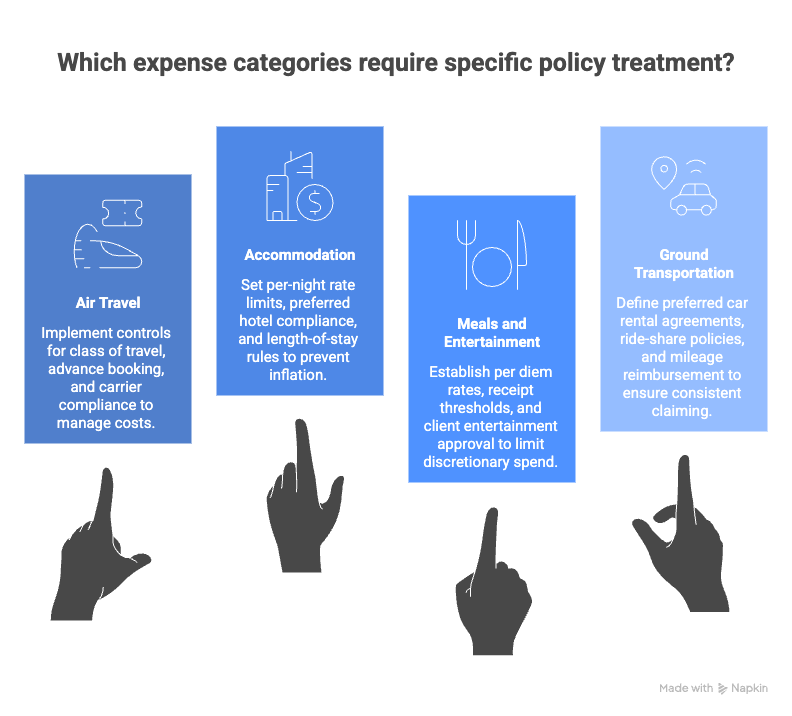
- Expense policy defines the rules of reimbursement — eligible categories, per diem rates, class of travel entitlements, receipt requirements, and the approval hierarchy for different spend levels. Policy clarity directly determines compliance rates and reduces the volume of claims requiring manual adjudication.
- Preferred supplier programme ensures that employees use negotiated rates for flights, hotels, and car hire rather than booking independently at market rates. Compliance with preferred suppliers directly affects the unit cost of travel spend.
- Expense management system automates submission, policy checking, approval routing, and payment processing. Systems that integrate receipt capture, policy validation, and approval workflows reduce the administrative burden on employees and managers while improving compliance visibility.
- Audit and compliance controls identify fraudulent, duplicate, or policy-non-compliant claims through automated checking and periodic manual audit. They protect the organization from financial loss and ensure that the expense policy is enforced consistently.
Key Benefits of Business Travel Reimbursement
- Controls indirect travel spend through policy limits, preferred supplier compliance, and pre-authorization requirements.
- Improves employee experience by ensuring timely, accurate reimbursement with clear policy guidance and minimal manual process.
- Provides spend visibility across the travel category, enabling procurement to negotiate preferred rates based on accurate volume data.
- Reduces fraud and policy abuse through systematic receipt validation, duplicate checking, and audit controls.
Common Pitfalls of Business Travel Reimbursement
- Unclear or inconsistent expense policy: Policies with ambiguous rules generate high volumes of adjudication requests, inconsistent approvals, and employee frustration. Clarity and specificity are prerequisites for effective reimbursement management.
- Low preferred supplier compliance: Negotiated travel rates only deliver value if employees book through approved channels. Low compliance rates undermine the commercial benefit of procurement’s supplier negotiations.
- Slow reimbursement timelines: Employees who wait weeks for reimbursement lose confidence in the process and may book outside policy to maintain control. Cycle time from submission to payment should be a managed performance metric.
- Treating travel expense as HR-only scope: Travel and expense is a significant spend category with strategic sourcing opportunity. Procurement should own the supplier relationships and policy framework, even where HR manages the reimbursement process.
KPIs of Business Travel Reimbursement
| Dimension | Sample KPIs |
| Policy Compliance | % of claims within policy limits, preferred supplier booking compliance rate |
| Process Efficiency | Average claim processing time, touchless claim rate, error and rejection rate |
| Cost Control | Average spend per trip, travel cost as % of revenue or budget |
| Audit Performance | Non-compliant claims identified, fraud incidents detected, recovery rate |
Key Terms in Business Travel Reimbursement
- Per Diem: A daily allowance for meals and incidentals, paid at a fixed rate rather than requiring itemized receipts.
- Travel Management Company (TMC): A corporate travel agency that manages travel bookings under negotiated rates on behalf of the organization.
- Preferred Supplier Programme: Negotiated agreements with airlines, hotels, and car rental companies that employees are expected to use when booking travel.
- Expense Management System: Technology that automates expense submission, receipt capture, policy validation, approval routing, and reimbursement processing.
- Pre-Authorization: A requirement to obtain approval before committing to travel spend, used for high-value trips with material budget impact.
Technology Enablement
Modern expense management platforms automate receipt capture via mobile OCR, apply policy checks at the point of submission, route approvals through configurable workflows, and integrate with payroll and AP for rapid reimbursement. Analytics dashboards provide procurement and finance with real-time visibility into travel spend by category, supplier, and business unit, supporting both policy enforcement and preferred supplier negotiation.
FAQs
Q1. What is business travel reimbursement?
The process through which employees are compensated for authorized business travel expenses incurred on behalf of the organization, within the limits defined by the expense policy.
Q2. What expenses are typically reimbursable?
Transportation, accommodation, meals within per diem limits, business communication costs, and incidentals incurred during authorized travel — subject to receipt requirements and policy limits.
Q3. What is the role of procurement in travel reimbursement?
Procurement designs the policy framework, negotiates preferred supplier agreements, selects the expense management system, and monitors compliance across the travel spend portfolio.
Q4. How should per diem rates be set?
By reference to published government or industry benchmarks for each city or country, reviewed annually to reflect cost-of-living changes.
Q5. How quickly should expense claims be reimbursed?
Best practice is within five to seven business days of approval. Longer timelines reduce policy confidence and push employees toward workarounds.
Q6. Can expense claims be submitted without receipts?
For amounts below a defined threshold or covered by per diem, receipt-free submission is common. Above threshold, receipts are required and their absence should trigger rejection.
References
For further insights into these processes, explore the following Zycus resources related to Business Travel Reimbursement:










