



A direct materials budget is a financial plan that estimates the quantity and cost of raw materials and components needed for production over a specific period. Direct spend budgeting translates production forecasts into material requirements and purchasing plans, ensuring that manufacturers have the inputs needed to meet demand while controlling inventory investment and cash flow. The direct materials budget is a critical input to both operational planning and financial forecasting.
Read more: Procurement Budget Management Guide: Strategies & Benefits
Why Direct Materials Budget Matters in Procurement
For manufacturing organizations, direct materials often represent 50–70% of product cost. The direct materials budget connects production planning to procurement execution, giving buyers visibility into future requirements. Without this budget, procurement operates reactively, rushing to secure materials as production needs arise. With a well-developed direct spend budget, procurement can negotiate better pricing, secure capacity commitments, and optimize inventory levels. It transforms purchasing from order-taking to strategic supply planning.
The Core Process of Direct Materials Budget
The process begins with production forecasting. Sales and operations planning provides expected output volumes by product and period. These volumes drive the quantity of materials required.
Bill of materials data translates finished goods volumes into component and raw material requirements. Each unit of production requires specific inputs, which are multiplied by production volumes to determine total material needs.
Current inventory and target inventory levels are factored in. The budget calculates purchases required by subtracting beginning inventory and adding desired ending inventory to production requirements.
Pricing assumptions are applied to quantity requirements. Procurement provides expected unit costs based on contracts, market conditions, and supplier negotiations, converting material quantities into dollar budgets.
Download Whitepaper: Smarter Way to Modernize Direct Procurement in Manufacturing
Core Components of Direct Materials Budget
Production Forecast: Expected output volumes by product and period that drive material requirements calculations.
Bill of Materials: The structured list of components and quantities required to produce each finished good.
Inventory Assumptions:. Beginning inventory levels, target ending inventory, and safety stock requirements that affect purchase volumes.
Material Pricing: Expected unit costs for each material based on contracts, market indices, and procurement forecasts.
Purchase Schedule: The timing of material purchases aligned with production schedules and supplier lead times.
Key Benefits of Direct Materials Budget
- Aligns procurement activities with production requirements, ensuring materials are available when manufacturing needs them.
- Enables proactive supplier engagement through early visibility into future volume requirements and capacity needs.
- Supports cash flow planning by forecasting material expenditures across the budget period with reasonable accuracy.
- Identifies cost reduction opportunities by highlighting high-spend materials that warrant strategic sourcing focus.
- Improves inventory management by balancing production needs against carrying costs and working capital constraints.
- Facilitates supplier negotiations by providing volume commitments that support better pricing and capacity agreements.
Inputs Required for Direct Materials Budgeting
- Sales forecast: Expected unit sales by product and period from sales and marketing.
- Production plan: Planned output volumes accounting for finished goods inventory targets.
- Bill of materials: Current, accurate component lists for each product from engineering.
- Inventory data: Current raw material inventory levels and target safety stock from operations.
- Supplier pricing: Contracted prices, market forecasts, and expected cost changes from procurement.
- Lead time data: Supplier lead times that determine when orders must be placed.
KPIs of Direct Materials Budget
| Dimension | Sample KPIs |
| Accuracy | Budget variance percentage, forecast accuracy, price variance to budget |
| Cost | Direct materials as percentage of COGS, cost per unit produced |
| Inventory | Raw material turns, days of inventory on hand, stockout incidents |
| Efficiency | Material yield, scrap rate, purchase price variance |
Key Terms in Direct Materials Budget
Direct Materials: Raw materials and components that become part of the finished product sold to customers.
Bill of Materials (BOM): A structured list of all components required to manufacture a product with quantities.
Material Requirements Planning (MRP): A system that calculates material needs based on production schedules and inventory.
Purchase Price Variance: The difference between budgeted and actual prices paid for materials.
Usage Variance: The difference between budgeted and actual quantities of materials consumed.
Safety Stock: Extra inventory held to buffer against demand variability or supply uncertainty.
Technology Enablement
Modern Source-to-Pay platforms integrate with ERP and MRP systems to provide visibility into material requirements and spending. This integration enables procurement to connect sourcing activities to production plans and track budget performance against actual material costs.
Explore Zycus’ Procurement Budget Management Software
FAQs
Q1. What is a direct materials budget?
A financial plan that estimates the quantity and cost of raw materials and components needed for production over a specific period.
Q2. How is it different from an indirect spend budget?
Direct materials become part of the finished product sold to customers. Indirect spend covers goods and services that support operations but are not incorporated into products.
Q3. Who creates the direct materials budget?
Typically a collaboration between procurement, finance, operations planning, and production management teams.
Q4. How often should the budget be updated?
Monthly or quarterly at minimum, with more frequent updates if demand patterns or material prices are volatile.
Q5. What causes direct materials budget variances?
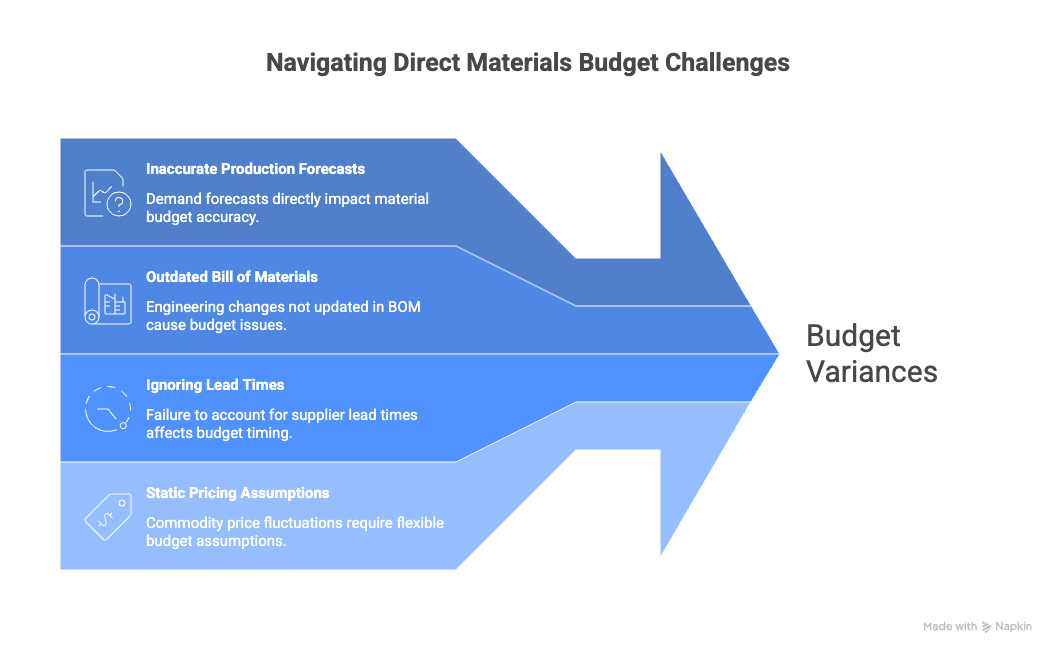
Production volume changes, material price fluctuations, yield or scrap issues, or engineering changes not reflected in the bill of materials.
Q6. How does procurement use the direct materials budget?
To plan sourcing activities, negotiate supplier volume agreements, secure capacity commitments, and manage inventory investments.










