Financial supply chain management (FSCM) refers to the set of processes, tools, and strategies that optimize the flow of financial transactions between buyers and suppliers across the procurement and payment cycle. It encompasses how invoices are processed, how payment terms are structured, how working capital is managed, and how financing instruments such as supply chain finance and dynamic discounting are deployed. FSCM connects procurement decisions to their financial outcomes throughout the source-to-pay process.
Why Financial Supply Chain Management Matters in Procurement
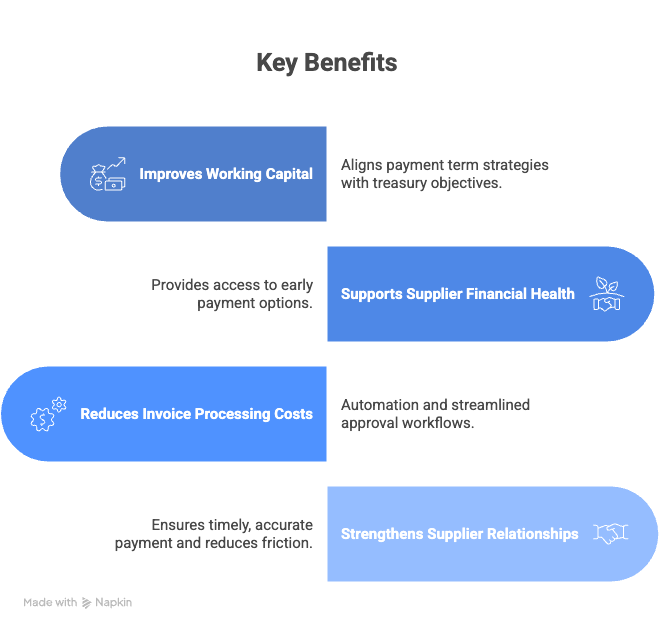
Procurement decisions have direct financial consequences. Payment terms affect cash flow; invoice processing efficiency affects AP costs and supplier experience. Procurement teams that understand financial supply chain dynamics negotiate more effectively, support supplier financial health, and contribute to liquidity goals. As supply chain finance programmes become more common, procurement acts as the bridge between supplier relationships and treasury objectives.
Read more: Optimizing Supplier Operations With Strategic Supply Chain Management and Supplier Collaboration
The Core Process of Financial Supply Chain Management
The process begins at the point of purchase order creation. Commercial terms established in the contract — payment terms, invoicing requirements, and discount provisions — define the financial parameters of the transaction. Procurement sets these terms during negotiation, making them a direct input into the financial supply chain.
When delivery is confirmed, the supplier submits an invoice that moves through receipt, validation, three-way match, and approval before posting to the accounts payable ledger. Speed and accuracy at this stage determine when payment is made and whether early payment discount opportunities can be captured. Where supply chain finance or dynamic discounting programmes are in place, approved invoices become eligible for early payment at a discount, giving suppliers liquidity access before the standard due date.
Post-payment, reconciliation confirms that payments match outstanding invoices and financial data flows back into reporting systems. Procurement uses this data to monitor payment term compliance, track discount capture rates, and assess supplier financial health over time.
Core Components of Financial Supply Chain Management
Payment terms management is the commercial foundation of FSCM. Terms negotiated by procurement determine how much working capital the organization retains and should reflect financial goals, supplier risk profile, and category market norms. Invoice processing efficiency directly affects both financial outcomes and supplier experience — delays create payment uncertainty, damage relationships, and reduce the viability of early payment programmes. Supply chain finance programmes allow suppliers to receive early payment on approved invoices funded by a third-party institution at a rate linked to the buyer’s credit, reducing supplier financing costs without accelerating the buyer’s cash outflow. Working capital optimization balances treasury’s interest in extended terms with suppliers’ need for earlier payment, supporting supply chain stability.
Read more: Procurement vs. Supply Chain: Key Differences and How They Work Together
Common Pitfalls of Financial Supply Chain Management
- Extending payment terms without assessing supplier impact: Unilaterally lengthening payment terms to improve working capital can destabilize smaller suppliers, increasing supply risk in the process.
- Operating supply chain finance without supplier adoption: A programme that only a fraction of eligible suppliers join delivers limited value. Procurement must actively communicate and onboard suppliers to maximize participation.
- Treating invoice processing as purely an AP function: Invoice bottlenecks often originate in procurement, such as late purchase order creation, goods receipt delays, or approval chain gaps. FSCM requires cross-functional ownership.
- Ignoring the cost of capturing discounts: Early payment discount programmes have a cost. The annualized rate of a discount should be compared against the organization’s cost of capital before systematically accepting all discounts offered.
Financial Supply Chain Instruments Procurement Should Understand
- Dynamic discounting: A buyer-funded programme that allows suppliers to request early payment on approved invoices in exchange for a discount, with the buyer deploying excess cash to earn a return.
- Supply chain finance (reverse factoring): A funder-supported programme where a financial institution pays the supplier early at a rate based on the buyer’s credit, and the buyer repays the funder on the original due date.
- Payment term extension with offsetting support: When buyers extend payment terms, offering access to a supply chain finance programme preserves the supplier’s liquidity while the buyer gains working capital.
KPIs of Financial Supply Chain Management
| Dimension | Sample KPIs |
| Working Capital | Days Payable Outstanding (DPO), payment term compliance rate |
| Invoice Efficiency | Invoice processing cycle time, touchless invoice rate, exception rate |
| Programme Performance | SCF supplier enrolment rate, early payment discount capture rate |
| Financial Accuracy | Payment error rate, duplicate payment incidents |
Key Terms of Financial Supply Chain Management
- Days Payable Outstanding (DPO): A measure of how long an organization takes to pay its suppliers, calculated as accounts payable divided by daily cost of goods sold.
- Supply Chain Finance (SCF): A set of financing solutions that optimize cash flow by allowing buyers and suppliers to access flexible payment terms supported by a financial institution.
- Dynamic Discounting: A buyer-funded early payment programme in which suppliers can request accelerated payment on approved invoices in exchange for a pricing discount.
- Working Capital: The difference between current assets and current liabilities, representing the liquidity available to fund day-to-day operations.
- Touchless Invoice: An invoice that is received, validated, matched, and approved without manual intervention, processed entirely through automated workflows.
- Three-Way Match: The control process that verifies alignment between purchase order, goods receipt, and supplier invoice before payment is approved.
- Reverse Factoring: Another term for supply chain finance; a third party pays the supplier early based on the buyer’s credit, and the buyer repays the funder at the original payment due date.
Technology Enablement
Integrated Source-to-Pay platforms connect procurement, accounts payable, and treasury functions, providing end-to-end visibility into the financial supply chain. Supply chain finance modules, dynamic discounting tools, and automated invoice processing capabilities within these platforms enable organizations to optimize working capital while maintaining strong supplier payment experiences.
FAQs
Q1. What is financial supply chain management? FSCM is the optimization of financial flows between buyers and suppliers across the procurement and payment cycle, encompassing payment terms, invoice processing, and financing instruments.
Q2. How does FSCM differ from accounts payable management? AP management focuses on processing and paying invoices. FSCM is broader, encompassing payment term strategy, working capital optimization, and supplier financing programmes.
Q3. What is the difference between supply chain finance and dynamic discounting? SCF uses a third-party funder to pay suppliers early based on the buyer’s credit. Dynamic discounting uses the buyer’s own cash to fund early payment in exchange for a discount.
Q4. How can procurement contribute to FSCM goals? By negotiating payment terms strategically, ensuring timely purchase order creation, facilitating supplier onboarding to finance programmes, and monitoring payment term compliance.
Q5. Does extending payment terms always benefit the buyer? Not necessarily. Extended terms improve DPO but can increase supplier risk and result in higher prices if suppliers factor in the cost of later payment.
Q6. How does FSCM support supply chain resilience? By improving supplier financial health through access to early payment options, FSCM reduces the risk of supplier insolvency or capacity reduction caused by cash flow pressure.
References
For further insights into these processes, explore Zycus’ dedicated resources related to Financial Supply Chain Management: