



Risk analysis in procurement is the systematic process of identifying, assessing, and prioritizing risks that could affect the organization’s ability to source goods and services, manage supplier relationships, or fulfill contractual obligations. It examines the likelihood of adverse events and their potential financial, operational, reputational, or compliance impact — producing a structured view of risk that supports sourcing decisions, contract design, supplier management, and business continuity planning.
Why Risk Analysis Matters in Procurement
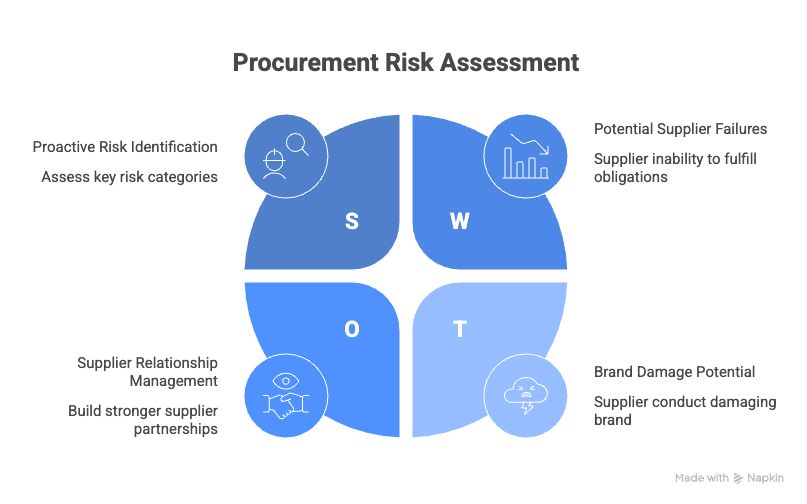
Every procurement decision carries risk. Choosing a supplier, structuring a contract, setting inventory levels, or concentrating spend all create exposures that, if not assessed, can materialize as supply disruptions, cost overruns, compliance failures, or reputational damage. Risk analysis converts these exposures from unknowns into managed, prioritized items that procurement can actively address. Organizations that embed risk analysis into procurement decisions consistently achieve better outcomes than those that treat risk as something to respond to after it occurs.
Read more: Best Tools for Supply Chain Risk Assessment in 2026
The Core Process of Risk Analysis
- Risk Identification: The process begins by systematically identifying the risks present in a category, supplier relationship, contract, or sourcing decision. Risk identification draws on spend data, market intelligence, supplier financial information, regulatory requirements, and historical incident records. The goal is to surface all material risks before they are assessed — gaps at this stage cannot be corrected later in the process.
- Risk Assessment: Each identified risk is assessed on two dimensions: likelihood — how probable is the risk event — and impact — what would the financial, operational, or reputational consequence be if it occurred. Combining these dimensions produces a risk rating that enables prioritization. High-likelihood, high-impact risks require immediate mitigation; low-likelihood, low-impact risks can be accepted or monitored.
- Risk Prioritization and Response Planning: Risks are ranked by their combined rating and assigned to one of four response strategies: avoid the risk by changing the sourcing approach; mitigate the risk by reducing likelihood or impact; transfer the risk through contract terms or insurance; or accept the risk where mitigation cost exceeds expected loss. Response plans are documented with owners and timelines.
- Monitoring and Review: Risk profiles are not static. Supplier financial health changes, markets shift, and regulatory requirements evolve. Risk registers must be reviewed regularly and updated when conditions change. Monitoring may be automated through supplier risk feeds or manual through periodic category reviews.
Core Components of Risk Analysis
- A risk register is a structured record of all identified risks, their assessment ratings, assigned owners, response strategies, and current status. It is the operational tool through which risk analysis findings are maintained and actioned.
- Likelihood and impact scoring provide a consistent framework for comparing risks across categories and suppliers. Scoring scales should be defined and applied uniformly — inconsistent scoring makes prioritization unreliable.
- Risk categorization groups risks by type — supply, financial, compliance, reputational, operational — enabling procurement to apply category-specific expertise and response strategies rather than treating all risks as equivalent.
- Risk response ownership assigns each risk to a named individual responsible for implementing the response plan and reporting on status. Unowned risks are rarely addressed.
Key Benefits of Risk Analysis
- Converts procurement risk from reactive incident management to proactive, structured exposure management.
- Informs sourcing strategy decisions single vs. dual source, contract length, inventory levels with structured risk evidence rather than assumptions.
- Supports contract design by identifying risks that should be addressed through indemnification, performance bonds, or termination rights.
- Creates a documented governance record demonstrating that risks were identified and managed, supporting audit and regulatory compliance.
Common Pitfalls of Risk Analysis
- Performing risk analysis as a compliance exercise rather than a management tool: Risk registers created for audit purposes and never actively maintained provide a false sense of security. Risk analysis must drive action, not just documentation.
- Assessing risk once and treating it as permanent: Risk profiles change continuously. Annual-only reviews miss the dynamic events — supplier financial deterioration, market disruptions, regulatory changes — that shift risk levels between review cycles.
- Focusing only on Tier 1 suppliers: Many significant risks originate at Tier 2 or Tier 3. Risk analysis that stops at direct suppliers misses a substantial portion of the organization’s true exposure.
- Conflating risk identification with risk response: Identifying a risk does not resolve it. Each risk requires a deliberate response decision, an owner, and a timeline. Identification without response planning adds no protection.
KPIs of Risk Analysis
| Dimension | Sample KPIs |
| Risk Coverage | % of strategic spend with completed risk assessments, Tier 2 visibility rate |
| Risk Profile | Distribution of risks by category and severity rating |
| Response Completion | % of high-rated risks with active response plans and named owners |
| Incident Rate | # of risk events materialized vs. identified, response activation time |
Download eBook: Empowering Your Business with Effective Supplier Risk Management Tool Strategies
Key Terms in Risk Analysis
- Risk Register: A structured document recording all identified procurement risks, their assessment ratings, owners, response strategies, and current status.
- Likelihood: The probability that a risk event will occur within a defined time horizon, typically scored on a defined scale.
- Impact: The severity of the consequence if a risk event occurs, assessed across financial, operational, compliance, and reputational dimensions.
- Risk Appetite: The level of risk an organization is willing to accept in pursuit of its objectives, which defines the threshold at which risks require active mitigation.
- Residual Risk: The risk exposure that remains after mitigation measures have been applied.
- Risk Transfer: A response strategy that shifts financial exposure to a third party through contract terms, insurance, or performance bonds.
Technology Enablement
Source-to-Pay platforms support risk analysis through integrated supplier risk monitoring dashboards, automated alerts from financial health and sanctions screening feeds, and risk register tools that track identified exposures and response plan status. Spend analytics modules identify concentration risk patterns, while contract management platforms flag upcoming renewals and contractual risk provisions for review.
FAQs
Q1. What is risk analysis in procurement?
The systematic process of identifying, assessing, and prioritizing risks that could affect sourcing, supplier relationships, or contractual obligations.
Q2. What is a risk register?
A structured record of all identified procurement risks, with likelihood and impact ratings, assigned owners, response strategies, and current status.
Q3. How often should procurement risk assessments be updated?
High-risk categories and strategic suppliers should be reviewed quarterly. Broader supply base assessments are typically annual, with ad-hoc reviews triggered by significant market or supplier events.
Q4. What is the difference between risk identification and risk assessment?
Identification surfaces the risks; assessment evaluates their likelihood and impact to produce a priority ranking that guides response decisions.
Q5. What is residual risk?
The risk that remains after mitigation measures have been implemented. Residual risk must be assessed to determine whether it falls within the organization’s risk appetite.
References
For further insights into these processes, explore Zycus’ dedicated resources related to Risk Analysis:
- AI Contract Risk Analysis with InstaReview: Transform Your Risk Management
- Elevate Your Strategy with Advanced Supplier Risk Analysis
- Strategies for Large and Medium Enterprises: Mastering Source-to-Pay Before It’s Too Late
- P2P Touchless Long tail spend: The New Benchmark for World Class P2P Process Efficiency
- Zycus Solution Demo: Automating Procurement Savings for Maximum Efficiency










