



Addressability of spend refers to the proportion of an organization’s total expenditure that procurement can realistically influence through sourcing strategies, contract management, supplier negotiation, or demand management. Not all spend is equally open to procurement intervention some is locked into long-term agreements, regulated by statutory requirements, or governed by decisions made outside procurement’s control. Understanding addressability allows procurement teams to focus effort where it will generate the most value.
Why Addressability of Spend Matters in Procurement
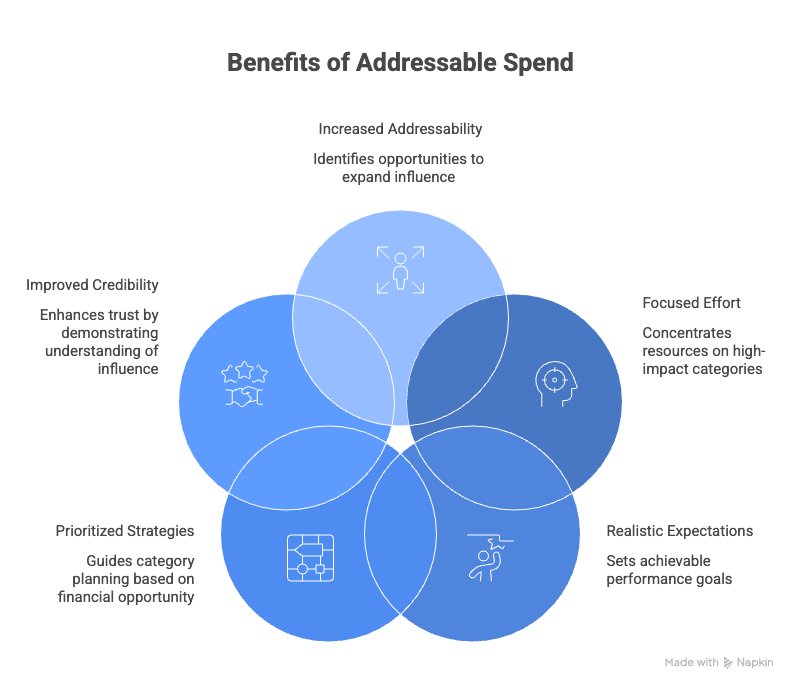
Procurement functions are often evaluated against their total spend base, but the more meaningful measure is how much of that spend they can actually influence. A procurement team working on a $500 million spend base where only $150 million is addressable should be measured on outcomes within that $150 million — not held accountable for the full figure. Addressability analysis sets realistic performance expectations, prioritizes category investment decisions, and focuses savings and compliance initiatives on the spend that is genuinely open to procurement action.
The Core Process of Addressability of Spend
Spend Classification: The process begins by categorizing total organizational spend into addressable and non-addressable buckets. Each spend category is assessed against a set of factors contract status, regulatory constraints, organizational policy, and procurement influence to determine how open it is to intervention.
Addressability Scoring: Each category is assigned an addressability rating reflecting the degree to which procurement can influence it. Fully addressable spend is open to competitive sourcing; partially addressable spend may be renegotiable within constraints; non-addressable spend cannot be changed within the planning period.
Opportunity Sizing: Addressable spend is analyzed to quantify the potential value available from sourcing, renegotiation, or demand management initiatives. This sizing exercise prioritizes where procurement should invest its capacity and expertise.
Portfolio Planning: Addressability findings feed directly into the forward procurement plan, ensuring that category strategies and sourcing events are targeted at spend that can realistically be influenced rather than broadly applied across all expenditure.
Core Components of Addressability of Spend
- Spend categorization maps total expenditure to defined categories and applies consistent criteria to determine addressability across each. Categories with similar profiles — contract status, supplier landscape, regulatory environment — should be treated consistently.
- The addressability criteria framework defines the factors used to classify spend, such as current contract lock-in, regulatory mandates, technical single-source constraints, and organizational policy restrictions. A clear framework prevents subjective or inconsistent classification.
- Opportunity value calculation translates addressable spend into estimated savings or compliance improvement potential, providing the financial basis for prioritizing category work and justifying procurement resource allocation.
- Governance and reporting ensure that addressability assessments are reviewed regularly and updated as contracts expire, regulations change, or organizational priorities shift. Stale addressability data leads to misallocated procurement effort.
Common Pitfalls of Addressability of Spend
- Classifying spend as non-addressable to reduce accountability: Teams under performance pressure sometimes over-classify spend as locked or constrained to shrink the base against which they are measured. Addressability assessments should be independently validated.
- Treating addressability as static: Contracts expire, regulations change, and organizational priorities shift. Addressability must be reassessed regularly — at a minimum annually — to remain accurate.
- Ignoring partially addressable spend: Spend that cannot be fully renegotiated may still offer partial improvement through volume reallocation, specification changes, or demand reduction. Partial addressability should not be treated as zero opportunity.
- Conflating addressability with savings potential: Some highly addressable spend may offer limited savings if the market is already well-priced. Addressability identifies where procurement can act; savings opportunity analysis determines whether acting is worthwhile.
Factors That Determine Whether Spend is Addressable
- Contract status: Spend under active long-term contracts with significant exit costs is less addressable than spend approaching renewal or operating under short-term or rolling arrangements.
- Regulatory constraints: Some categories are governed by statutory pricing, mandated suppliers, or procurement rules that restrict procurement’s ability to source competitively or renegotiate terms.
- Technical single-source dependency: Where only one supplier is technically qualified or certified, addressability is limited until alternative sources can be qualified.
- Organizational decision authority: Spend controlled by senior stakeholders outside procurement’s mandate — such as executive-level supplier relationships or board-approved agreements — may be nominally addressable but practically constrained.
KPIs of Addressability of Spend
| Dimension | Sample KPIs |
| Addressability Coverage | Addressable spend as % of total spend, by category and business unit |
| Opportunity Value | Estimated savings opportunity within addressable spend |
| Portfolio Alignment | % of forward procurement plan targeted at addressable categories |
| Addressability Accuracy | Variance between projected and realized addressability, reassessment frequency |
Key Terms in Addressability of Spend
- Addressable Spend: The portion of total organizational spend that procurement can realistically influence through sourcing, negotiation, or demand management.
- Non-Addressable Spend: Expenditure that cannot be influenced within the planning period due to contract lock-in, regulatory requirements, or organizational constraints.
- Spend Under Management (SUM): The proportion of total spend actively governed through procurement processes — distinct from addressable spend, which is what procurement can theoretically influence.
- Category Opportunity Sizing: The process of estimating the financial value available from procurement intervention within a defined spend category.
- Demand Management: Influencing internal consumption levels or specifications to reduce spend, one lever available where spend is addressable but sourcing options are limited.
Technology Enablement
Spend analytics platforms support addressability assessment by combining spend data with contract status, supplier information, and category metadata to classify expenditure automatically. Category management modules use addressability outputs to prioritize sourcing pipelines and track whether procurement effort is being deployed against spend that can actually be influenced.
FAQs
Q1. What is the addressability of spend?
The proportion of total organizational spend that procurement can realistically influence through sourcing, negotiation, contract management, or demand management.
Q2. Why is addressability different from spend under management?
Spend under management is what procurement currently governs. Addressability is what procurement could theoretically influence — including spend not yet under active management.
Q3. How is addressability assessed?
By evaluating each spend category against factors including contract status, regulatory constraints, technical dependencies, and organizational decision authority.
Q4. What should procurement do with non-addressable spend?
Monitor it for changes in addressability status — contract expiry, regulatory reform, or organizational restructuring — and prepare to act when constraints are lifted.
Q5. How often should addressability assessments be updated?
Annually at minimum, with interim updates triggered by contract renewals, significant regulatory changes, or shifts in organizational strategy.
Q6. Should addressability be reported to senior leadership?
Yes. Reporting addressable spend alongside total spend gives leadership a realistic view of procurement’s influence and sets appropriate performance expectations.
Reference
For further insights into these processes, explore Zycus’ dedicated resources related to Addressability Of Spend:
- Built to Last: Three Paths to a Successful Procurement Transformation – Path 1 – The Greenfield Scenario Contd.
- Procurement’s Transformation: A 11 step Toolkit for Success
- Enhancing Supply Chain Resilience with Predictive Procurement Orchestration
- Pull Out All The Stops: A Cure-all for Chief Procurement Officers
- Enhancing Supply Chain with Digital Procurement: A Strategic Guide










