


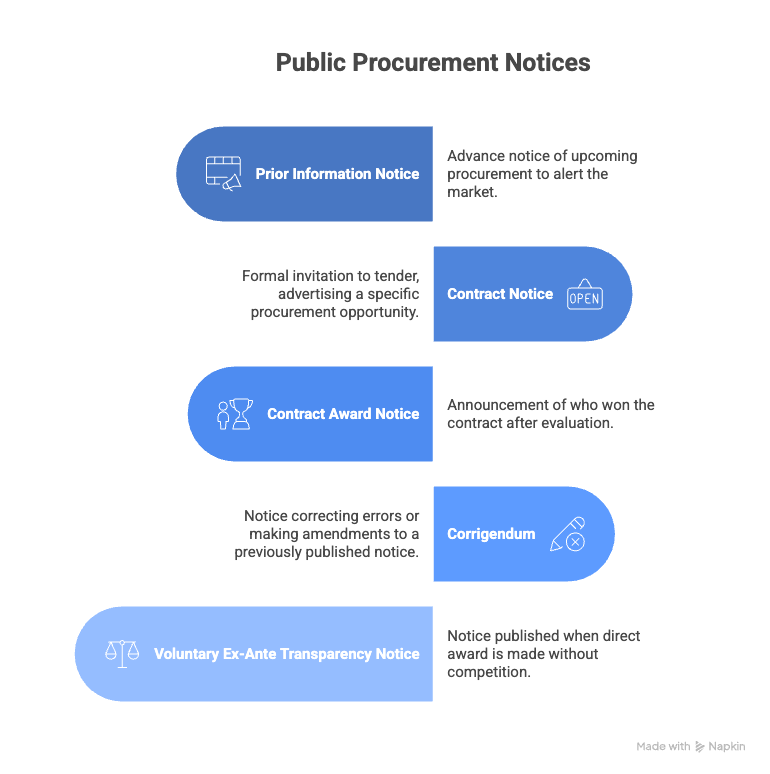
A contract notice is a formal public announcement that a government agency or public sector organization intends to procure goods, services, or works. Public contract notices are published to invite suppliers to participate in competitive bidding processes. Required by procurement regulations in most jurisdictions, these notices ensure transparency, equal access, and fair competition for public contracts. Contract notices typically appear on official government portals and procurement platforms where suppliers can find and respond to opportunities.
Read more: Mastering Open Tendering: A Comprehensive Guide to Public Procurement Success
Why Contract Notice Matters in Procurement
For public sector procurement, contract notices are a legal requirement that ensures taxpayer money is spent through open competition. Publishing notices gives all qualified suppliers an equal opportunity to bid, preventing favoritism and closed-door deals. For suppliers, monitoring contract notices is essential to identifying public sector opportunities. For procurement professionals in government agencies, understanding notice requirements ensures compliance with regulations and avoids challenges to procurement decisions based on inadequate advertisement.
The Core Process of Contract Notice
The process begins when a procurement need is identified and approved. The contracting authority determines that the requirement meets thresholds requiring public advertisement.
The contract notice is drafted containing all required information — description of the requirement, estimated value, submission deadline, evaluation criteria, and contact details. Standard templates ensure completeness.
The notice is published on designated platforms. In the EU, notices above threshold values appear in the Official Journal (TED). In the US, federal opportunities are posted on SAM.gov. Many jurisdictions have regional or local portals as well.
Suppliers review published notices, request clarifications if needed, and prepare their bids. After the submission deadline, the contracting authority evaluates responses and awards the contract, often followed by a contract award notice announcing the result.
Core Components of Contract Notice
- Contracting Authority: The government agency or public body issuing the notice and conducting the procurement.
- Subject of Contract: Clear description of what goods, services, or works are being procured.
- Estimated Value: The anticipated contract value, which determines applicable procurement rules and thresholds.
- Submission Deadline: The date and time by which suppliers must submit their bids or expressions of interest.
- Award Criteria: How bids will be evaluated — lowest price, most economically advantageous tender, or other defined criteria.
- Procedure Type: The procurement procedure being used — open, restricted, negotiated, or competitive dialogue.
Key Benefits of Contract Notice
- Ensures transparency in public spending by openly advertising contract opportunities to all potential suppliers.
- Promotes fair competition by giving equal access to information about procurement requirements and evaluation criteria.
- Achieves better value through competitive bidding from a wider pool of qualified suppliers.
- Demonstrates compliance with procurement regulations and reduces risk of legal challenges to contract awards.
- Creates an auditable record of how procurement opportunities were advertised and made available to the market.
- Supports economic goals by enabling small and diverse businesses to identify and pursue public sector opportunities.
Common Pitfalls of Contract Notice
- Incomplete information: Notices missing key details generate excessive clarification requests. Include all required elements.
- Insufficient response time: Tight deadlines reduce competition. Allow adequate time for quality bid preparation.
- Wrong publication channel: Notices must appear on correct official platforms to meet legal requirements.
- Vague requirements: Ambiguous descriptions produce inconsistent bids. Be specific about what is needed.
KPIs of Contract Notice
| Dimension | Sample KPIs |
| Competition | Number of bids received per notice, supplier response rate, and new bidder participation |
| Compliance | Notice completeness score, publication timeliness, and correction rate |
| Efficiency | Time from approval to publication, clarification requests per notice |
| Outcomes | Challenge rate, successful challenge percentage, and award-to-notice ratio |
Key Terms in Contract Notice
- Contract Notice: Public announcement inviting suppliers to bid on a government procurement opportunity.
- Contracting Authority: The government body or public entity conducting the procurement and issuing the notice.
- TED (Tenders Electronic Daily): The EU’s official journal for publishing public procurement notices above threshold values.
- Threshold: The contract value above which specific procurement rules and publication requirements apply.
- Open Procedure: A procurement method where any interested supplier can submit a bid in response to the notice.
- Standstill Period: Mandatory waiting time between award decision and contract signature allowing challenges.
Technology Enablement
Modern eProcurement platforms automate contract notice creation using templates that ensure completeness and compliance with regulatory requirements. These systems publish notices to required portals, manage supplier questions and clarifications, and maintain audit trails throughout the procurement process from advertisement through award.
FAQs
Q1. What is a contract notice?
A public announcement that a government agency intends to procure goods, services, or works, inviting suppliers to bid.
Q2. Where are contract notices published?
On official government procurement portals such as TED in the EU, SAM.gov in the US, and regional platforms.
Q3. Are contract notices legally required?
Yes, for public procurement above certain value thresholds, advertisement through official notices is mandatory.
Q4. What information must a contract notice contain?
Description of requirements, estimated value, deadline, award criteria, procedure type, and contact details.
Q5. How long must a notice be open for responses?
Minimum periods vary by procedure and jurisdiction — typically 30–52 days for open procedures in the EU.
Q6. What happens after the contract is awarded?
A contract award notice is published announcing the winner, contract value, and other required details.
References
For further insights into these processes, explore Zycus’ dedicated resources related to Contract Notice: