



A category sourcing strategy is a documented plan that defines how an organization will procure a specific category of goods or services over a multi-year horizon. Category procurement strategy goes beyond individual transactions to establish the overall approach — whether to consolidate suppliers or diversify, negotiate long-term contracts or spot buy, partner strategically or maintain arm’s-length relationships. The strategy translates category analysis into actionable decisions about how to optimize value, manage risk, and achieve business objectives for that spend area.
Read more: The Complete Guide to Category Management
Why Category Sourcing Strategy Matters in Procurement
Tactical procurement treats each purchase as an isolated event. Strategic category management recognizes that purchases within a category are connected — the supplier selected for one order affects leverage on the next. A category sourcing strategy provides direction that aligns individual decisions with long-term objectives. Without a strategy, procurement reacts to requests rather than proactively shaping the supply base. With a clear strategy, every sourcing decision moves the category toward defined goals for cost, quality, risk, and innovation.
The Core Process of Category Sourcing Strategy
The process begins with category analysis. Procurement examines spend data, supply market dynamics, internal stakeholder requirements, and business context. This foundation informs strategic options.
Strategic options are identified and evaluated. Choices include supplier consolidation versus diversification, contract length, geographic sourcing, make-versus-buy, and demand management. Each option has trade-offs.
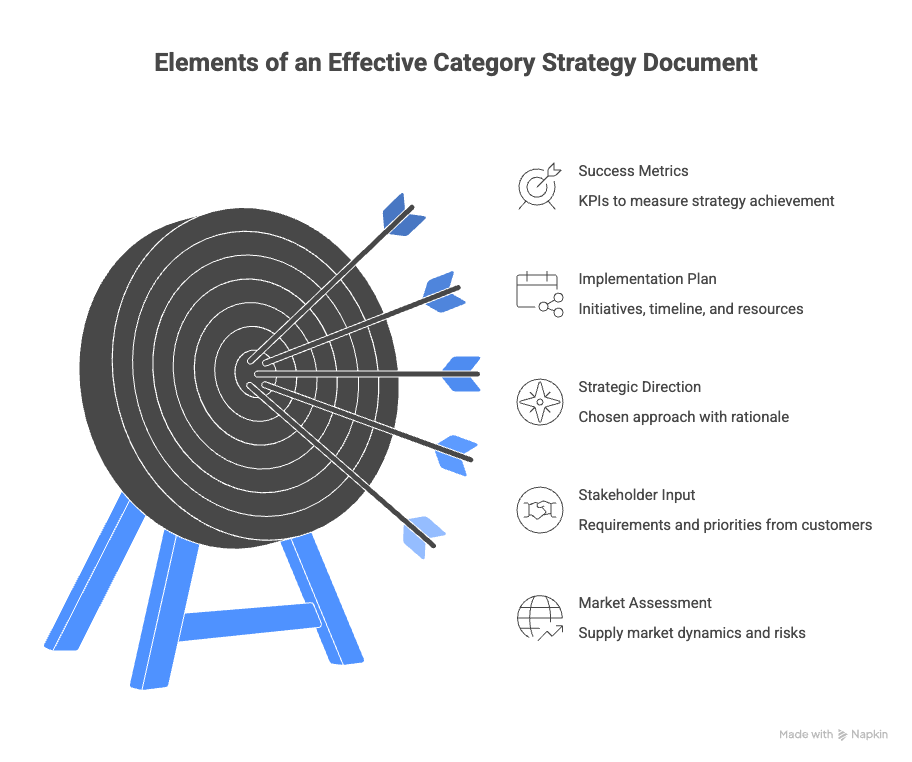
The preferred strategy is selected based on analysis. The strategy document captures the chosen approach, rationale, target outcomes, implementation roadmap, and success metrics.
Strategy is executed through sourcing events, contract negotiations, and supplier management activities. Performance is monitored against targets, and the strategy is refreshed periodically as market conditions and business needs evolve.
Core Components of Category Sourcing Strategy
- Category Profile: Overview of spend, suppliers, contracts, and business context, establishing baseline understanding.
- Market Analysis: Assessment of supply market structure, trends, risks, and opportunities that shape strategic options.
- Stakeholder Requirements: Internal customer needs, preferences, and constraints that the strategy must address.
- Strategic Options: Alternative approaches evaluated against criteria such as cost, risk, quality, and feasibility.
- Implementation Roadmap: Sequenced plan of sourcing activities, milestones, and initiatives to execute the strategy.
- Performance Metrics: KPIs that measure strategy success and track progress toward defined objectives.
Key Benefits of Category Sourcing Strategy
- Aligns procurement activities with business objectives by connecting sourcing decisions to strategic goals.
- Optimizes total category value by considering all levers — price, quality, risk, innovation — holistically.
- Improves negotiating leverage through planned supplier rationalization and volume concentration.
- Reduces supply risk by proactively addressing market vulnerabilities and supplier dependencies.
- Enables stakeholder alignment by documenting agreed direction and decision rationale.
- Provides continuity across personnel changes by capturing institutional knowledge in strategy documents.
Common Pitfalls of Category Sourcing Strategy
- Analysis paralysis: Endless data gathering without decisions. Set time limits and move to action.
- Ignoring stakeholders: Strategies developed without business input fail to gain adoption. Involve stakeholders early.
- Static strategies: Markets change. Review and refresh strategies annually or when conditions shift significantly.
- Disconnected execution: Strategies that sit on shelves accomplish nothing. Link strategy to sourcing plans and measure execution.
KPIs of Category Sourcing Strategy
| Dimension | Sample KPIs |
| Cost | Category savings percentage, cost avoidance, price trend vs. market index |
| Supply Base | Supplier count, consolidation progress, preferred supplier adoption |
| Risk | Single-source exposure, supplier financial health scores, risk mitigation completion |
| Execution | Strategy completion percentage, initiative milestone achievement, stakeholder satisfaction |
Key Terms in Category Sourcing Strategy
- Category Management: The discipline of managing procurement by groups of related goods or services rather than individual transactions.
- Sourcing Strategy: The planned approach for how goods or services in a category will be procured over time.
- Supply Market Analysis: Research into supplier landscape, market dynamics, and trends that inform strategy development.
- Supplier Rationalization: Reducing the number of suppliers to improve leverage and simplify management.
- Strategic Sourcing: A systematic approach to procurement that optimizes value through analysis and structured processes.
- Wave Plan: A sequenced schedule of category sourcing initiatives across the procurement portfolio.
Technology Enablement
Modern Source-to-Pay platforms support category strategy development through spend analytics for baseline assessment, market intelligence tools for supply market research, strategy documentation templates and collaboration features, and dashboards that track execution progress against strategic objectives and KPIs over the strategy horizon.
FAQs
Q1. What is a category sourcing strategy?
A documented plan defining how an organization will procure a specific category of goods or services over a multi-year horizon.
Q2. Who develops category strategies?
Category managers typically lead strategy development, with active input from stakeholders, technical subject matter experts, and procurement leadership.
Q3. How often should strategies be updated?
Annually at minimum, or whenever significant market changes, business shifts, or major contract expirations warrant strategic review.
Q4. What categories need formal strategies?
High-spend, high-risk, or strategically important categories benefit most from formal strategy work. Not every category requires deep analysis.
Q5. How long does strategy development take?
Typically 4–12 weeks depending on category complexity, data availability, and stakeholder engagement requirements.
Q6. What is the difference between strategy and sourcing?
Strategy defines the overall approach and direction. Sourcing executes specific events like RFPs within that established strategic framework.
References
For further insights into these processes, explore the following Zycus resources related to Category Sourcing Strategy:










