WHAT IS A TAX RESIDENCY CERTIFICATE (TRC) FOR SUPPLIERS?
A tax residency certificate (TRC) is a document issued by a tax authority that confirms a supplier is resident in that country for tax purposes. Buyers collect it from overseas suppliers to support a claim for reduced or nil withholding tax under a double tax treaty.
WHY IT MATTERS IN PROCUREMENT
When a company pays certain amounts to a supplier abroad, such as royalties, interest or fees for services, local law may require it to withhold tax at a standard rate. A tax treaty can lower that rate, but the payer usually needs proof of where the supplier is resident.
Without that proof, the payer often has to withhold at the higher domestic rate, and the supplier then has to claim a refund. Rules differ by country and by type of payment, so confirm the current requirements with tax counsel. Not legal or tax advice.
THE CORE PROCESS / LIFECYCLE
- Flag In-Scope Payments. Tax and procurement agree which cross-border payment types may attract withholding. Royalties, interest and some services are common candidates, but treatment varies.
- Request the Certificate. The request goes out at onboarding or before the first payment, not after the invoice arrives. The supplier must apply to its own tax authority, which takes time.
- Review the Document. A reviewer checks the issuer, the supplier name, the country, the period covered and any local format or translation requirement before accepting it.
- Apply the Treaty Position. Tax applies the treaty rate or exemption if the rules are met, and records the basis. If the document is missing or fails review, the domestic rate applies.
- Store and Refresh. The certificate is linked to the supplier record with its validity period. A reminder prompts the supplier for a new one before it lapses.
CORE COMPONENTS
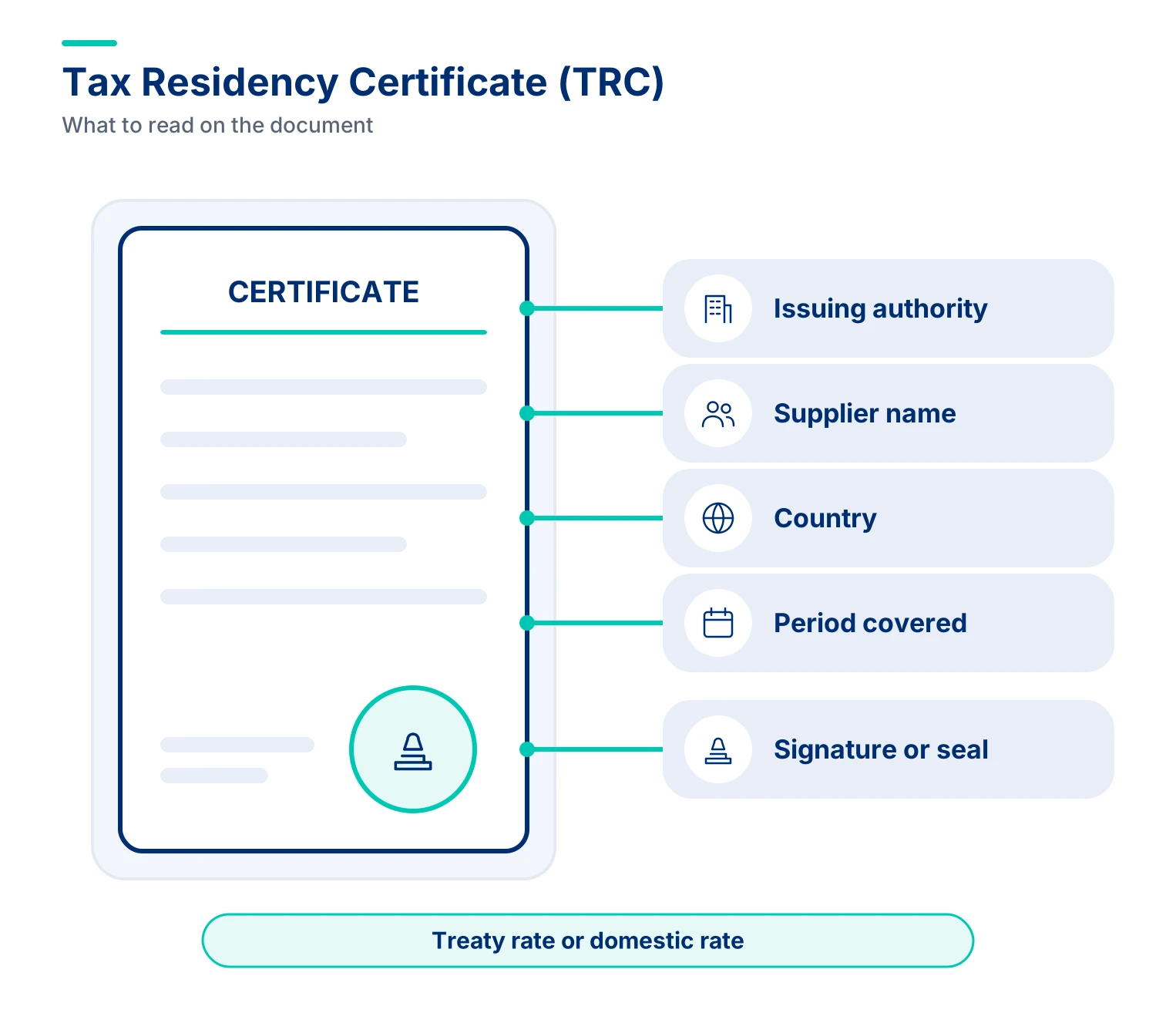
The issuing authority is the tax office of the supplier’s country of residence. In the United States, for example, the IRS issues Form 6166, and in the United Kingdom HMRC issues a certificate of residence. The supplier identity includes the legal name and, usually, a tax identification number. The period covered states the years or dates for which residence is certified. The signature or seal shows the document is official.
KEY BENEFITS
Collecting certificates up front lets the payer apply the right rate at source. That avoids over-withholding that suppliers must reclaim later, and it avoids under-withholding that the payer may have to correct with penalties and interest.
A tidy file also helps in tax audits, because the team can show what it relied on and when. Linking the certificate to supplier master records means AP does not chase it again at every payment. Connecting that record to invoice processing lets the right rate be applied consistently.
COMMON PITFALLS
- Asking after the invoice arrives. A certificate can take weeks to obtain, so late requests lead to withholding at the standard rate and later refund claims.
- Accepting a certificate for the wrong entity. A parent company or a branch in another country may hold the certificate, while the contracting entity does not.
- Ignoring the period. An expired or out-of-period certificate may not support the treaty position for the payment date.
- Treating the certificate as the whole claim. Some countries ask for further forms or declarations, such as ownership of the income. The certificate is one input.
CHECKS TO RUN ON EVERY CERTIFICATE YOU RECEIVE
Local rules may add steps, so tax should own the final version.
- Issuer. Confirm the document comes from the tax authority of the supplier’s country, not from the supplier’s accountant or bank.
- Name match. The name must match the contracting entity on the purchase order and invoice, including legal form.
- Country. The country of residence should be the one whose treaty with your country you plan to rely on.
- Period. The dates should cover the payment date.
- Format and language. Check any local requirement for originals, certified copies or translations before filing the document.
- Other declarations. Ask tax whether a statement on beneficial ownership of the income or a form with extra details is also needed.
KPIs
| Dimension | Sample KPIs |
| Coverage | Share of in-scope overseas suppliers with a valid certificate on file; suppliers with an expired certificate |
| Timeliness | Days from request to receipt; certificates received before first payment |
| Accuracy | Certificates rejected at review; payments made at the wrong withholding rate |
| Cost | Refund claims raised by suppliers; penalties or interest from withholding corrections |
KEY TERMS
- Withholding Tax. Tax a payer deducts from a payment and pays to the tax authority on the recipient’s behalf.
- Double Tax Treaty. An agreement between two countries that allocates taxing rights and can reduce withholding rates.
- Tax Residence. A person’s tax home under a country’s law, which decides where they are taxed on worldwide income.
- Treaty Relief. A reduced rate or exemption available under a tax treaty.
- Beneficial Owner. The person who is entitled to the income, not an intermediary passing it on.
- Domestic Rate. The standard withholding rate under local law, applied when no treaty relief is documented.
FAQs
1. What is a Tax Residency Certificate (TRC) for suppliers?
A Tax Residency Certificate (TRC) is an official document issued by a country’s tax authority confirming that a supplier is a tax resident of that country. Businesses typically collect TRCs from overseas suppliers to support reduced withholding tax rates or exemptions under applicable Double Taxation Avoidance Agreements (DTAAs). The certificate helps procurement and finance teams verify tax residency, apply eligible treaty benefits, and maintain accurate cross-border payment records.
2. Why is a Tax Residency Certificate required for international supplier payments?
A Tax Residency Certificate helps businesses establish a supplier’s eligibility for withholding tax relief under an applicable tax treaty. Without valid residency documentation, buyers may need to deduct tax at the standard domestic rate, potentially increasing supplier payment costs or requiring subsequent refund claims. Procurement and accounts payable teams should collect TRCs before processing relevant international payments to reduce tax compliance risks and avoid unnecessary payment delays.
3. Who issues a Tax Residency Certificate, and how can suppliers obtain one?
A Tax Residency Certificate is issued by the tax authority in the supplier’s country of residence. Suppliers generally apply through their local tax administration and provide required identification and residency information. For example, the U.S. Internal Revenue Service issues Form 6166, while the UK’s HM Revenue and Customs issues certificates of residence. Processing timelines and documentation requirements vary by country, so suppliers should apply before their certificates are needed.
4. What information should procurement teams verify on a Tax Residency Certificate?
Procurement teams should verify the issuing tax authority, supplier’s legal name, country of residence, tax identification details, and certificate validity period. The supplier’s name should match the contracting entity on purchase orders and invoices. Organizations should also check applicable signature, translation, and document authentication requirements. Tax teams must confirm whether additional declarations, such as beneficial ownership documentation, are necessary before approving treaty benefits.
5. Does every international supplier need a Tax Residency Certificate?
No, every international supplier does not automatically need a Tax Residency Certificate. Its relevance depends on the payment type, applicable withholding tax rules, and whether tax treaty benefits are being claimed. Payments involving royalties, interest, or certain services may require residency documentation. Procurement teams should work with tax specialists to identify suppliers requiring TRCs and establish appropriate document collection procedures during supplier onboarding.
6. What is the difference between a Tax Residency Certificate and W-8 or W-9 forms?
A Tax Residency Certificate is issued by a government tax authority to confirm a supplier’s tax residence. In contrast, W-8 and W-9 forms are generally completed by payees to provide tax information under U.S. reporting and withholding requirements. W-8 forms primarily apply to foreign persons, while Form W-9 is used by U.S. persons. A TRC may support treaty relief, but additional tax forms can still be required.
7. How long is a Tax Residency Certificate valid, and what happens if it expires?
A Tax Residency Certificate generally covers a specified tax year or validity period, depending on the issuing country and applicable regulations. If a certificate expires or does not cover the relevant payment date, the buyer may be unable to apply reduced treaty withholding rates. Procurement teams should track certificate validity, request renewals before expiration, and coordinate with tax and accounts payable teams to prevent incorrect tax deductions.