



PunchOut Procurement Solutions enable employees to shop directly on a supplier’s online catalog from within the organization’s eProcurement system, while keeping the entire transaction compliant with internal procurement workflows.
Instead of buying outside approved processes, users access a supplier storefront, build a cart, and return that cart into the procurement platform where it follows the standard path: requisition → approval → PO → receipt → invoice matching → payment.
In short: PunchOut brings supplier shopping into controlled procurement execution.
Why PunchOut Matters in Source-to-Pay (S2P)
PunchOut exists for one clear reason: employees need speed, and procurement needs control.
When buying happens outside the system, it creates familiar problems:
higher price leakage, contract non-compliance, poor spend visibility, and invoice exceptions caused by unstructured purchases.
PunchOut reduces that leakage by enabling:
- Faster requisition creation without free-text entry
- Preferred supplier usage by default
- Contract pricing adherence within the buying journey
- Clean PO and invoice data for downstream processing
- Audit trail continuity from shopping to payment
Within S2P, PunchOut becomes a high-impact lever to bring tail spend under management without increasing procurement workload.
The Core PunchOut Procurement Flow
1. Guided Entry into Approved Supplier Catalogs
PunchOut begins inside the eProcurement interface. Users select a supplier catalog through approved routes, such as:
preferred supplier lists, category tiles, contract-based recommendations, or compliant buying channels.
This prevents off-platform purchasing by giving business users the “right way” to buy from the start.
In guided buying setups, this step becomes even smoother by routing users to the most compliant supplier path for the request.
2. PunchOut Session Launch (Secure Supplier Connection)
Once a supplier catalog is chosen, the procurement system creates a live PunchOut session to the supplier storefront using standard integration methods such as:
- cXML PunchOut
- OCI (commonly used in SAP environments)
This session transfers the organizational context needed for controlled buying: user identity, business unit, delivery location rules, pricing agreements, and catalog permissions.
The outcome is simple: the user shops in the supplier environment, but the procurement system still governs the transaction.
3. Supplier Catalog Shopping
Users browse the supplier catalog as they would on a normal web store, searching items, selecting quantities, and building the cart.
But unlike consumer shopping, this experience is procurement-controlled: pricing reflects negotiated agreements, restricted products can be blocked, and approved SKUs can be prioritized.
PunchOut works best in categories where catalog size and pricing change frequently, such as MRO supplies, IT peripherals, and facilities buying.
4. Cart Return into eProcurement (Requisition Creation)
Instead of placing an order on the supplier site, the user returns the cart into the procurement system.
The returned cart includes structured requisition-ready fields: item description, quantity, unit price, supplier references, and delivery details.
This step eliminates free-text requisitions and reduces downstream mismatches in PO creation and invoice processing.
In systems that support it well, cart return becomes a clean conversion into a requisition with minimal user effort.
5. Approvals, Budget Checks, and Policy Enforcement
Once the cart becomes a requisition, it enters standard internal controls:
approval workflows, budget validations, spend limits, and category-specific policy checks.
This is where PunchOut delivers its real value: employees buy quickly, but procurement governance still applies before any financial commitment is created.
A controlled buying journey ensures supplier purchases are validated before conversion into a purchase order.
6. PO Creation and Supplier Order Transmission
After approval, the requisition converts into a formal purchase order and is transmitted to the supplier via:
supplier network, portal, EDI/cXML routing, or standard outbound channels, depending on the setup.
This ensures the supplier receives the correct purchase instruction while the buyer retains: PO traceability, delivery accountability, and document continuity for audit readiness.
7. Receipt and Invoice Alignment (Downstream Impact)
PunchOut improves downstream execution because the transaction begins with structured catalog data.
That improves:
- receipt accuracy
- PO compliance
- invoice match rates
- exception reduction in AP workflows
This is why PunchOut is not just an eProcurement feature—it directly affects P2P performance and invoice approval efficiency.
Core Components of PunchOut Procurement Solutions
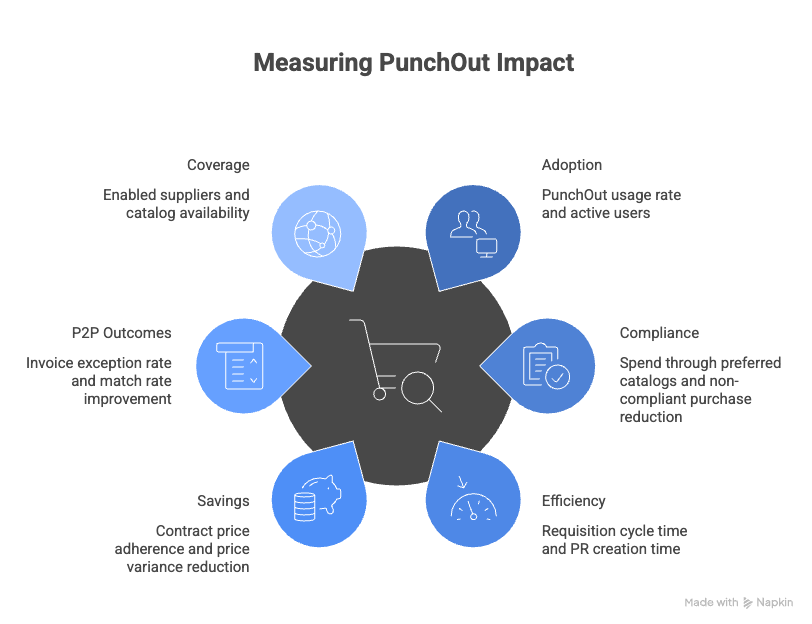
1. Supplier Catalog Integration (PunchOut Enablement)
PunchOut requires suppliers to be enabled with integrated catalogs that support session-based shopping and cart return.
Catalog enablement includes: supplier storefront connection, item visibility rules, contract pricing logic, and return-field mapping.
In enterprise scale environments, the ability to onboard catalogs quickly becomes critical, because adoption depends on coverage.
2. Contract Pricing and Supplier Compliance Controls
PunchOut is most valuable when contract controls are embedded into the buying journey.
That includes: pricing enforcement, preferred SKU alignment, and supplier eligibility validation so that users purchase within negotiated agreements, not ad-hoc catalogs.
This ensures contract compliance is not something enforced after the fact—it’s built into the purchase decision itself.
3. Guided Buying Experience and Supplier Routing
PunchOut works best when employees do not have to “choose the right supplier” manually.
Guided buying routes users based on: category, supplier approval status, location constraints, and contract availability.
In platforms aligned to intake and guided procurement models, this logic can be connected to request intent so users land directly in the right catalog path without friction.
4. Policy Guardrails and Restricted Item Governance
PunchOut environments need controls to prevent non-compliant purchases from becoming transactions.
This includes: restricted items, approval thresholds, category-based buying rules, and supplier-level permissions.
When guardrails are implemented correctly, organizations can increase self-service buying without increasing compliance risk or audit exposure.
5. Cart Normalization and Data Consistency
Once the cart returns, the procurement system must normalize it into compliant, consistent requisition data:
currency, UOM mapping, supplier master linkage, and classification alignment.
This prevents downstream errors such as: PO rework, incorrect receipt matching, or invoice mismatches that trigger AP exceptions.
6. Multi-Entity Catalog Governance (Scale and Global Support)
PunchOut becomes complex in multi-entity procurement setups where different business units require different catalogs, pricing agreements, and delivery rules.
Modern setups support:
multi-entity onboarding, regional catalog segmentation, and policy routing by location or business unit, creating one global procurement backbone without compromising local requirements.
7. Spend Visibility and Adoption Tracking
PunchOut adoption must be measured, because its value comes from controlled usage.
Procurement teams typically track: catalog usage, preferred supplier buying rates, and the portion of spend routed through compliant channels.
High-performing programs treat PunchOut as a spend capture mechanism, not just a buying feature.
Where PunchOut Creates the Most Value
PunchOut is most effective in categories where purchases are frequent, fragmented, and operationally urgent:
- MRO supplies and spares
- IT hardware and peripherals
- office and facilities purchasing
- lab and engineering supplies
- tail spend buying that otherwise escapes compliance
In these categories, PunchOut reduces procurement friction while improving governance.
Key Terms in PunchOut Procurement
- PunchOut — Supplier catalog shopping launched from eProcurement with cart return.
- cXML — Standard integration format commonly used for PunchOut connectivity.
- OCI — SAP ecosystem catalog integration format used for PunchOut sessions.
- Cart Return — Conversion of supplier cart into a requisition record.
- Hosted Catalog — Catalog stored and maintained inside procurement software.
- Preferred Supplier — Approved supplier prioritized for compliant buying.
- Tail Spend — Low-value, high-volume purchases that often escape control.
- Maverick Spend — Purchases made outside approved procurement channels.
- Guided Buying — A controlled buying experience that routes employees to the right channel.
- Catalog Compliance — Spend routed through approved catalogs and contract pricing.
Examples of PunchOut Procurement Solutions
- Zycus eProcurement + Guided Buying — PunchOut-enabled supplier shopping with compliant cart return, workflow approvals, and PO conversion.
- SAP Ariba Buying & Invoicing — PunchOut catalog connectivity integrated into requisition-to-order workflows.
- Coupa Procurement — PunchOut supplier catalogs with approval enforcement and spend controls.
- Oracle iProcurement — OCI-based PunchOut support embedded in ERP procurement execution.
- Jaggaer eProcurement — PunchOut enablement with category-based purchasing workflows.
FAQs
Q1. What is PunchOut in procurement?
PunchOut allows employees to shop on supplier catalogs from within eProcurement and return the cart for approvals and PO creation.
Q2. What is the difference between PunchOut and hosted catalogs?
Hosted catalogs store items inside the procurement system, while PunchOut connects users to the supplier’s live storefront and returns the cart back into the system.
Q3. Why do companies use PunchOut?
To improve compliant buying, contract pricing adherence, and spend capture—especially for indirect and tail spend categories.
Q4. Does PunchOut reduce maverick spend?
Yes. It brings supplier buying into approved workflows, reducing off-system purchases and improving audit traceability.
Q5. Where does PunchOut fit in the P2P process?
PunchOut sits in the requisition stage and improves downstream PO accuracy, receipt alignment, and invoice matching performance.
References
- How Digital Catalog Management is Transforming B2B Practices
- Procurement Catalog Management Software– Powering Smart, Seamless Buying
- Punchout Catalogs Are Changing E-Procurement: Know How!
- What Is Procurement Catalog Management: Your AIO Guide
- Reimagining Office Supplies Procurement: From Commodity Management to Strategic Value
- Catalog Buying in B2B Procurement: Building Stronger Supplier Relationships
- Building Resilient Supply Chains through AI in Supply Chain Management










