

The procurement lifecycle is the end-to-end process through which an organization identifies a need, sources suppliers, purchases goods or services, manages delivery and payment, and evaluates supplier performance. It represents how procurement activities flow from demand to value realization, ensuring every purchase aligns with business objectives, policies, and budgets.
Rather than a one-time transaction, the procurement lifecycle is a continuous, governed cycle that balances cost, risk, compliance, efficiency, and supplier collaboration across the entire Source-to-Pay ecosystem.
Read more: Procurement Process: 7 Steps for Optimal Efficiency and Cost Savings
Why the Procurement Lifecycle Matters
Without a structured lifecycle, procurement becomes fragmented, leading to maverick spend, weak contracts, supplier risk, and poor visibility. A well-defined procurement lifecycle creates discipline and transparency across all stages of buying.
An effective procurement lifecycle enables organizations to:
- Optimize total spend and reduce uncontrolled purchases
- Enforce policy adherence and regulatory compliance
- Improve operational efficiency and cycle times
- Strengthen supplier relationships and accountability
- Convert procurement into a strategic value driver
In essence, the procurement lifecycle ensures what is bought, how it is bought, and who it is bought from is consistently governed and measurable.
Watch Webinar: Leading Procurement in the AI Era: With Intelligent Orchestration Built for Speed and Impact
The Complete Procurement Lifecycle
The procurement lifecycle operates as a closed loop, where insights from later stages continuously improve earlier decisions.
| Stage | Purpose | Outcome |
| Needs Identification | Define what is required | Clear demand signal |
| Sourcing & Supplier Selection | Identify and evaluate suppliers | Best-fit supplier |
| Contracting | Formalize commercial and legal terms | Enforceable agreement |
| Purchasing & Ordering | Execute approved purchases | Controlled spend |
| Receiving & Verification | Confirm delivery and quality | Proof of fulfillment |
| Invoicing & Payment | Validate and pay suppliers | Financial accuracy |
| Performance & Review | Evaluate outcomes and suppliers | Continuous improvement |
The Core Procurement Lifecycle Flow
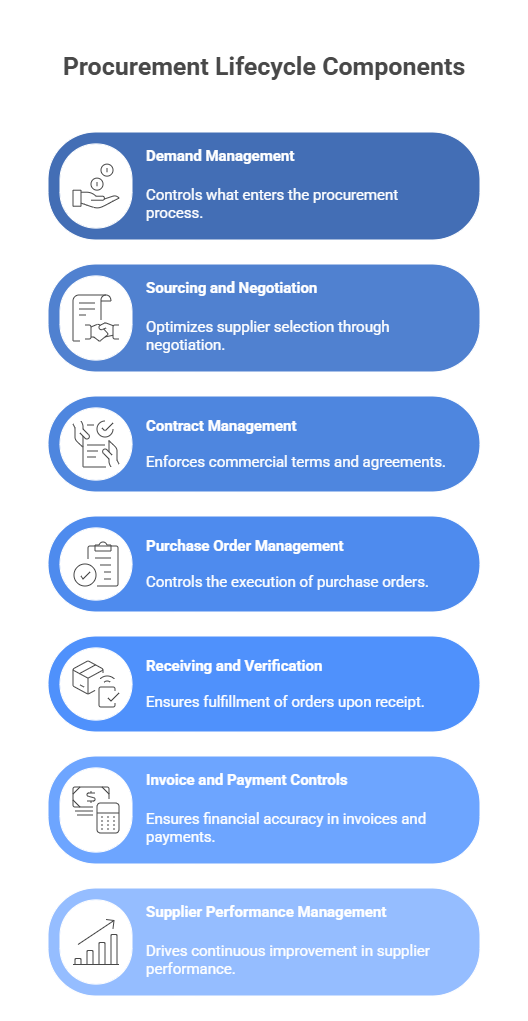
1. Needs Identification and Demand Planning
The lifecycle begins when a business unit identifies a requirement for goods or services. This stage defines scope, quantity, specifications, timelines, and budget expectations.
Clear demand definition prevents unnecessary purchases and ensures procurement efforts are aligned with operational priorities and financial constraints.
2. Sourcing and Supplier Selection
Once demand is defined, procurement evaluates sourcing options. This may involve competitive sourcing, supplier discovery, RFx processes, or renewal decisions.
Suppliers are assessed on pricing, capability, quality, risk, compliance, and long-term fit, not just cost. This stage determines the value foundation for all downstream activity.
3. Contracting and Commercial Alignment
Selected suppliers enter contract negotiations where pricing, service levels, obligations, and risk protections are finalized.
Contracts translate sourcing decisions into enforceable agreements, ensuring commercial terms, compliance requirements, and performance expectations are clearly documented.
4. Purchase Requisition and Order Execution
With contracts in place, approved purchase requests are converted into purchase orders. This step ensures purchases align with negotiated terms, budgets, and approvals.
Purchase orders act as the operational control point—linking intent, authorization, and supplier commitment.
5. Goods or Services Receipt
Delivered goods or completed services are verified against purchase orders and contracts. Quantities, quality, and timelines are validated to ensure fulfillment matches expectations.
This stage creates proof of delivery and protects the organization from overbilling or non-compliant supply.
6. Invoicing and Payment Processing
Suppliers submit invoices, which are validated against purchase orders, receipts, and contract terms. Approved invoices move to payment based on agreed terms.
This stage ensures financial accuracy, prevents duplicate or incorrect payments, and supports working capital optimization.
7. Supplier Performance and Lifecycle Review
After fulfillment and payment, procurement evaluates supplier performance across cost, quality, delivery, compliance, and responsiveness.
Insights from this stage inform future sourcing strategies, supplier development efforts, renewals, or exits—closing the loop and strengthening the next cycle.
Core Components of the Procurement Lifecycle
Key Concepts in the Procurement Lifecycle
Several principles underpin an effective procurement lifecycle:
- Governance: Policies and approvals embedded at every stage
- Compliance: Alignment with legal, regulatory, and internal standards
- Visibility: End-to-end transparency across spend and suppliers
- Risk Management: Proactive identification of supplier and market risks
- Value Creation: Focus on total cost, performance, and long-term outcomes
These concepts elevate procurement from execution to strategy.
KPIs That Measure Procurement Lifecycle Effectiveness
| Dimension | Sample KPIs |
| Efficiency | Cycle time, touchless processing rate |
| Cost | Savings realized, cost avoidance |
| Compliance | Contract coverage %, policy adherence |
| Risk | High-risk supplier exposure |
| Quality | Supplier defect rate, delivery accuracy |
Tracking these metrics ensures the procurement lifecycle delivers measurable business impact.
Key Terms in the Procurement Lifecycle
- Demand Identification: The stage where business requirements are defined in terms of scope, quantity, and budget.
- Sourcing: The process of identifying, evaluating, and selecting suppliers through competitive or negotiated methods.
- Contracting: Formalizing commercial, legal, and performance terms with selected suppliers.
- Purchase Order (PO): An official document authorizing the procurement of goods or services.
- Goods Receipt: Verification that ordered goods or services have been delivered as agreed.
- Invoice Matching: Validation of supplier invoices against POs, receipts, and contracts.
- Supplier Performance Management: Ongoing evaluation of supplier delivery, quality, cost, and compliance.
- Maverick Spend: Purchases made outside approved procurement processes or contracts.
- Audit Trail: A traceable record of procurement actions and approvals across the lifecycle.
FAQs
Q1. What is the procurement lifecycle?
The procurement lifecycle is the structured sequence of activities an organization follows to acquire goods and services—from identifying a need to supplier evaluation and payment.
Q2. What are the main stages of the procurement lifecycle?
Typical stages include demand identification, sourcing, contracting, purchasing, receiving, invoicing and payment, and supplier performance review.
Q3. How do digital tools support the procurement lifecycle?
Digital tools automate approvals, enforce compliance, provide spend visibility, and connect sourcing, purchasing, and payment into a single governed flow.
Q4. Why is the procurement lifecycle important for cost control?
It reduces maverick spend, ensures contract compliance, and enables consistent tracking of savings and spend efficiency.
Q5. How does the procurement lifecycle support supplier management?
It creates structured touchpoints for supplier selection, performance evaluation, risk management, and continuous improvement.
Q6. Is the procurement lifecycle a one-time process?
No. It is a continuous cycle where insights from performance and spend analysis inform future sourcing and purchasing decisions.
References
For further insights into these processes, explore Zycus’ dedicated resources related to Procurement Lifecycle:
- Beyond Automation: The Future of Human-AI Collaboration in Procurement
- Business continuity in ANZ: 4-ways in which procurement can help!
- AI-Solutions every procurement team must own by 2025
- e-Invoicing Playbook : How to Plan for AP Transformation Success
- Empowering Supplier Management with Zycus SRPM Automation