



A forward auction is a competitive selling mechanism where a seller offers goods or services to multiple potential buyers who submit increasingly higher bids until the highest bidder wins the item. In procurement, forward auctions are primarily used when organizations sell surplus assets, dispose of obsolete inventory, or divest business units rather than for standard purchasing activities. Understanding forward auctions helps procurement professionals maximize returns when their organizations are in the seller position.
Read more: Mastering Procurement: Demystifying Source to Contract (S2C) Process
Why Forward Auctions Matter in Procurement
While procurement primarily focuses on buying, organizations frequently need to sell surplus equipment, excess inventory, scrap materials, or retired assets. Forward auctions create competitive tension among buyers that typically generates higher returns than negotiated sales to single parties. Procurement teams involved in asset disposal or surplus management can leverage forward auction mechanisms to maximize recovery value, reduce disposal costs, and create transparent processes that satisfy internal audit requirements. Mismanaging disposal represents foregone revenue and potential compliance risks that impact organizational finances.
The Core Process of Forward Auctions
Forward auction preparation begins with cataloging items for sale, establishing accurate descriptions, determining starting prices or reserve minimums, and selecting appropriate auction platforms or channels based on item type and expected buyer audience characteristics.
Marketing and bidder qualification attracts potential buyers and verifies their ability to complete purchases successfully. Effective marketing reaches relevant buyer communities while qualification prevents wasted effort on bidders who cannot perform.
The auction event follows defined rules for bid submission, increments, timing, and winner determination. Whether live, timed online, or sealed bid format, clear rules ensure fairness and maximize participation from qualified bidders.
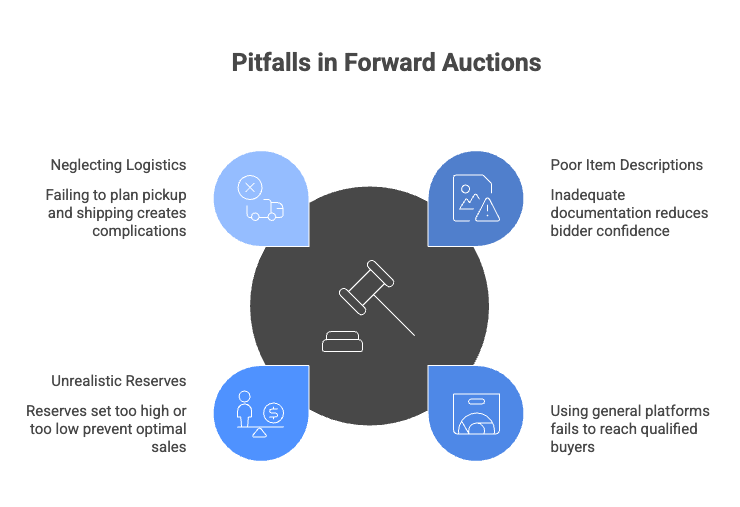
Post-auction administration handles payment collection, ownership transfer, item pickup or shipping, and documentation. Efficient closing processes convert winning bids into actual revenue recovery for the organization.
Core Components of Forward Auctions
Item documentation provides detailed descriptions, specifications, condition assessments, and photographs that enable bidders to evaluate items confidently. Better documentation attracts more bidders and typically generates higher prices.
Pricing strategy sets starting bids and reserve prices that balance attracting bidder interest against ensuring acceptable returns. Starting too high discourages participation while reserves set too low risk undervaluation.
Platform selection chooses between internal auction capabilities, third-party auction houses, or online marketplaces based on item type, volume, buyer audience reach, and cost structure considerations.
Terms and conditions define payment requirements, pickup timelines, warranty disclaimers, and other transaction parameters that protect the seller while remaining acceptable to buyers.
Key Benefits of Forward Auctions
- Price discovery: Competitive bidding reveals true market value rather than relying on estimates or single-party negotiations alone.
- Revenue maximization: Competition among buyers typically generates higher returns than fixed-price sales or negotiated disposals.
- Process efficiency: Auctions establish clear timelines and rules that accelerate disposal compared to extended negotiation processes.
- Transparency: Documented competitive processes satisfy audit requirements and demonstrate fair value was obtained for assets.
- Market reach: Auction platforms access buyer networks that individual sellers cannot reach effectively through direct marketing.
Forward Auction Versus Reverse Auction
- Direction of bidding: Forward auctions have buyers bidding prices up while reverse auctions have sellers bidding prices down. The roles are opposite.
- Typical use: Forward auctions sell surplus or assets to buyers. Reverse auctions source goods or services from competing suppliers.
- Who benefits from competition: Forward auctions benefit sellers through buyer competition. Reverse auctions benefit buyers through supplier competition.
- Price movement: Forward auction prices increase toward close. Reverse auction prices decrease toward close.
- Procurement application: Procurement uses reverse auctions frequently for sourcing. Forward auctions apply when procurement helps dispose of organizational assets.
KPIs of Forward Auction
| Dimension | Sample KPIs |
| Revenue | Recovery rate versus book value, price achieved versus reserve |
| Participation | Number of registered bidders, active bidders per auction event |
| Efficiency | Time from listing to sale completion, items sold per auction |
| Costs | Auction fees as percentage of sales, administrative cost per item |
Key Terms in Forward Auction
- Reserve Price: The minimum acceptable price below which the seller will not complete the sale.
- Starting Bid: The minimum opening bid amount required to participate in the auction.
- Bid Increment: The minimum amount by which each subsequent bid must exceed the previous bid.
- Hammer Price: The final winning bid amount before any buyer premiums or fees are added.
- Buyer Premium: A percentage added to the hammer price that the buyer pays to the auction house.
- Sealed Bid: Auction format where bidders submit confidential bids without seeing competitor offers.
Technology Enablement
Online auction platforms enable organizations to conduct forward auctions with global reach, real-time bidding, and integrated payment processing. These systems simplify auction administration while expanding the buyer audience beyond what traditional methods could achieve, improving both recovery rates and overall process efficiency.
FAQs
Q1. What is a forward auction?
A selling mechanism where multiple buyers compete by submitting increasing bids, with the highest bidder winning the item.
Q2. How does this relate to procurement?
Procurement teams use forward auctions when selling surplus assets, excess inventory, or retired equipment.
Q3. What items suit forward auctions?
Vehicles, equipment, real estate, excess inventory, and other items with multiple potential buyers work well for this format.
Q4. Should we use auction houses or run our own?
Third-party auction houses provide expertise and buyer networks. Internal auctions offer control and lower fees but require capabilities.
Q5. How do we set reserve prices?
Base reserves on market research, book value, and minimum acceptable recovery while remaining realistic about market conditions.
Q6. What are typical auction fees?
Commission structures vary widely from five to twenty percent, depending on item type and service level provided.
References
For further insights into these processes, explore Zycus’ dedicated resources related to Forward Auctions:
- The Future of Procurement in the Coronavirus Era: A New Dawn for Strategic Sourcing
- Mastering Procurement: Demystifying Source to Contract (S2C) Process
- Procure to Pay ERP Solutions for Optimal Procurement Efficiency: Finding the Perfect Match for Your Procurement Process
- Unraveling Cognitive Procurement: Unlocking Efficiency With AI
- Unlocking Stakeholder Visibility with Zycus Solutions










