



A Hold Harmless Agreement is a contractual provision in which one party agrees to release another from legal liability for specific losses or claims arising from a defined activity. In procurement, it protects the buying organization from liability for incidents arising from a supplier’s work — and vice versa. It is a risk allocation tool that defines who bears the financial consequence of specified risks before they materialize.
Why Hold Harmless Agreement Matters in Procurement
Procurement teams engaging contractors or on-site vendors expose the organization to liability for incidents they do not directly control. A hold harmless agreement shifts or limits that exposure contractually, ensuring the party best placed to manage a risk bears its financial consequence. Without this protection, the buying organization can be liable for events caused entirely by supplier actions — a position proper contract design should prevent.
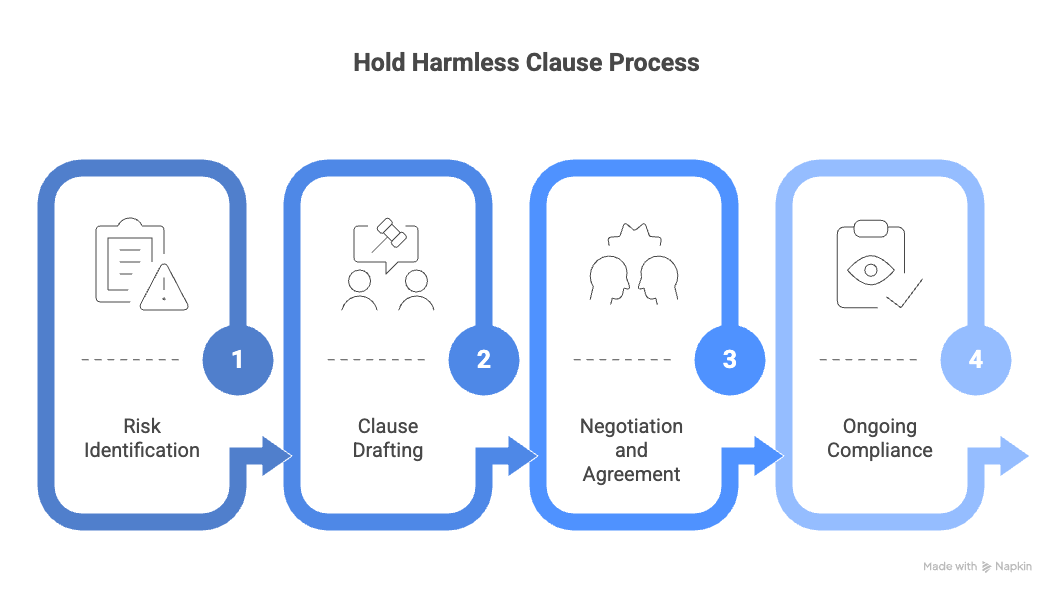
The Core Process of Hold Harmless Agreement
- Risk Identification: The process begins by identifying the specific risks present in the supplier engagement — on-site work, use of the buyer’s equipment, data handling, or third-party interactions. Understanding which party controls each risk is the foundation for deciding who should bear liability for it.
- Clause Drafting: Legal or procurement teams draft the hold harmless provision, specifying which party is protected, for what categories of claim, and under what circumstances. The clause must be precise — broad or ambiguous language creates enforcement uncertainty and may not hold up in disputes.
- Negotiation and Agreement: The clause is negotiated as part of the broader contract. Suppliers may push back on one-sided provisions or seek mutual hold harmless arrangements. The final agreed position should reflect the actual risk distribution between the parties.
- Ongoing Compliance: Once the contract is live, procurement and legal teams confirm that the conditions supporting the hold harmless arrangement remain in place — including that required insurance coverage is maintained and that the supplier’s personnel operating under the agreement are properly trained and supervised.
Core Components of Hold Harmless Agreement
- Indemnification scope defines what categories of loss or claim the hold harmless provision covers — personal injury, property damage, intellectual property infringement, third-party claims, or specific regulatory liabilities. Overly broad scope creates unenforceable provisions; overly narrow scope leaves gaps in protection.
- Party designation specifies who is being protected and who is assuming the liability. Provisions may be unilateral — protecting only one party — or mutual, where both parties hold each other harmless for their respective areas of risk.
- Insurance requirements are typically linked to hold harmless provisions. The party assuming liability must carry adequate insurance to back the indemnification commitment, otherwise the financial protection the clause provides is theoretical rather than real.
- Carve-outs and limitations define circumstances where the hold harmless protection does not apply — typically gross negligence, wilful misconduct, or fraud. These carve-outs ensure the agreement cannot be used to shield a party from the consequences of their own deliberate or reckless behavior.
Key Benefits of Hold Harmless Agreement
- Protects the buying organization from liability for losses arising from supplier actions, personnel, or equipment on the buyer’s premises or within the buyer’s operations.
- Creates clear risk allocation before incidents occur, reducing the cost and uncertainty of post-incident disputes.
- Provides a documented audit trail showing that risk allocation was considered and agreed at the outset of the supplier relationship.
Common Pitfalls of Hold Harmless Agreement
- Using a generic boilerplate without tailoring to the engagement: A clause drafted for construction may be inadequate for IT services. Clauses must reflect the actual risks of the specific relationship.
- Failing to link hold harmless provisions to adequate insurance: A supplier who indemnifies the buyer but carries insufficient insurance provides theoretical protection only. Insurance minimums should be specified and verified throughout the term.
- Not maintaining insurance compliance monitoring: Certificates provided at signing expire. Procurement should track renewal dates and confirm coverage remains in place throughout the engagement.
When Hold Harmless Provisions Are Most Important
- On-site contractor and maintenance work: When suppliers send personnel to the buyer’s premises, the risk of injury, property damage, or third-party claims increases significantly.
- Data processing and IT services: Suppliers handling sensitive data carry liability for breaches, and hold harmless provisions clarify who bears the cost of regulatory penalties and remediation.
- Professional services and advice: Where suppliers provide advice that the buyer acts upon, liability for consequential losses from incorrect or negligent advice must be clearly allocated.
KPIs of Hold Harmless Agreement
| Dimension | Sample KPIs |
| Contract Coverage | % of high-risk supplier contracts with hold harmless provisions |
| Insurance Compliance | % of suppliers with current, verified insurance certificates |
| Clause Quality | % of hold harmless provisions reviewed by legal, tailored vs. boilerplate rate |
| Incident Response | # of liability claims invoked, resolution time, recovery rate |
Key Terms in Hold Harmless Agreement
- Indemnification: A contractual obligation by one party to compensate another for specified losses, damages, or legal costs.
- Liability Cap: A contractual limit on the maximum financial exposure a party accepts under an agreement, often linked to contract value or insurance coverage.
- Mutual Hold Harmless: A reciprocal arrangement in which both parties agree to hold each other harmless for their respective areas of risk and responsibility.
- Consequential Damages: Indirect losses such as lost profits or reputational harm which hold harmless provisions often specifically address or exclude.
- Certificate of Insurance: A document issued by an insurer confirming that a party carries the specified coverage types and minimums required under the contract.
Technology Enablement
Contract management platforms support hold harmless compliance through clause libraries that contain pre-approved indemnification language, obligation tracking tools that monitor insurance renewal dates, and alert systems that notify procurement when certificates are approaching expiry. These capabilities reduce the risk of hold harmless provisions being rendered ineffective by lapsed insurance coverage.
FAQs
Q1. What is a Hold Harmless Agreement?
A contractual provision in which one party agrees to release another from liability for specified losses, damages, or claims arising from a defined activity.
Q2. Is a hold harmless agreement the same as an indemnity clause?
They are closely related. An indemnity clause obliges a party to compensate for losses; a hold harmless clause releases a party from liability. They are often combined in the same provision.
Q3. Can a hold harmless agreement protect against all claims? No. Most hold harmless provisions carve out gross negligence, wilful misconduct, and fraud. They also cannot override statutory rights or regulatory obligations.
Q4. What insurance should be required alongside a hold harmless agreement? At a minimum, public liability and employers liability insurance. Professional indemnity, product liability, or cyber insurance may also be required depending on the nature of the engagement.
Q5. Can both parties be protected under the same agreement? Yes. Mutual hold harmless provisions protect both parties for their respective areas of risk and are common in commercial contracts where both parties carry operational exposure.
Q6. Who should review hold harmless provisions before signing? Legal counsel should review all hold harmless and indemnification provisions, particularly in high-value or high-risk engagements, to confirm the protection is enforceable and adequate.
References
For further insights into these processes, explore Zycus’ dedicated resources related to Hold Harmless Agreement:
- Closing the Procurement-Compliance Gap with a World-Class Supplier Screening Program
- “Touchless†Long Tail Spend: the New Benchmark for World-Class P2P Process Efficiency – Part 2: Closing the P2P Efficiency Gap
- The Psychology Behind User-Friendly Procurement Platforms: A Deep Dive into Mental Efficiency
- Pulse of Procurement
- Future of Procurement: Insights from Nesrin Chabbeh










