



Spend taxonomy is a hierarchical classification system that organizes an organization’s procurement expenditure into structured categories, subcategories, and line items. It provides a consistent framework for labeling and grouping spend data so that procurement teams can analyze patterns, benchmark performance, identify savings opportunities, and manage supplier relationships at the right level of granularity. A well-designed taxonomy is the backbone of effective spend analysis and category management.
Why Spend Taxonomy Matters in Procurement
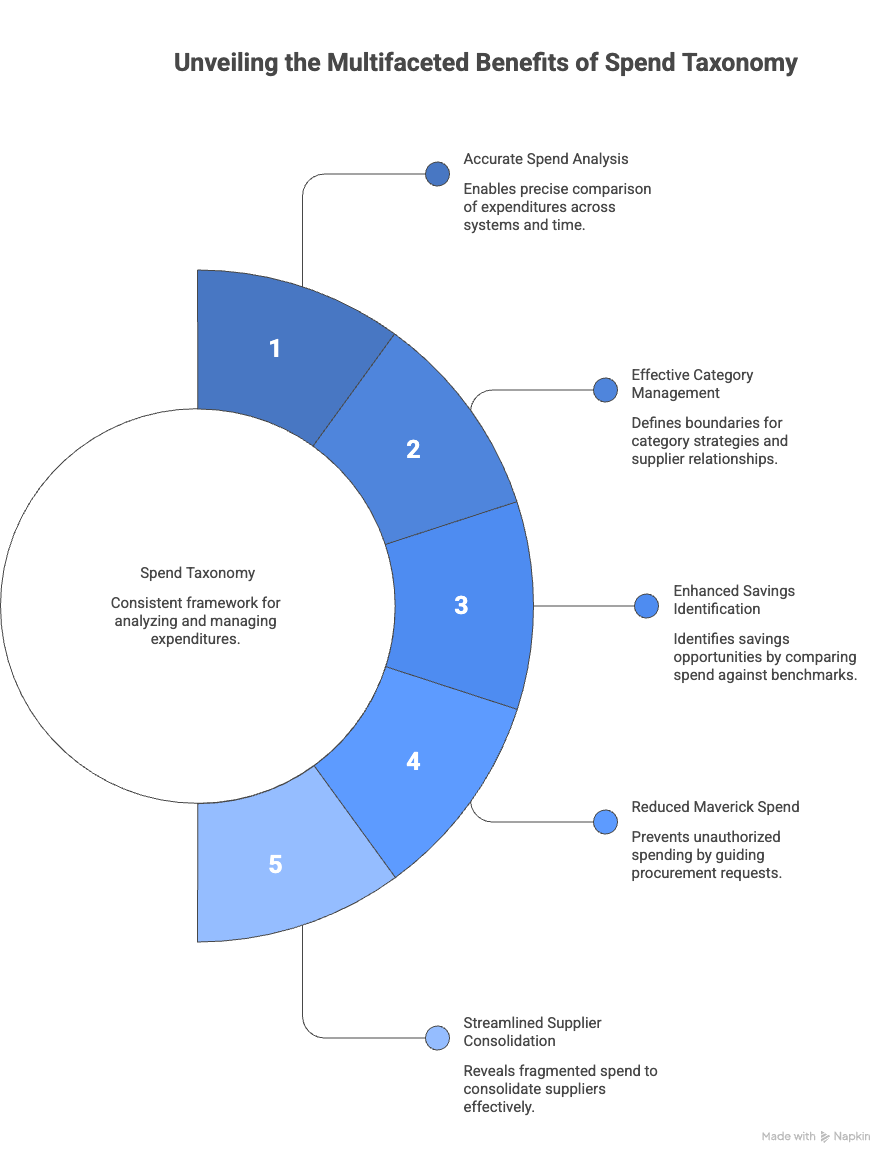
Without a consistent taxonomy, spend data is fragmented across systems and cost centers in ways that make meaningful analysis impossible. Procurement teams cannot reliably answer basic questions about category spend, supplier count, or consolidation opportunity. Spend taxonomy creates the common language that connects purchasing data to procurement strategy, enabling decisions grounded in evidence rather than estimates.
Read more: A Comprehensive Guide to Spend Analysis: Process, Benefits & Best Practices
The Core Process of Spend Taxonomy
The process begins with a data audit. Procurement reviews existing spend data across ERP systems, purchase orders, invoices, and p-card transactions to understand how expenditure is currently coded. This reveals inconsistencies, gaps, and the extent of unclassified or miscategorized spend that will need to be addressed.
With the data landscape understood, procurement selects or constructs a taxonomy framework. Many organizations adopt an industry-standard classification system such as UNSPSC or eClass as the foundation, then customize it to reflect internal category structures and business-specific requirements. The taxonomy is typically organized across two to four hierarchical levels, from broad segments down to specific commodity or service types.
Spend data is then mapped to the taxonomy. This involves matching supplier transactions to the appropriate classification nodes, either through automated rules-based matching, machine learning tools, or manual review for complex or ambiguous entries. The quality of this mapping directly determines the reliability of subsequent analysis.
Once mapped, the taxonomy is embedded into procurement workflows so future spend is captured consistently at the point of purchase, and reviewed periodically to reflect changes in category strategy or business structure.
Core Components of Spend Taxonomy
Hierarchy design determines how many levels the taxonomy contains and how broad or narrow each node is. A taxonomy that is too shallow loses analytical precision; one that is too deep becomes unwieldy for day-to-day use. Most procurement taxonomies operate across three to four levels: segment, family, class, and commodity.
Classification consistency ensures that the same type of spend is always mapped to the same taxonomy node, regardless of which system, department, or supplier generated the transaction. Inconsistent classification undermines comparability and makes aggregated spend figures unreliable.
Governance and maintenance define who owns the taxonomy, how change requests are managed, and how often the structure is reviewed. Taxonomies that are built once and never updated accumulate drift as new categories emerge and legacy nodes become obsolete.
Common Pitfalls of Spend Taxonomy
- Building a taxonomy in isolation from category managers: A taxonomy designed by IT or finance without procurement input often reflects system logic rather than how categories are actually managed, reducing its operational usefulness.
- Over-engineering the hierarchy: A taxonomy with six or more levels becomes difficult to maintain and impractical for users to navigate. Depth should be added only where analytical precision genuinely requires it.
- Treating mapping as a one-time exercise: Spend mapping must be refreshed as new suppliers, products, and transaction types enter the system. Stale mappings undermine data quality over time.
- Ignoring unclassified spend: Many organizations have a significant share of spend that remains uncategorized. This spend is invisible to analysis and often represents the highest concentration of savings opportunity.
Questions to Ask When Designing a Spend Taxonomy
- Does it align with how categories are actually managed?
The taxonomy should reflect procurement’s operational structure, not just how the finance system codes expenditure. - Can it accommodate future spend types?
A taxonomy should be flexible enough to absorb new categories without requiring a full redesign every time the business evolves. - Who will maintain it?
Without an assigned owner and a defined update process, taxonomies deteriorate quickly as organizational and market conditions change. - How will it be enforced at the point of purchase?
Integration into procurement systems ensures new spend is captured consistently rather than relying on manual classification after the fact.
KPIs of Spend Taxonomy
| Dimension | Sample KPIs |
| Classification Quality | % of spend classified, % correctly classified vs. audit sample |
| Coverage | % of spend categories mapped to taxonomy, unclassified spend value |
| Maintenance | Taxonomy review frequency, # of nodes added or retired per cycle |
| Analytical Value | # of category insights generated from taxonomy-based analysis |
Key Terms in Spend Taxonomy
- Spend Classification: The process of assigning procurement transactions to taxonomy categories for analysis and reporting purposes.
- UNSPSC: The United Nations Standard Products and Services Code, a globally recognized hierarchical classification system for goods and services.
- Category Management: A procurement approach that groups related spend into categories and manages them strategically to maximize value.
- Maverick Spend: Purchases made outside approved channels or contracts, often uncategorized and invisible to procurement analysis.
- Taxonomy Node: An individual classification point within the taxonomy hierarchy, representing a specific category or subcategory of spend.
Technology Enablement
Spend analytics platforms support taxonomy management through automated classification engines, machine learning tools that improve mapping accuracy over time, and dashboards that display spend at any taxonomy level. Source-to-Pay platforms embed taxonomy codes in purchase requisitions and purchase orders, ensuring that new spend is captured consistently at the point of commitment.
FAQs
Q1. What is spend taxonomy?
A hierarchical classification framework that organizes procurement expenditure into structured categories for analysis and management.
Q2. How is spend taxonomy different from a chart of accounts?
A chart of accounts reflects financial accounting structure. Spend taxonomy reflects procurement category structure. The two serve different analytical purposes and rarely align perfectly.
Q3. Should organizations build their own taxonomy or use a standard?
Most organizations use an industry standard such as UNSPSC as the foundation and customize it to reflect internal category structures.
Q4. How many levels should a spend taxonomy have?
Three to four levels is the practical standard. Fewer levels lose precision; more levels become difficult to maintain and navigate.
Q5. What happens to spend that cannot be classified?
Unclassified spend should be flagged, investigated, and mapped. High volumes signal a data quality problem that limits analytical value.
Q6. How often should a spend taxonomy be reviewed?
Annual reviews are standard, with interim updates triggered by significant changes in category strategy, business structure, or supply market.
References
For further insights into these processes, explore Zycus’ dedicated resources related to Spend Taxonomy:
- [ProcureCon Webinar] Skills for the Modern Procurement Professional
- 4 Key Procurement Objectives for 2014: Part 5 – Value realization through non-sourcing activities
- Optimizing P2P for Large Enterprises: 7 Best Practices
- 6 Steps to Reduce Costs and Improve Cash Flows
- Next-Gen Procurement: Driving Value through Risk Management, Customer Centricity, and Supplier Synergies










