



WHAT IS SCOPE 3 CATEGORY 1?
Scope 3 Category 1 is the greenhouse gas emissions category, defined by the GHG Protocol Corporate Value Chain (Scope 3) Standard, that covers upstream cradle-to-gate emissions from the production of all goods and services a company purchases in the reporting year. For many companies, especially in retail, consumer goods and services, it is the largest Scope 3 category.
WHY IT MATTERS IN PROCUREMENT
Category 1 is where procurement decisions show up in a company’s carbon footprint. Every supplier choice, specification and volume affects it, so procurement owns much of the data and most of the levers for reduction.
Reporting rules such as ESRS E1 under the EU CSRD, IFRS S2 and California climate disclosure laws, along with customer demands, are making supplier emissions data harder to avoid. Scope and timing of these rules are changing, so confirm the current position. Many buyers now ask suppliers for product-level or company-level figures, and targets such as the Science Based Targets initiative rely on Scope 3 baselines. Procurement teams that can supply credible Category 1 numbers and engage suppliers on reductions are better placed to meet those demands.
THE CORE PROCESS / LIFECYCLE
Define Boundary and Spend. The team sets the reporting boundary and pulls purchased goods and services for the year from the spend and purchasing data, separating them from capital goods and other categories.
Classify Purchases. Spend and quantities are grouped by category and supplier, and items that belong to other Scope 3 categories are moved out to avoid double counting.
Choose a Calculation Method. For each group, the team picks the most accurate method it has data for, using supplier-specific or hybrid data where available, and average-data or spend-based methods otherwise.
Collect Data and Factors. Suppliers provide emissions data, or the team applies emission factors from published databases to quantities or spend.
Calculate and Review. Emissions are calculated, checked against prior periods and sense-tested, and the data quality and assumptions are recorded.
Engage Suppliers and Improve. Hotspots are identified, suppliers are asked for better data and reduction plans, and the method is upgraded over time.
CORE COMPONENTS
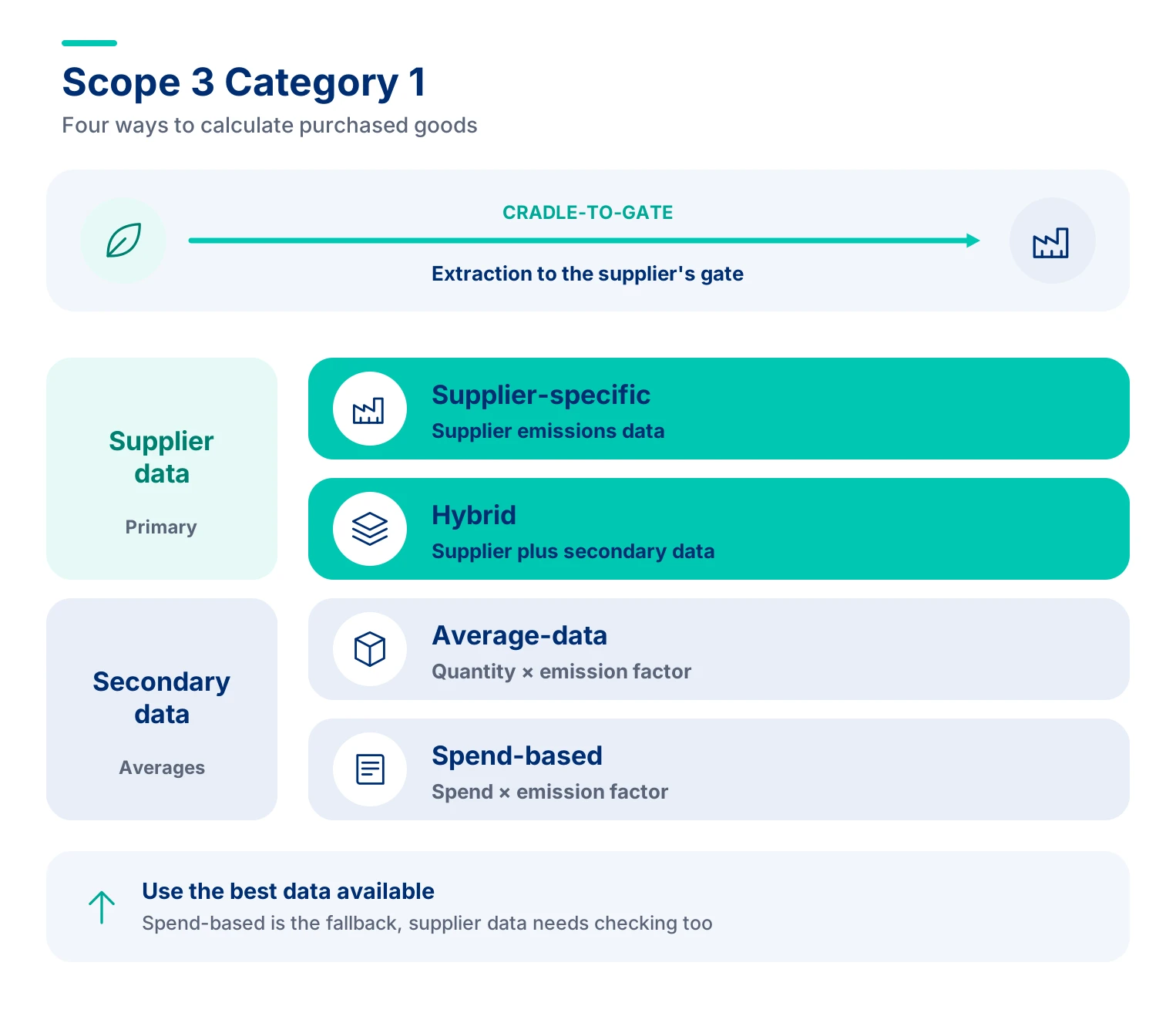
Cradle-to-gate scope counts emissions from extraction through to the point the product leaves the supplier, and excludes use and disposal by the buyer. Calculation methods are the four options in the GHG Protocol: supplier-specific, hybrid, average-data and spend-based. Emission factors convert quantity or spend into emissions. Supplier data is the input that most improves accuracy. Boundary rules keep Category 1 separate from Category 2 capital goods, Category 3 fuel and energy activities, and other categories.
KEY BENEFITS
A sound Category 1 inventory gives procurement a baseline that shows which categories and suppliers drive emissions, so reduction work targets the biggest sources. It supports credible target setting and meets the data requests of customers, investors and regulators.
It also improves supplier conversations. Suppliers asked for data in a consistent format respond more reliably, and the buyer can reward low-carbon performance in sourcing decisions. Over time, replacing spend-based estimates with supplier data makes the figures more responsive to real supplier action.
COMMON PITFALLS
Relying on spend-based estimates indefinitely. Spend-based figures move with price, not with emissions, so supplier reductions may not show up in the result.
Assuming supplier-specific data is always more accurate. Supplier data can be incomplete or use a different boundary, so check its scope and quality before using it.
Double counting across categories. Capital goods, fuel and energy, transport and other items belong to their own categories, and counting them twice inflates the total.
Treating it as a one-off annual exercise. Without ongoing supplier engagement, the data stays stale and the inventory cannot support reduction targets.
FOUR CALCULATION METHODS AND WHEN TO USE EACH
The GHG Protocol describes four methods. The first two use data from suppliers, and the last two use secondary data.
| Method | Data used | Typical use |
| Supplier-specific | Cradle-to-gate emissions data from the supplier for the product purchased | Major suppliers and high-emission categories |
| Hybrid | Supplier data for some activities, secondary data for the rest | Partial supplier data available |
| Average-data | Quantity purchased multiplied by an average emission factor per unit | Physical quantities known, no supplier data |
| Spend-based | Spend multiplied by an emission factor per unit of spend | Low-spend or data-poor categories, and a first estimate |
KPIS
| Dimension | Sample KPIs |
| Coverage | Share of spend covered by calculation; categories with a method assigned |
| Data quality | Share of emissions from supplier-specific data; share from spend-based estimates |
| Supplier engagement | Suppliers providing emissions data; suppliers with reduction targets |
| Performance | Category 1 emissions per unit of revenue; year-on-year change |
KEY TERMS
GHG Protocol. The widely used set of standards for measuring and reporting greenhouse gas emissions.
Scope 3. All other indirect emissions in a company’s value chain, outside Scope 1 and Scope 2.
Cradle-to-Gate. Emissions from raw material extraction through to the supplier’s factory gate.
Emission Factor. A value that converts activity data, such as quantity or spend, into emissions.
Primary Data. Data collected directly from suppliers or specific activities.
Secondary Data. Data from databases or averages rather than from the actual supplier.
Product Carbon Footprint. The emissions associated with a single product over a defined life cycle stage.
Hotspot. A category or supplier that contributes a large share of emissions.
FAQS
What does Scope 3 Category 1 cover?
It covers upstream cradle-to-gate emissions from the goods and services a company buys in the reporting year.
Why is Category 1 usually the largest category?
Many companies buy large volumes of materials, components and services, so the emissions embedded in those purchases outweigh other categories.
What methods can be used?
Supplier-specific, hybrid, average-data and spend-based. The first two use supplier data and the last two use secondary data.
Is the spend-based method acceptable?
Yes, it is a recognized method and a common starting point, but it is less precise because it follows spend rather than emissions.
How is Category 1 different from Category 2?
Category 1 covers purchased goods and services. Category 2 covers capital goods, which are accounted for separately.
How can procurement lower Category 1 emissions?
By choosing lower-emission suppliers and materials, setting supplier targets, specifying lower-carbon options and reducing unnecessary consumption.
Where does the data come from?
From spend and purchasing systems, supplier disclosures and published emission factor databases.