



Direct Purchase refers to the procurement of goods or services directly from a supplier through an organization’s approved purchasing process, without using intermediaries or informal buying channels.
In Source-to-Pay (S2P), direct purchase is typically executed through structured workflows such as requisitions, approvals, purchase orders, receipts, and invoice validation—ensuring each purchase is compliant, traceable, and financially controlled.
Simply put: it is “buying straight from the supplier,” but under procurement governance.
Read more: A Guide to Direct Procurement in the Digital Age
Why Direct Purchase Matters in S2P
Direct purchase is one of the most important ways procurement converts intent into controlled spend.
Without direct purchase discipline, organizations face common breakdowns such as off-contract buying, invoice disputes, pricing leakage, and weak supplier accountability.
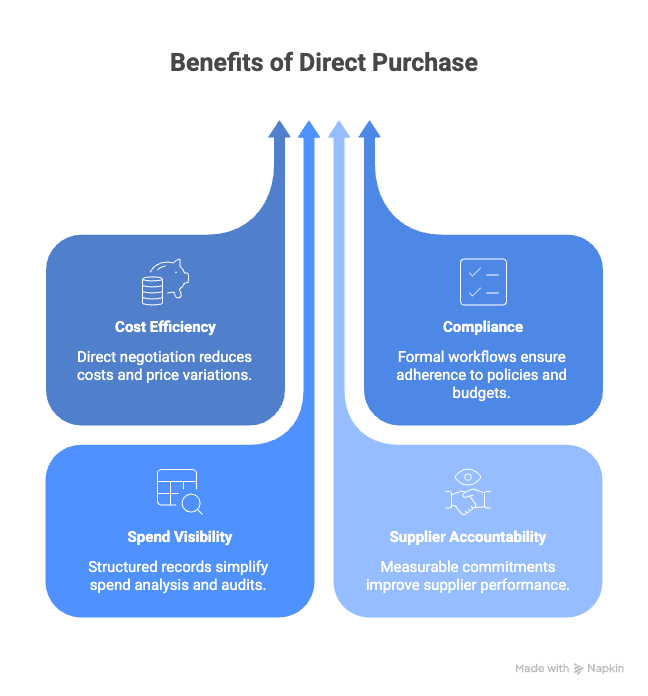
A well-governed direct purchase model helps procurement deliver four critical outcomes:
- Cost control through contracted pricing and negotiation leverage.
- Compliance by keeping purchases within approval and supplier policy.
- Visibility through trackable transactions from request to payment.
- Continuity by strengthening supplier reliability and fulfillment predictability.
Read more: 10 Key Elements of a High-Performing Direct Procurement Strategy
The Core Direct Purchase Flow
1. Requirement Capture and Internal Validation
Direct purchase begins when a business user raises a need for goods or services.
Instead of converting needs into informal buying decisions, procurement captures this requirement as a structured request with quantity, category, and justification, ensuring the purchase can be routed into the right approval and supplier path.
This step matters because unclear requirements lead to downstream mismatches in PO, delivery, and invoicing.
2. Supplier Selection and Governance Fit
Once the requirement is defined, the next step is ensuring the supplier is eligible for direct purchase.
Procurement either routes the request to a preferred supplier, selects from an approved supplier list, or triggers supplier onboarding if the supplier is new.
This ensures the supplier is contract-compliant, risk-validated, and operationally ready before spend is committed.
3. Commercial Alignment and Contract Guardrails
Before a purchase is executed, direct purchase aligns the transaction with commercial controls such as negotiated pricing, delivery terms, warranty obligations, and payment conditions.
This is what prevents value leakage, because the purchase is anchored to agreed terms instead of re-negotiated from scratch every time.
For services or strategic categories, this step often includes contract checks and SLA references.
4. Purchase Order Creation and Approval
Once supplier and terms are aligned, procurement converts the request into a formal Purchase Order (PO).
The PO becomes the control document that defines what will be delivered, how it will be priced, and what conditions apply.
Approvals are applied based on policy thresholds, category rules, and budget ownership, ensuring direct purchase remains governed rather than discretionary.
5. Fulfillment, Delivery, and Goods/Service Confirmation
After the PO is issued, fulfillment execution begins.
For physical goods, delivery confirmation is recorded using a GRN (Goods Receipt Note).
For services, confirmation may be captured through service entry or completion sign-off.
This confirmation stage protects the organization from paying for incomplete delivery, wrong quantities, or unresolved issues.
6. Invoice Validation and Match Readiness
Direct purchase enables invoice validation to run cleanly because invoice values are tied back to procurement intent.
Invoices are validated against PO details, receipt confirmation, and contract terms—reducing mismatches and manual intervention.
When direct purchase is properly executed, invoices are easier to approve, faster to post, and far less dispute-heavy.
7. Payment Readiness and Closure
Once invoice approval is completed, the payment process becomes predictable and controlled.
Payments follow defined terms, discount opportunities can be captured systematically, and supplier payment performance becomes measurable over time.
This closure phase ensures the direct purchase loop is complete, from request to payment, with full traceability.
Direct Purchase vs Spot Buying (Why the Difference Matters)
Direct purchase is structured and policy-aligned.
Spot buying is often reactive, unmanaged, and inconsistent, typically happening outside preferred suppliers and contracted rates.
The difference shows up clearly in outcomes:
Direct purchase improves control, compliance, and predictability.
Spot buying increases leakage, risk exposure, and dispute volume.
Read more: Direct Procurement vs. Indirect Procurement: Key Differences Explained
KPIs That Prove Direct Purchase Is Working
Direct purchase performance is typically measured through KPIs that reflect both efficiency and governance:
- PO compliance rate (how much spend follows approved PO workflows)
- % spend through preferred suppliers
- invoice match rate (2-way / 3-way match coverage and success)
- cycle time from request → PO → receipt → payment
- exception rate (price mismatch, missing receipt, duplicate invoices)
- maverick spend reduction
- supplier on-time delivery and defect rates
These metrics connect purchasing behavior to measurable procurement outcomes.
FAQs
Q1.What is direct purchase?
Direct purchase is buying goods or services directly from a supplier through an approved procurement process.
Q2. How direct purchasing works
It follows a governed flow: request → supplier selection → PO → receipt/confirmation → invoice match → approval → payment.
Q3. Direct vs indirect procurement
Direct procurement supports production output, while indirect procurement supports operations—both can use direct purchase workflows.
Q4. Benefits and risks of direct purchases
Benefits include better pricing, compliance, and visibility; risks include supplier dependency and poor control if processes are bypassed.
Q5. When to use direct purchases
Use direct purchases for planned, repeatable, or high-impact spend where pricing, quality, and supplier accountability matter.
References
For further insights into these processes, explore Zycus’ dedicated resources related to Direct Purchase:
- Smarter Way to Modernize Direct Procurement in Manufacturing
- Direct Procurement vs. Indirect Procurement: Key Differences Explained
- 4 Disruptive Digital Trends Procurement Needs to Keep an Eye On – Part 1
- Tech-Enabled Supplier Risk Assessment Process: Unlocking Cost and Time Savings
- Areas Procurement Can Gain From In An Evolving Supply Chain
- Understanding Procurement’s Role in Advancing Sustainability










