



Supplier onboarding is the structured process through which an organization formally registers, verifies, approves, and activates a new supplier before any commercial transactions take place. It ensures that suppliers meet legal, financial, operational, and compliance requirements and are properly integrated into procurement, finance, and risk systems.
Rather than a simple data entry task, supplier onboarding serves as the gateway to supplier governance—determining who an organization can safely and compliantly do business with.
Read more: Procurement Orchestration for Supplier Onboarding
Why Supplier Onboarding Matters
Poorly managed onboarding creates long-term risk. Incomplete supplier data, missing certifications, or weak controls at onboarding can lead to compliance failures, payment delays, fraud exposure, and supply disruptions later in the lifecycle.
Effective supplier onboarding enables organizations to:
- Ensure regulatory and policy compliance from day one
- Reduce supplier risk before transactions begin
- Improve data accuracy across procurement and finance
- Accelerate supplier activation without sacrificing control
- Build a trusted, audit-ready supplier base
Strong onboarding shifts procurement from reactive risk management to preventive governance.
Read more: Revolutionizing Supplier Onboarding with Generative AI: Efficiency, Accuracy, and Beyond
Supplier Onboarding Framework
Supplier onboarding operates as a controlled, multi-stage process that balances speed with due diligence.
| Area | Objective | Outcome |
| Supplier Intake | Capture supplier details | Clean data |
| Verification | Validate documents and credentials | Compliance assurance |
| Risk Assessment | Identify supplier exposure | Risk visibility |
| Approval | Apply governance checks | Controlled activation |
| System Integration | Enable transactions | Operational readiness |
| Ongoing Validation | Maintain accuracy | Continuous compliance |
The Core Supplier Onboarding Lifecycle
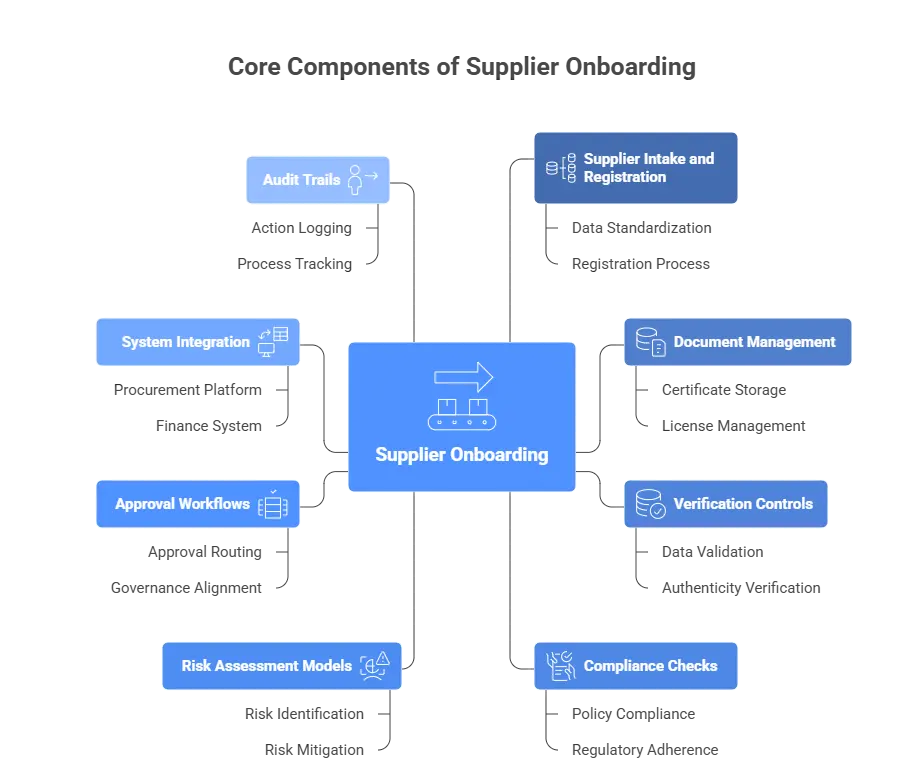
1. Supplier Identification and Intake
The onboarding process begins when a supplier is nominated through sourcing, business request, or supplier discovery. Basic information—such as legal name, address, tax identifiers, and contact details—is collected through structured forms or supplier self-registration.
This stage establishes the supplier’s identity and initiates governance checks.
2. Data Collection and Documentation
Suppliers are required to submit supporting documents based on category, geography, and risk profile. These may include tax forms, banking details, insurance certificates, quality certifications, ESG disclosures, or data security attestations.
Centralized data capture ensures consistency and reduces manual follow-ups.
3. Verification and Validation
Submitted information is reviewed and validated for accuracy, completeness, and authenticity. This includes verifying tax IDs, confirming bank details, checking certificate validity, and ensuring documents are current.
Verification prevents downstream issues such as payment errors, compliance violations, or audit gaps.
4. Compliance and Policy Alignment
Suppliers must formally acknowledge and agree to organizational policies, including codes of conduct, data protection standards, ethical sourcing requirements, and regulatory obligations.
Policy acceptance ensures suppliers are contractually and operationally aligned before engagement.
5. Risk Assessment and Segmentation
Suppliers are assessed across multiple risk dimensions—financial, operational, regulatory, cybersecurity, ESG, and geographic exposure. Based on this assessment, suppliers are segmented by criticality or risk tier.
This determines the depth of controls, monitoring frequency, and approval thresholds applied.
6. Approval and Governance Review
Approval workflows route onboarding requests to relevant stakeholders—procurement, finance, legal, compliance, or risk—based on supplier type and risk level.
This ensures supplier activation is authorized and defensible.
7. Supplier Activation and System Enablement
Once approved, suppliers are activated across procurement and finance systems, enabling them to receive purchase orders, submit invoices, and participate in sourcing events.
Activation marks the transition from onboarding to active supplier lifecycle management.
8. Ongoing Data Maintenance and Revalidation
Supplier onboarding does not end at activation. Supplier data, certifications, and compliance attestations must be refreshed periodically to remain valid.
Continuous revalidation ensures supplier records stay accurate and audit-ready over time.
Key Concepts in Supplier Onboarding
Several principles define successful supplier onboarding:
- Right First Time: Capture accurate data upfront to avoid downstream rework
- Risk-Proportionate Controls: Apply deeper checks to higher-risk suppliers
- Supplier Experience: Balance governance with ease of engagement
- Data as a Foundation: Clean onboarding data supports all downstream processes
- Continuous Compliance: Treat onboarding as an ongoing responsibility
These concepts help organizations scale onboarding without increasing risk
KPIs for Supplier Onboarding
| Dimension | Sample KPIs |
| Efficiency | Average onboarding cycle time |
| Data Quality | % complete supplier profiles |
| Compliance | Policy acceptance rate |
| Risk | High-risk suppliers onboarded |
| Experience | Supplier onboarding satisfaction score |
Tracking these KPIs ensures onboarding delivers measurable operational and governance value.
Supplier Onboarding in the Procurement Ecosystem
Supplier onboarding connects directly with:
- Supplier Management & SLM for lifecycle oversight
- Sourcing to qualify suppliers for RFx participation
- Contract Management to enforce legal alignment
- Procure-to-Pay for transaction enablement
- Risk and Compliance for continuous monitoring
As the first formal touchpoint, onboarding determines the quality and resilience of the entire supplier base.
FAQs
Q1. What is supplier onboarding?
Supplier onboarding is the structured process of registering, verifying, approving, and activating a supplier before any transactions occur. It ensures suppliers meet legal, compliance, risk, and data requirements so procurement can engage them safely and efficiently.
Q2. What is included in a supplier onboarding checklist?
A typical supplier onboarding checklist includes supplier master data capture, tax and banking verification, compliance documents, certifications, policy acceptance, risk assessment, and internal approvals before system activation.
Q3. How does digital supplier onboarding reduce risk?
Digital onboarding automates validation, enforces policy checks, tracks document expiries, and creates audit trails—reducing manual errors, fraud exposure, compliance gaps, and supplier-related disruptions.
Q4. What risks arise from poor supplier onboarding?
Incomplete onboarding can lead to non-compliant suppliers, duplicate records, incorrect payments, audit findings, reputational damage, and long-term supply chain risk.
References
For further insights into these processes, explore Zycus’ dedicated resources related to Supplier Onboarding:
- Optimizing Your Strategy: 6 Efficient Zycus Supplier Onboarding Steps
- Revolutionizing Supplier Onboarding with Generative AI: Efficiency, Accuracy, and Beyond
- Revolutionizing Supplier Onboarding: How GenAI-Powered Agents Transform the Process
- AI-ready, change-ready: what should CPOs prioritise to compete in today’s procurement landscape
- Revolutionizing Supplier Onboarding with Generative AI: Efficiency, Accuracy, and Beyond
- How Supplier Onboarding Software in the Nordics Empowers Registration, Qualification Workflows & Approval Systems
- Procurement Orchestration for Supplier Onboarding










