



The Most Economically Advantageous Tender (MEAT) is an evaluation approach used primarily in public procurement to select the bid that offers the best overall value rather than simply the lowest price. MEAT criteria procurement considers multiple factors, including quality, technical merit, sustainability, lifecycle costs, and service levels, alongside price. This methodology ensures that contract awards reflect total value to the organization and taxpayers, not just upfront cost.
Read more: Guide to Public Procurement: Strategies, Compliance & Digital Transformation
Why Most Economically Advantageous Tender (MEAT) Matters in Procurement
Lowest price selection often delivers poor outcomes — cheap suppliers may underperform, cut corners, or fail to deliver. MEAT allows procurement to balance cost against quality, risk, and strategic factors that affect long-term value. In public sector procurement, MEAT is legally mandated in many jurisdictions to ensure fair evaluation and prevent race-to-the-bottom pricing. For procurement professionals, understanding MEAT criteria is essential for designing evaluations that select suppliers capable of delivering sustained value.
The Core Process of Most Economically Advantageous Tender (MEAT)
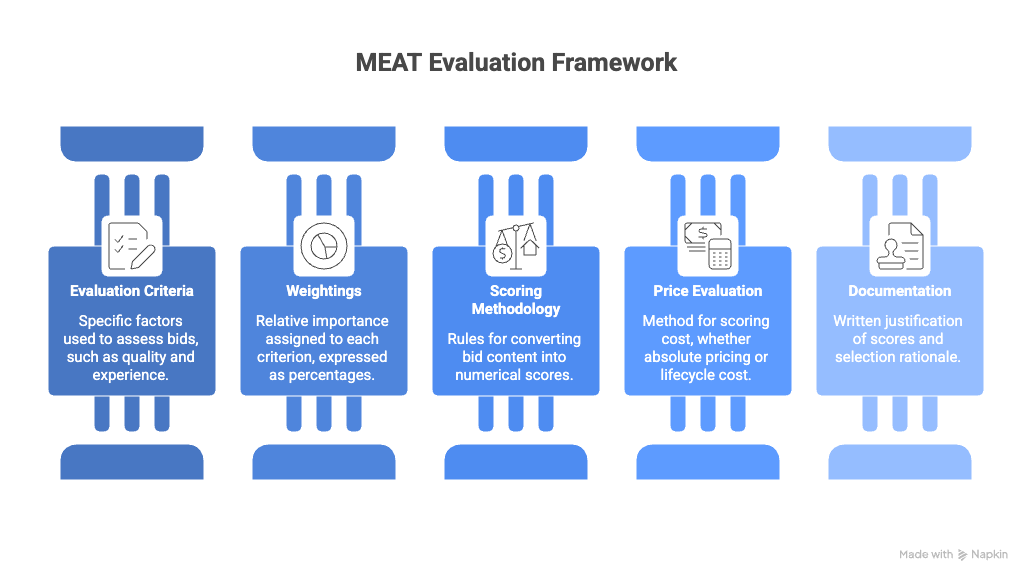
The process begins with defining evaluation criteria before the tender is issued. Procurement identifies the factors that matter for this specific requirement — quality indicators, technical capabilities, delivery performance, sustainability commitments, and price — and assigns weightings reflecting their relative importance.
Criteria and weightings are disclosed in the tender documentation. Transparency ensures suppliers understand what matters and can tailor their responses accordingly, while supporting fair and defensible evaluation.
When bids are received, each is scored against the defined criteria. Evaluators assess technical submissions, verify claims, and apply the scoring methodology consistently across all bidders.
Scores are weighted and aggregated to determine the most economically advantageous tender. The winning bid is the one with the highest combined score, not necessarily the lowest price. The selection rationale is documented to support audit and challenge.
Key Benefits of Most Economically Advantageous Tender (MEAT)
- Selects suppliers based on overall value, not just lowest initial cost, improving long-term outcomes.
- Enables consideration of quality, risk, and strategic factors that affect contract success.
- Supports sustainable and socially responsible procurement by incorporating non-price criteria.
- Creates transparent, defensible selection processes that withstand audit and legal challenge.
- Discourages unsustainably low bids by rewarding quality and capability alongside price competitiveness.
- Aligns with public procurement regulations that mandate value-based rather than price-only evaluation.
Common Pitfalls of Most Economically Advantageous Tender (MEAT)
- Criteria misaligned with outcomes: Evaluate what actually predicts success, not what is easy to measure.
- Inappropriate weightings: If price dominates excessively, MEAT becomes de facto lowest price. Balance weightings to reflect true priorities.
- Subjective scoring without calibration: Evaluators must be trained and aligned to score consistently across bids.
- Late criteria changes: Modifying criteria after bids are received undermines fairness and invites challenge.
Common MEAT Criteria Categories
- Quality: Technical excellence, service levels, defect rates, and conformance to specifications.
- Technical merit: Proposed methodology, innovation, and approach to delivering requirements.
- Experience and capability: Relevant track record, qualifications, and resources available for the contract.
- Delivery and responsiveness: Lead times, flexibility, and ability to meet schedule requirements.
- Sustainability: Environmental impact, carbon footprint, social value, and ethical practices.
- Lifecycle cost: Total cost of ownership including maintenance, operation, and disposal, not just purchase price.
- Risk: Financial stability, supply chain resilience, and mitigation of delivery risks.
KPIs of MEAT
| Dimension | Sample KPIs |
| Evaluation Quality | Challenge rate, successful challenge percentage, scoring consistency |
| Outcomes | Post-award supplier performance, contract success rate, value realization |
| Process | Evaluation cycle time, evaluator training completion, documentation compliance |
| Value | Quality score vs. price score correlation, lifecycle savings achieved |
Key Terms in MEAT
- MEAT: Most Economically Advantageous Tender — the evaluation approach selecting the best value bid, not just lowest price.
- Award Criteria: The factors and weightings used to evaluate and rank bids in MEAT evaluations.
- Price-Quality Ratio: A scoring method that balances cost against qualitative factors in bid evaluation.
- Lifecycle Costing: Evaluating total cost of ownership over the contract period, not just purchase price.
- Best Value: The procurement principle of selecting suppliers based on overall value rather than lowest price.
- Standstill Period: The mandatory waiting period between award decision and contract signature allowing unsuccessful bidders to challenge.
Technology Enablement
Modern Source-to-Pay platforms support MEAT evaluation through configurable scoring matrices, weighted criteria templates, collaborative evaluation workflows, score normalization tools, and comprehensive audit trails that document how each bid was assessed. These capabilities ensure consistent, transparent, and legally defensible award decisions.
FAQs
Q1. What does MEAT stand for?
Most Economically Advantageous Tender — a method for selecting the bid offering best overall value.
Q2. How is MEAT different from lowest price selection?
MEAT considers multiple factors like quality, technical merit, and sustainability alongside price, not price alone.
Q3. Is MEAT mandatory in public procurement?
In many jurisdictions including the EU, MEAT or equivalent best-value evaluation is required for public contracts.
Q4. How are MEAT criteria weighted?
Weightings reflect relative importance, must be disclosed upfront, and typically total 100%.
Q5. Can price be the only MEAT criterion?
Technically yes, but this defeats the purpose. MEAT is intended to incorporate non-price factors.
Q6. How do you defend a MEAT award decision?
Through documented scoring against published criteria, evaluator notes, and clear rationale for the selection.
References
For further insights into these processes, explore Zycus’ dedicated resources related to Most Economically Advantageous Tender (MEAT):
- In conversation with Alfred Aloysius – Asian Procurement Part 1
- Coronavirus: How procurement teams can mitigate supply chain disruptions
- Leveraging Big Data for Supplier Performance Improvement: A Data-Driven Approach to a Stronger Supply Chain
- The Ins and Outs of Supplier Networks: A Comprehensive Guide
- In Focus: Sustainable Business Performance – Key Highlights










