WHAT IS POLITICALLY EXPOSED PERSON (PEP) SCREENING?
Politically exposed person (PEP) screening is the check of a supplier’s owners, directors and other key people against data on individuals who hold or have held prominent public functions, and on their family members and close associates. Procurement uses it to spot elevated bribery and corruption risk.
WHY IT MATTERS IN PROCUREMENT
A PEP is not a wrongdoer. The Financial Action Task Force (FATF) is clear that being a PEP does not prejudge a link to criminal activity. The concern is position: people with public power can be offered, or can demand, improper benefits, and a supplier connected to them may win business for the wrong reasons.
Procurement is a natural place for that risk to appear, especially in sales to government, in regulated sectors and in markets where officials hold business interests. A PEP link rarely stops a relationship. It does call for a closer look, a senior sign-off and a record of why the company went ahead. Definitions and duties vary by country, so confirm local rules with compliance.
THE CORE PROCESS / LIFECYCLE
- Set Policy and Scope. Compliance defines who counts as a PEP, which suppliers are in scope and what happens when a link is found. Higher-risk categories and countries usually get the fullest checks.
- Collect the Names. At onboarding, gather names, dates of birth and roles for owners, directors and senior signatories. Missing data makes screening weak, because common names produce noise.
- Screen Against PEP Data. Run the names through a PEP data source. Results typically show the person’s role, country and any listed relatives or associates.
- Review the Hit. A reviewer confirms identity, role and relationship. Many hits are the wrong person or a very junior or long-past role, and they can be closed with a written reason.
- Assess and Decide. For a confirmed link, assess the risk using the seniority of the role, the country, the contract and the supplier’s own record. The outcome can be approval, approval with conditions, enhanced due diligence or refusal.
- Monitor and Refresh. People take up and leave public roles. Rescreen on a risk-based cycle, and when ownership or leadership changes.
CORE COMPONENTS
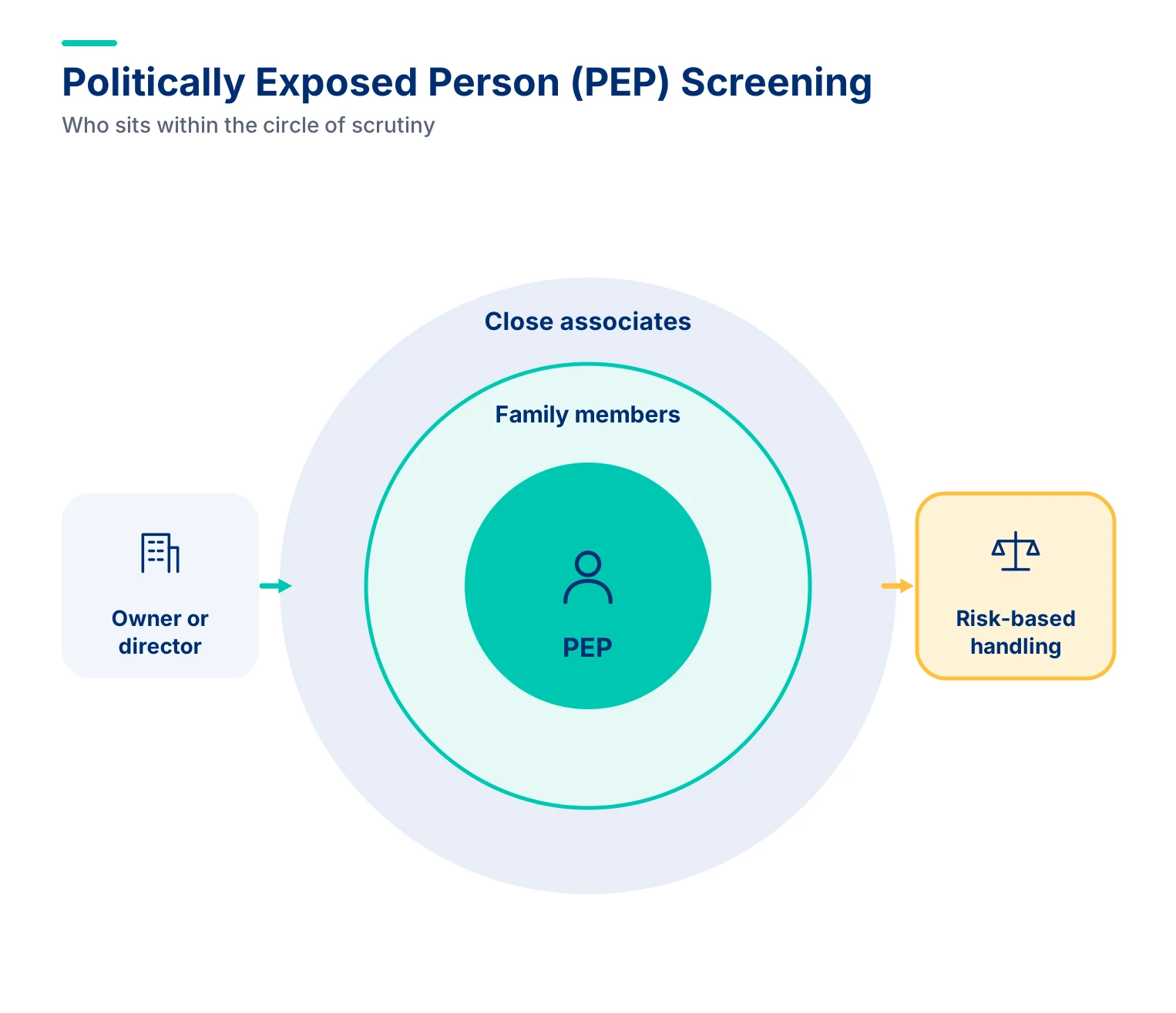
The PEP is someone entrusted with a prominent public function. FATF distinguishes foreign PEPs, domestic PEPs and people with prominent roles in international organizations. Family members are related by blood or marriage. Close associates are people closely connected socially or professionally. Screening data is a commercial or public dataset of such people. Risk assessment decides how much extra scrutiny a link deserves. Approval and records capture who signed off and why.
KEY BENEFITS
Screening brings corruption risk into view before a contract starts, when the company still has leverage to ask questions or set conditions. It supports anti-bribery programs by showing that the company looked at who sits behind its suppliers.
A graded response keeps the cost down. Because the handling follows risk, low-risk links move through with a record, and effort goes to the few cases that carry real exposure, as part of wider supplier risk management.
COMMON PITFALLS
- Treating PEP status as a ban. FATF guidance for financial institutions says a PEP link alone should not lead to automatic refusal. Assess the risk and decide.
- Screening only the supplier company. The exposure usually sits with owners, directors or relatives, so those names must be collected and screened.
- Forgetting relatives and associates. A supplier owned by a minister’s spouse is as sensitive as one owned by the minister.
- Applying a fixed cutoff for former officials. FATF notes that handling of former PEPs should rest on risk and not on set time limits.
FACTORS THAT RAISE OR LOWER THE RISK OF A PEP LINK
Use these factors to grade a confirmed link. They are prompts for judgment, not a scoring formula.
| Factor | Raises the risk | Lowers the risk |
| Seniority | Head of state, minister or senior executive of a state body | Junior or advisory role with no decision power |
| Timing | Currently in office or recently left, with continuing influence | Left office long ago and holds no continuing influence |
| Link to contract | Supplier sells to the PEP’s ministry or sector | No connection between the role and the contract |
| Country | Higher perceived corruption or weak controls | Stronger institutions and transparency |
| Ownership | Large or hidden stake, nominees involved | Small, disclosed stake |
KPIs
| Dimension | Sample KPIs |
| Coverage | Share of in-scope suppliers with owners and directors screened; suppliers with missing person data |
| Alert quality | False-positive rate; hits cleared with a recorded reason |
| Governance | Confirmed links approved at the required level; links without a documented risk assessment |
| Timeliness | Days to resolve a hit; screening refreshed within policy cycle |
KEY TERMS
- PEP. A person who holds or has held a prominent public function.
- Close Associate. A person closely connected to a PEP, socially or professionally.
- Enhanced Due Diligence. Additional checks and approvals applied to higher-risk relationships.
- Source of Wealth. The origin of a person’s overall assets.
- Domestic PEP. A person with a prominent public function in the same country.
- Anti-Bribery Program. The policies and controls a company uses to prevent improper payments.
- Risk-Based Approach. Applying stronger controls where risk is higher and lighter ones where it is lower.
FAQs
1. What is Politically Exposed Person (PEP) screening in procurement?
Politically Exposed Person (PEP) screening is the process of checking suppliers, beneficial owners, directors, and key stakeholders for connections to individuals holding prominent public positions. It helps procurement teams identify potential bribery, corruption, and conflict-of-interest risks. PEP screening is part of supplier due diligence and third-party risk management, enabling organizations to assess politically connected suppliers before establishing business relationships.
2. Who qualifies as a Politically Exposed Person (PEP)?
A Politically Exposed Person is an individual entrusted with a prominent public function, such as a head of state, government minister, senior judge, military official, or senior executive of a state-owned enterprise. PEP classifications also include certain senior officials of international organizations. Family members and close associates may require additional screening because of their connections to influential individuals. Specific definitions and requirements vary by jurisdiction.
3. How does the PEP screening process work for suppliers?
PEP screening begins by collecting identifying information about supplier owners, directors, and key decision-makers. Their names are checked against PEP databases to identify potential political connections. Compliance teams verify matches, assess the individual’s public role, ownership interests, geographic exposure, and relationship to the transaction. Confirmed higher-risk connections may require enhanced due diligence and senior approval. Periodic rescreening helps identify changes in political exposure.
4. Does a PEP screening match mean a supplier must be rejected?
No, a PEP screening match does not automatically disqualify a supplier or indicate criminal activity. It signals the need for additional risk assessment. Procurement and compliance teams should verify the match, evaluate political influence, assess potential conflicts of interest, and document their findings. Depending on the risk level, organizations may approve the supplier, require enhanced due diligence, impose additional controls, or decline the relationship.
5. What is the difference between PEP screening and sanctions screening?
PEP screening identifies individuals with prominent political roles and their close connections to assess potential corruption risks. Sanctions screening checks individuals and organizations against government lists of parties subject to legal or financial restrictions. A PEP match generally requires risk-based evaluation rather than automatic rejection, while a confirmed sanctions match may prohibit transactions. Organizations often use both screening methods within supplier due diligence and compliance programs.
6. Are former government officials still considered Politically Exposed Persons?
Yes, former government officials may continue to be treated as Politically Exposed Persons depending on their previous responsibilities, ongoing influence, and applicable regulations. The Financial Action Task Force (FATF) recommends a risk-based approach rather than automatically removing PEP status after a fixed period. Organizations should evaluate the individual’s former position, time since leaving office, continuing political connections, and potential influence over supplier relationships.
7. How can organizations automate PEP screening and ongoing supplier monitoring?
Organizations can automate PEP screening using supplier risk management software integrated with PEP databases and supplier onboarding workflows. Automated systems can identify potential matches, flag changes in political exposure, and trigger risk reviews. Procurement teams should maintain accurate ownership records, periodically rescreen relevant individuals, and document screening decisions. Human verification remains essential for resolving false positives and evaluating confirmed political connections.