



Spend analytics is the process of collecting, cleansing, classifying, and analyzing procurement expenditure data to generate actionable insights about how an organization spends money, with whom, on what, and at what cost. It transforms raw transaction data from ERP systems, invoices, purchase orders, and p-cards into a structured, categorized view of organizational spend — enabling procurement teams to identify savings opportunities, monitor supplier performance, enforce compliance, and support strategic sourcing decisions.
In modern procurement, spend analytics is no longer a periodic exercise — it is the always-on intelligence layer connecting intake, sourcing, contracts, and supplier performance into a continuous picture of where value is being created or lost. Within an Intake-to-Outcomes (I2O) framework, it links every procurement decision back to its financial outcome — confirming whether contracted savings were realized and whether supplier performance matched the commitments made at award. AI platforms such as Merlin take this further, applying agentic capabilities to classify spend automatically, surface anomalies in real time, and generate insights that would take teams days to produce manually.
See how AI transforms spend analytics into continuous procurement intelligence: Explore Merlin Agentic AI Platform →
Why Spend Analytics Matters in Procurement
Without a clear picture of what the organization spends and with whom, category managers cannot identify consolidation opportunities and finance cannot validate savings claims. Spend analytics provides the factual foundation every procurement strategy requires — replacing assumptions with evidence and enabling procurement to engage stakeholders with data-backed recommendations rather than estimates alone.
The Core Process of Spend Analytics
- Data Extraction: Spend data is extracted from all transaction sources — ERP systems, accounts payable records, purchase orders, expense management platforms, and procurement cards. At this stage, the data is typically inconsistent: supplier names vary, cost codes differ across business units, and transaction descriptions are unstructured.
- Data Cleansing: Raw data is deduplicated, normalized, and enriched. Supplier names are standardized, incomplete transactions flagged, and data quality issues resolved. The quality of cleansing directly determines the reliability of downstream analysis.
- Spend Classification: Cleansed transactions are mapped to a defined taxonomy — typically UNSPSC or a custom internal hierarchy — assigning each line to a category, subcategory, and commodity. Classification is what makes spend data analytically useful, enabling aggregation and comparison across any dimension.
- Analysis and Insight Generation: With classified spend in place, procurement analysts examine patterns across suppliers, categories, business units, geographies, and time periods. This analysis surfaces consolidation opportunities, compliance gaps, supplier concentration, tail spend, and savings potential.
- Action and Monitoring: Insights drive procurement decisions — sourcing events, contract renegotiations, supplier exits, policy enforcement. Spend analytics then monitors whether those decisions are having the intended effect, closing the loop between analysis and outcome.
Core Components of Spend Analytics
- Data integration connects spend analytics to all transaction sources — ERP, AP, procurement platforms, p-cards, and expense systems — ensuring analysis reflects total organizational spend, not only managed-channel transactions.
- Classification engine maps transactions to taxonomy categories automatically, using rules-based matching, machine learning, or AI-assisted classification. Classification accuracy is the primary determinant of analytical reliability.
- Spend cube organizes classified spend across multiple dimensions — category, supplier, business unit, geography, time period — enabling procurement to slice and filter expenditure from any analytical perspective.
- Reporting and visualization present spend data in dashboards that category managers, finance, and leadership can navigate without technical query skills — making insight accessible, not just available.
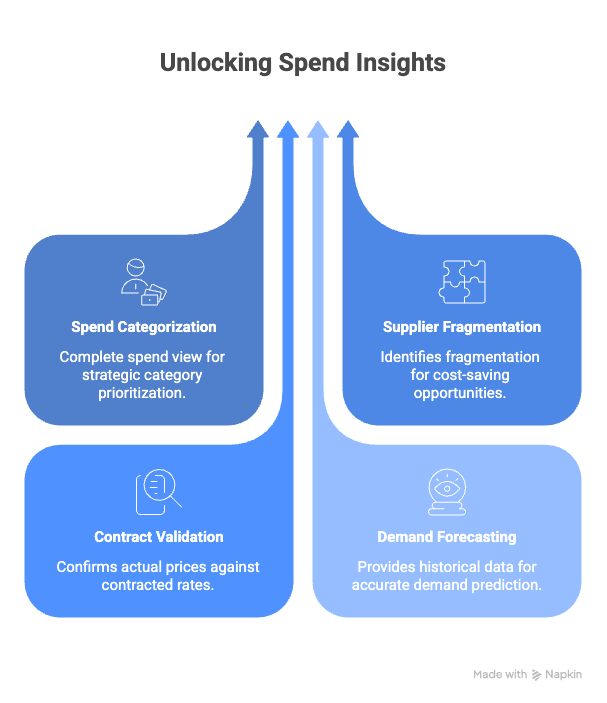
What Good Spend Analytics Enables
- Category strategy development: A complete spend picture shows total addressable spend per category, the supplier landscape, and current commercial terms — the inputs every category strategy requires.
- Supplier rationalization: Spend analytics reveals fragmentation across categories — where the same goods or services are purchased from multiple suppliers without strategic justification.
- Contract compliance monitoring: By comparing actual invoice prices against contracted rates, spend analytics confirms whether negotiated savings are being realized or whether supplier pricing has drifted above contracted terms.
- Savings baseline establishment: Every savings initiative requires a defensible baseline from actual transaction data. Spend analytics provides this from invoice records rather than estimates, ensuring savings claims are credible and verifiable.
KPIs of Spend Analytics
| Dimension | Sample KPIs |
| Data Quality | % of spend classified, % classified to Commodity level (Level 4), supplier deduplication rate |
| Coverage | % of total organizational spend included in analytics, unmanaged spend ratio |
| Insight Action Rate | # of sourcing initiatives triggered by analytics, savings identified vs. actioned |
| Compliance | % of spend with preferred suppliers, off-contract spend value by category |
Key Terms in Spend Analytics
- Spend Classification: The process of mapping procurement transactions to a defined taxonomy for analytical purposes.
- Spend Cube: A multidimensional view of expenditure across category, supplier, business unit, and time period dimensions.
- UNSPSC: The United Nations Standard Products and Services Code — a globally recognized classification system used as the basis for many spend analytics taxonomies.
- Maverick Spend: Purchasing outside approved channels, contracts, or suppliers — identifiable through spend analytics and typically the primary compliance target.
Technology Enablement
Modern spend analytics platforms use AI-powered classification engines that continuously categorize incoming transactions, machine learning models that improve accuracy over time, and real-time dashboards that give category managers and finance stakeholders always-current visibility into organizational spend. Within an agentic AI environment, spend analytics becomes an active capability — with AI agents monitoring spend patterns, flagging anomalies, and triggering procurement actions automatically rather than waiting for periodic human review.
FAQs
Q1. Why is spend classification important?
Classification organizes raw transaction data into categories that can be analyzed, compared, and acted on. Without it, spend data is a list of transactions with no analytical structure.
Q2. How often should spend data be refreshed?
Monthly is the minimum. Organizations with active category management benefit from weekly or real-time refresh where platform capability allows.
Q3. How does AI improve spend analytics?
AI automates classification, improves accuracy over time through machine learning, surfaces anomalies that rule-based tools miss, and enables natural language querying of spend data.
Q4. How does spend analytics connect to the I2O model?
In an Intake-to-Outcomes framework, spend analytics closes the loop — confirming whether the value committed at intake was realized in actual expenditure, feeding data back into future planning cycles.
Ready to move from periodic spend reports to continuous procurement intelligence? Discover Merlin Agentic AI Platform →
References
Explore Zycus resources to learn more about Spend Analytics:










