



An approval chain is the defined sequence of individuals or roles that must authorize a procurement action before it can proceed. It governs which purchases, contracts, or supplier commitments require sign-off, at what value or risk level each approval tier activates, and in what order approvals must be obtained. An effective approval chain balances organizational control with operational efficiency ensuring that spending decisions receive appropriate oversight without creating bottlenecks that slow down legitimate procurement activity.
Why Approval Chain Matters in Procurement
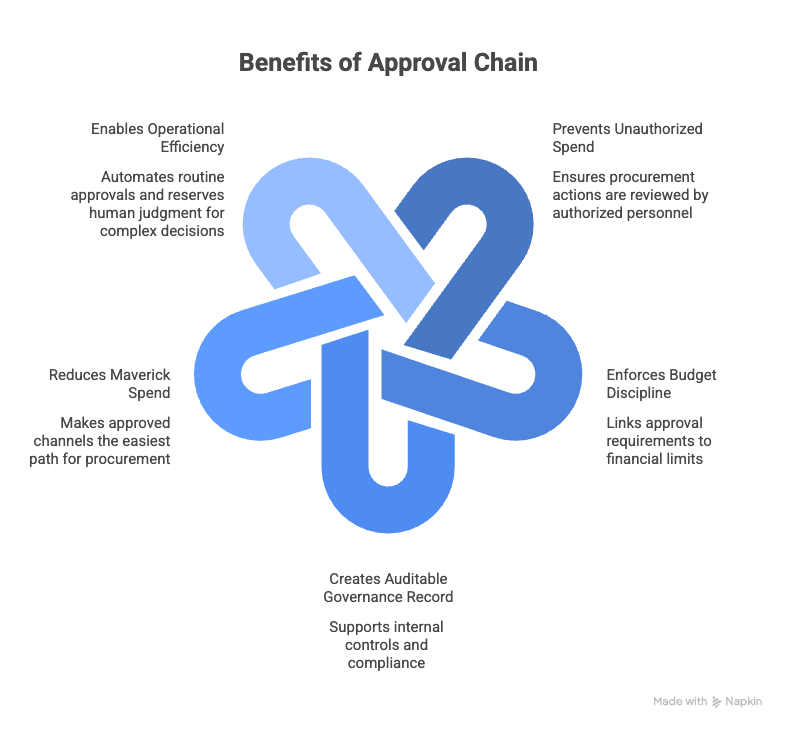
Approval chains are the primary internal control mechanism for procurement spend. They prevent unauthorized commitments, enforce budget discipline, and ensure that decisions above defined risk or value thresholds are reviewed by people with the authority and context to assess them properly. For procurement teams, a well-designed approval chain enables speed for routine decisions while applying appropriate governance to high-value or high-risk commitments. Poorly designed chains — too long, too rigid, or unclear — create delays that push stakeholders toward workarounds, driving maverick spend and eroding compliance.
Download Analyst Report: Procurement Contracts – Real Value, Real Returns
The Core Process of Approval Chain
- Policy Design: The approval chain is defined through procurement or financial policy, specifying approval tiers by spend value, contract risk, category type, and supplier status. Thresholds at each tier are set to reflect the organization’s risk appetite and the appropriate level of seniority for decisions of each type.
- System Configuration: Approval chains are embedded into procurement platforms and ERP systems as automated workflows. When a purchase requisition, purchase order, or contract is created, the system determines the required approvers based on the transaction’s attributes and routes it accordingly.
- Transaction Processing: When a procurement action is initiated, the approval workflow activates. Each approver in the chain receives a notification, reviews the request against their delegated authority, and approves or rejects with any required comments. Escalation rules handle scenarios where approvers are unavailable or exceed their response time limit.
- Audit and Compliance Monitoring: Completed approval chains are logged in the procurement system, creating an auditable record of who approved what, when, and at what value. Compliance reports identify transactions that bypassed the approval chain or were approved outside the correct authority level.
Core Components of Approval Chain
- The delegated authority matrix defines each role’s approval authority by spend value, category, and risk level. It is the policy document that underpins the approval chain and must be reviewed and updated as organizational structures change.
- Approval tiers create graduated oversight: low-value or routine purchases may require only line manager approval, while high-value contracts require finance director or CPO sign-off. The number of tiers should reflect the risk profile of the spend, not organizational hierarchy for its own sake.
- Workflow automation routes approvals through the procurement system without manual coordination, reducing delay and ensuring that every transaction follows the defined path. Automated reminders and escalation rules maintain momentum without administrative intervention.
- Audit trail records every approval action — the approver, timestamp, decision, and comments — creating the evidence base needed for internal audit, external audit, and regulatory compliance reviews.
Common Pitfalls of Approval Chain
- Setting approval thresholds too low. Requiring senior approval for routine purchases creates bottlenecks and incentivizes workarounds. Thresholds should reflect genuine risk, not symbolic control.
- Designing chains that mirror org charts rather than risk profiles. Approval requirements based on seniority rather than decision risk produce chains that are too long for simple purchases and too short for complex ones.
- Failing to update delegated authority matrices as organizations change. Restructuring and staff turnover make authority matrices stale, creating approval gaps or routing decisions to the wrong people.
Signs That an Approval Chain Needs Redesign
- High volume of retrospective approval requests. Frequent requests to ratify purchases already made signal that the approval chain is too slow or too complex for the pace of the business.
- Significant maverick spend in categories with approval requirements. Stakeholders buying outside approved channels despite approval being required indicates that the chain is creating more friction than compliance.
- Long average approval cycle times. If approvals routinely take longer than the business needs to commit spend, the chain is reducing operational effectiveness and credibility.
KPIs of Approval Chain
| Dimension | Sample KPIs |
| Compliance | % of transactions processed through the approved chain, bypass rate |
| Efficiency | Average approval cycle time by tier, % approved within SLA |
| Governance | % of approvals with documented rationale, retrospective approval rate |
| Control Quality | # of audit findings related to approval chain, out-of-authority approvals |
Key Terms in Approval Chain
- Delegated Authority: The formal authorization granted to a role or individual to commit organizational spend up to a defined limit.
- Purchase Requisition: A formal internal request to procure goods or services, which initiates the approval chain before a purchase order is raised.
- Approval Workflow: The automated routing of approval requests through a procurement or ERP system based on predefined rules and thresholds.
- Maverick Spend: Purchases made outside approved channels or without completing the required approval chain, representing a governance control failure.
- Escalation Rule: A system-defined trigger that routes an approval to a higher authority when the assigned approver does not respond within a defined timeframe.
Technology Enablement
Source-to-Pay platforms embed approval chains through configurable workflow engines that route transactions automatically based on spend value, category, and supplier attributes. Dashboards track cycle times, flag bottlenecks, and identify bypass rates — giving procurement the visibility needed to maintain governance effectiveness.
FAQs
Q1. What is an approval chain in procurement?
A defined sequence of individuals or roles that must authorize a procurement action before it can proceed, based on spend value, risk level, or category type.
Q2. How is an approval chain different from a delegated authority matrix?
The delegated authority matrix defines who can approve what. The approval chain is the workflow that routes transactions through those approvers in the right sequence.
Q3. How many approval tiers should a procurement process have?
As few as necessary to provide meaningful oversight without creating operational delays. Most organizations operate three to five tiers based on spend value thresholds.
Q4. What should happen when an approver is unavailable?
Escalation rules should automatically route the approval to a designated alternate or to the next tier within a defined timeframe.
Q5. How should procurement handle purchases made without approval?
Through a defined retrospective approval process that documents the breach, requires senior sign-off, and triggers a review of whether the threshold or workflow contributed to the bypass.
Q6. How often should approval thresholds be reviewed?
Annually, and whenever significant changes occur in organizational structure, inflation, or the volume and nature of procurement activity.
References
Here are 3 Zycus resources related to Approval Chain:
- Agentic AI Procurecon Indirect West
- How is AI changing procurement
- Procurement Workflow Management Guide 2026: Benefits & Challenges
- Procurement Orchestration for Complex Approval Workflows
- Taming the Approval Beast: Streamlining Approvals with Procurement Workflow Tools
- GenAI in Procurement Intake: Revolutionize Procurement with GenAI’s Command Center










