


Supply base management is the systematic approach organizations use to define, structure, maintain, and optimize the group of suppliers they rely on to fulfill procurement requirements. It encompasses decisions about how many suppliers to maintain in each category, which suppliers to develop or exit, and how the overall supply base is governed. Effective supply base management ensures the organization is served by the right suppliers at the right scale, without unnecessary complexity or risk concentration.
Why Supply Base Management Process Matters in Procurement
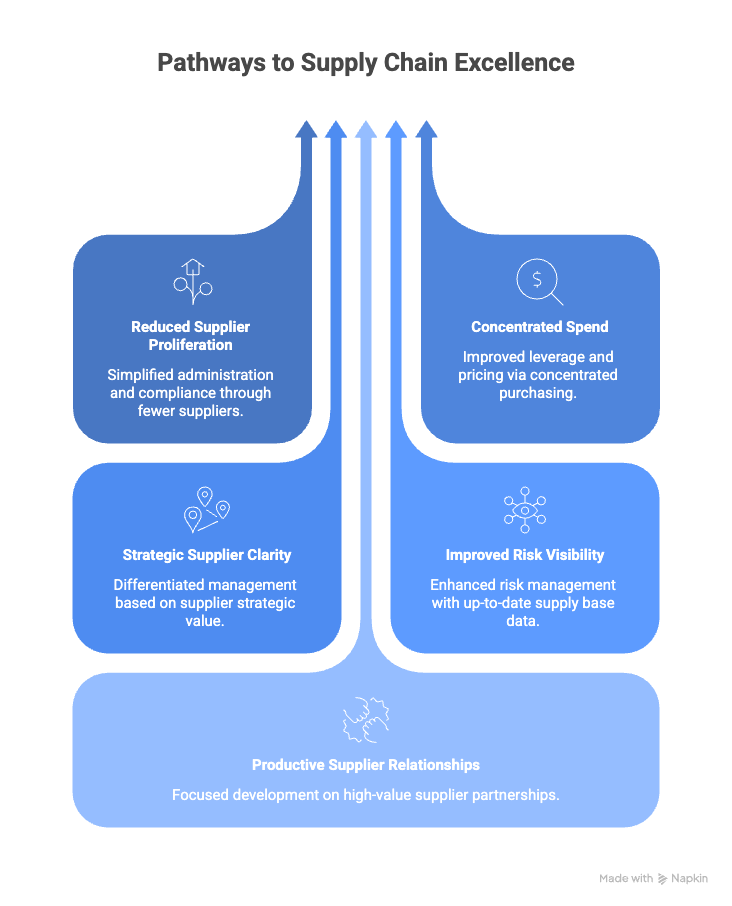
An unmanaged supply base tends to grow through fragmented buying, emergency sourcing, and decentralized decisions, resulting in supplier proliferation: too many suppliers, too little spend with each, and insufficient leverage across any. Supply base management creates structure around who is in the supply base, why, and how they are governed. For procurement leaders, a well-managed supply base improves commercial outcomes, simplifies compliance oversight, reduces administration, and enables more productive supplier relationships.
The Core Process of Supply Base Management Process
The process begins with supply base mapping. Procurement assembles a complete picture of the current supplier landscape, including total supplier count, spend distribution, category coverage, and performance status. This baseline reveals where the supply base is over-dense and where concentration risk may exist.
Segmentation follows, classifying suppliers by spend level, strategic importance, risk profile, and performance history. Common segments include strategic, preferred, approved, and transitional, each carrying differentiated management expectations. The segmentation output drives rationalization decisions, concentrating spend with fewer, higher-performing partners, while development activities are initiated for strategic suppliers.
Supplier exits are managed through a structured offboarding process that transitions spend responsibly and preserves operational continuity. Ongoing governance monitors supply base health through performance reviews, risk reassessments, and segmentation updates.
Core Components of Supply Base Management Process
Supplier segmentation provides the organizing logic for the supply base, determining which suppliers receive the most attention, investment, and governance. Supplier rationalization reduces unnecessary complexity by consolidating spend with fewer suppliers, improving leverage and reducing transaction overhead. Supplier development builds capability in strategic relationships over time. The governance framework establishes the review frequency, escalation paths, and conditions under which suppliers are moved between segments or exited.
Common Pitfalls of the Supply Base Management Process
- Conducting supply base mapping once and treating it as static: Supplier landscapes shift constantly. Maps must be refreshed regularly to remain actionable.
- Rationalizing without managing transition risk: Exiting suppliers without a transition plan can leave categories temporarily uncovered and operations exposed.
- Segmenting by spend alone: Strategic importance, risk profile, and performance history are equally relevant to segmentation decisions.
- Neglecting supplier exits: Organizations often focus on adding suppliers and neglect structured offboarding, creating legal and operational risk.
Read more: A 5-Step Process to Effective Supplier Management
Supply Base Health Indicators to Monitor
- Supplier count by category: An unusually high supplier count signals fragmentation and a rationalization opportunity.
- Spend concentration: The percentage of category spend held by the top three suppliers reveals how dispersed the supply base is.
- Active vs. inactive supplier ratio: A high proportion of inactive suppliers in the system inflates administration and compliance overhead.
- Time since last segmentation review: Segmentation not updated in over twelve months is unlikely to reflect the current landscape accurately.
KPIs of Supply Base Management Process
| Dimension | Sample KPIs |
| Supply Base Scale | Total active supplier count, year-on-year change by category |
| Rationalization Progress | # of suppliers exited, spend consolidated per rationalization initiative |
| Segmentation Health | % of suppliers segmented and reviewed in last 12 months |
| Spend Concentration | % of spend with top-tier suppliers, tail spend ratio |
Key Terms in Supply Base Management Process
- Supplier Segmentation: The classification of suppliers into tiers or groups based on strategic importance, spend, risk, and performance.
- Supplier Rationalization: The deliberate reduction of supplier count to consolidate spend and improve management efficiency.
- Supply Base: The complete set of suppliers an organization uses to fulfill procurement requirements.
- Tail Spend: Low-value, high-volume transactions distributed across a large number of suppliers, representing disproportionate management cost.
- Supplier Development: Structured activities aimed at improving supplier capabilities, processes, or performance over time.
- Supplier Offboarding: The formal process of exiting a supplier relationship, including spend transfer and financial settlement.
- Preferred Supplier: A supplier designated as the primary source in a category based on sustained performance and strategic alignment.
Technology Enablement
Source-to-Pay platforms support supply base management through supplier information portals, spend analytics that identify rationalization opportunities, and segmentation tools that track supplier classification over time. Automated alerts notify procurement when performance or risk indicators shift, enabling timely supply base decisions.
FAQs
Q1. What is supply base management?
The process of defining, structuring, maintaining, and optimizing the suppliers an organization uses to fulfill procurement requirements.
Q2. How many suppliers should an organization have?
The right number depends on category complexity and risk tolerance. The goal is the fewest suppliers that reliably meet all requirements without creating concentration risk.
Q3. What is supplier rationalization?
The process of reducing supplier count by consolidating spend with fewer, better-performing suppliers.
Q4. How do you segment a supply base?
Using criteria such as spend level, strategic importance, risk profile, and performance history to classify suppliers into tiers.
Q5. What triggers a supply base review?
Annual planning cycles, major sourcing events, organizational restructuring, and significant shifts in spend patterns are common triggers.
Q6. How is supply base management different from supplier relationship management?
Supply base management governs the overall composition; supplier relationship management focuses on individual supplier engagement and performance.
Q7. What tools support supply base management?
Spend analytics, supplier information management systems, and procurement platforms with segmentation and performance tracking capabilities.
References
For further insights into these processes, explore Zycus’ dedicated resources related to Supply Base Management Process:
- AI Agents for Spend Management: Unlocking Real-Time Spend Insights with AI-Driven Analytics
- 11 Successful Tips for Winning Supplier Negotiation
- Creating an Effective Supplier Risk Management Template
- Procurement’s Priorities for 2022: Go from Survive to Thrive
- Zycus Campus Film: Shekhar Varma’s Story