


What is supplier segmentation?
Supplier segmentation is the practice of grouping suppliers by factors such as spend, risk, strategic importance and how easily they can be replaced, so each group can be managed differently. It lets procurement put relationship effort where it matters most.
Why it matters in procurement?
A supply base is not uniform. A sole-source supplier of a critical part and a one-off office supplier need very different attention. Treating them the same wastes effort on low-value suppliers and under-manages the critical ones.
Segmentation also gives teams a shared language. Category managers, risk teams and finance can agree which suppliers get performance reviews, risk monitoring or joint development, and which run through simple standard processes. It also gives a basis for deciding where to invest in relationships and where to automate, so limited team time is spent on suppliers where it changes outcomes.
The core process / lifecycle
- Define Criteria. Procurement agrees the factors that matter, usually spend, business impact, supply risk and how easily the supplier can be replaced.
- Gather Data. Spend, performance, risk and category data are pulled from ERP, procure-to-pay and supplier management systems and cleaned.
- Score and Plot. Each supplier is scored on the criteria and placed on a matrix, often with business impact on one axis and supply risk on the other.
- Assign Segments. Suppliers are grouped into segments such as strategic, leverage, bottleneck and routine, or into tiers such as strategic, preferred and transactional.
- Set Management Approach. Each segment gets a defined approach covering review frequency, governance, risk monitoring and level of collaboration.
- Review and Refresh. Segments are reviewed at least annually, and whenever spend, risk or market conditions change.
Core components
- Segmentation criteria define what drives the grouping.
- Scoring rules make placement repeatable.
- The matrix shows the segments, with the four-box Kraljic model the most common.
- Segment strategies set how each group is managed.
- Ownership names who maintains the data and reviews the segments.
Key benefits
Segmentation focuses effort where it pays, so strategic suppliers get real attention and routine ones get light touch. It supports risk management, because critical and hard-to-replace suppliers are identified. It guides sourcing strategy, since each segment suggests a different approach. It reduces review workload for low-value suppliers, so teams spend their time where it counts. Segments also make supplier development and performance reviews more consistent, because the review depth, meeting cadence and scorecard are set by segment rather than negotiated one supplier at a time. New buyers can pick up a category faster when they can see where each supplier sits and why.
Common pitfalls
- Segmenting by spend alone. A small-spend supplier of a critical part can matter more than a large-spend commodity supplier.
- Treating segments as permanent. Markets, suppliers and spend change, so a stale segment leads to the wrong management approach.
- Creating too many segments. Beyond four or five groups, teams cannot apply a distinct approach to each.
- Segmenting without acting. A matrix with no segment strategies is a chart, not a management tool.
- Typical segments and how each is managed
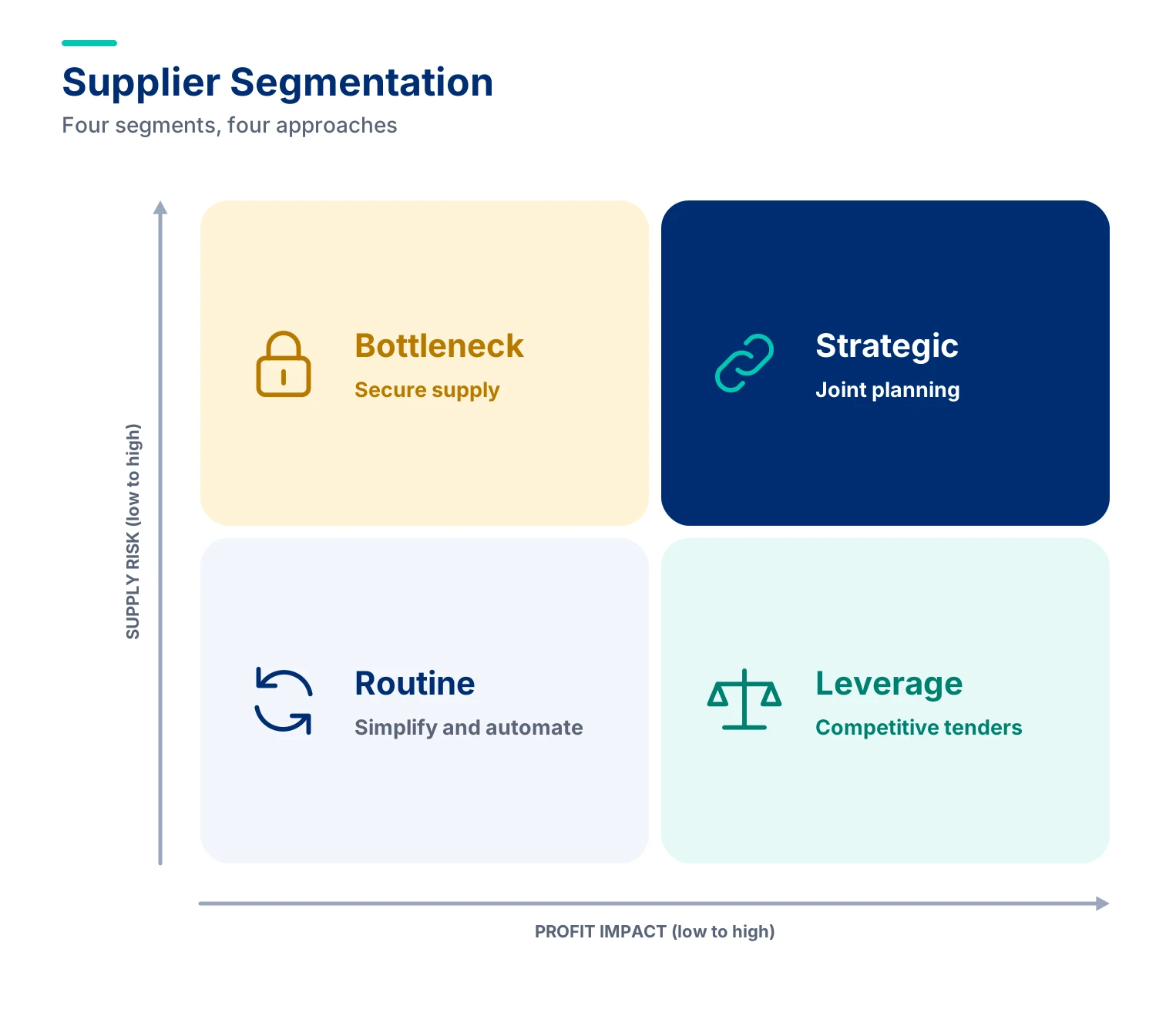
These follow the Kraljic matrix, which classifies purchases by profit impact and supply risk. Segments apply to suppliers and the categories they supply.
- Strategic. High impact and high risk. Manage through joint planning, executive sponsorship, regular business reviews and risk plans.
- Leverage. High impact and low risk, with many alternatives. Use competitive tenders, volume consolidation and price negotiation.
- Bottleneck. Low impact and high risk. Secure supply, qualify alternatives and hold safety stock where justified.
- Routine. Low impact and low risk. Simplify buying, use catalogs and automate to cut effort.
KPIs
| Dimension | Sample KPIs |
| Coverage | Spend segmented; suppliers with a current segment |
| Management | Strategic suppliers with a review plan; reviews completed on time |
| Risk | Bottleneck suppliers with an alternative qualified; single-source exposure |
| Efficiency | Share of suppliers in routine segment; effort per supplier by segment |
Key Terms
- Kraljic Matrix. A four-box model that classifies purchases by profit impact and supply risk.
- Strategic Supplier. A supplier whose products or services are critical and hard to replace.
- Preferred Supplier. An approved supplier a buyer favors for a category, usually on negotiated terms.
- Single Source. A situation where one supplier provides a product or service the buyer needs.
- Supplier Tiering. Grouping suppliers into levels that set the depth of management and review.
- Supply Risk. The likelihood and impact of a supply disruption.
- Business Impact. The effect a supplier’s goods or services have on revenue, cost or operations.
FAQs
1. What is supplier segmentation in procurement?
Supplier segmentation is the process of categorizing suppliers based on spending, business impact, supply risk, and strategic importance. It helps procurement teams develop appropriate sourcing strategies and supplier management approaches for different vendor groups. By distinguishing strategic suppliers from routine vendors, organizations can prioritize critical relationships, improve supplier performance, reduce supply chain risks, and allocate procurement resources more effectively.
2. Why is supplier segmentation important in supply chain management?
Supplier segmentation helps organizations identify critical suppliers, prioritize relationship management, and reduce supply chain vulnerabilities. It enables procurement teams to invest more resources in high-impact suppliers while simplifying processes for low-risk vendors. Effective segmentation also supports supplier performance monitoring, strategic sourcing decisions, and risk mitigation. This approach improves procurement efficiency by ensuring suppliers receive management attention proportional to their business importance and operational risks.
3. What criteria are used to segment suppliers?
Common supplier segmentation criteria include purchasing spend, supply risk, business impact, supplier performance, and ease of replacement. Procurement teams may also consider geographic exposure, financial stability, and innovation potential. For example, a low-spend supplier providing a critical component may require closer monitoring than a high-spend supplier offering easily replaceable products. Combining financial and operational criteria helps organizations develop more accurate supplier classifications.
4. What are the four supplier segments in the Kraljic Matrix?
The Kraljic Matrix classifies purchases into four categories based on profit impact and supply risk:
- Strategic: High impact, high risk. Prioritize collaboration and relationship management.
- Leverage: High impact, low risk. Focus on competitive sourcing and price negotiation.
- Bottleneck: Low impact, high risk. Secure supply and develop alternatives.
- Routine: Low impact, low risk. Simplify purchasing and automate transactions.
Procurement teams can use these categories to guide supplier management strategies.
5. How do you develop an effective supplier segmentation strategy?
An effective supplier segmentation strategy begins by defining evaluation criteria such as spend, supply risk, and business criticality. Procurement teams then collect supplier data, assign scores, and classify suppliers into meaningful segments. Each segment receives a tailored management strategy covering performance reviews, risk monitoring, and collaboration. Organizations should regularly update classifications to reflect changing supplier performance, market conditions, and business priorities.
6. What is the difference between supplier segmentation and supplier rationalization?
Supplier segmentation groups vendors based on strategic importance, risk, and business value to determine appropriate management approaches. Supplier rationalization focuses on reducing or optimizing the number of suppliers to improve efficiency, consolidate spending, and eliminate unnecessary duplication. While segmentation helps organizations manage existing suppliers effectively, rationalization helps streamline the supplier base. Both strategies complement each other in improving procurement performance and supplier relationship management.
7. How often should organizations review supplier segmentation, and how is success measured?
Organizations should review supplier segmentation at least annually or whenever significant changes occur in spending, supplier performance, supply risk, or market conditions. Success can be measured through KPIs such as percentage of spend segmented, suppliers with updated classifications, completion of strategic supplier reviews, and reduction in single-source exposure. Regular monitoring ensures supplier management strategies remain aligned with business priorities and evolving procurement risks.