



A cost reimbursement contract is a contractual arrangement where the buyer agrees to pay the supplier for allowable incurred costs plus an additional amount for profit or fee. In procurement, cost reimbursement contracts are used when project scope or requirements cannot be precisely defined upfront, making fixed-price arrangements impractical or unreasonably risky for suppliers to accept. These contracts shift cost risk from the supplier to the buyer while providing flexibility to accommodate evolving requirements throughout performance.
Read more: Government Procurement: A Strategic Guide to Contracts, Process & Solutions
Why Cost-Reimbursement Contract Matters in Procurement
Not all procurement situations lend themselves to fixed-price contracts. Research and development projects, emergency responses, and novel services often involve significant uncertainty that suppliers cannot accurately price in advance. Cost reimbursement contracts enable procurement to access these capabilities despite uncertainty, but they require robust cost monitoring and contractor oversight since suppliers lack the same incentive to control costs that fixed-price arrangements create naturally. Procurement professionals must understand when cost reimbursement is appropriate and how to structure these contracts to protect organizational interests while maintaining productive supplier relationships.
The Core Process of Cost-Reimbursement Contract
Cost reimbursement contracting begins with determining that fixed-price approaches are unsuitable due to scope uncertainty, technical risk, or market conditions that prevent reasonable price estimation by qualified suppliers.
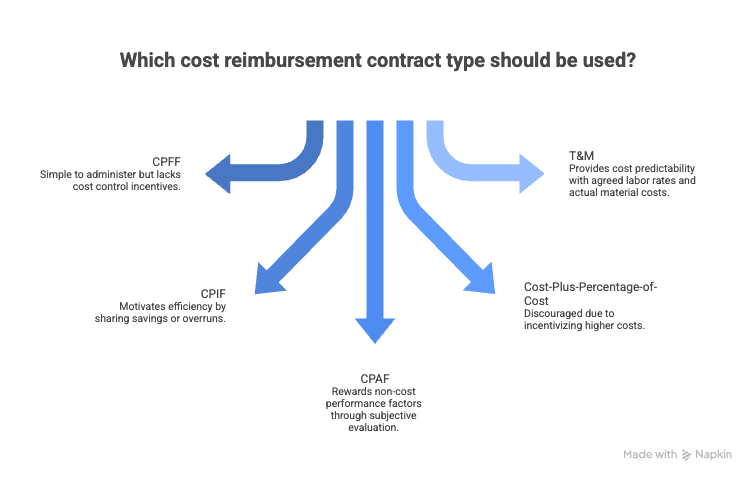
Contract structure selection chooses among cost reimbursement variants including cost-plus-fixed-fee, cost-plus-incentive-fee, or cost-plus-award-fee based on the desired balance between cost control incentives and contractor motivation.
Cost allowability definitions establish which expenses qualify for reimbursement under the contract. Detailed allowable cost clauses prevent disputes and limit buyer exposure to inappropriate or unreasonable charges.
Ongoing administration monitors incurred costs, validates allowability against contract terms, tracks progress against estimates, and manages fee calculations throughout the contract performance period.
Core Components of Cost-Reimbursement Contract
Allowable costs define which expenses the buyer will reimburse under the contract. Contracts specify cost categories, documentation requirements, and approval processes for expenses that fall outside normal parameters.
Fee structures determine how supplier profit is calculated under the agreement. Fixed fees remain constant regardless of costs incurred, while incentive or award fees vary based on performance against defined criteria.
Cost ceilings or limitations may cap total reimbursement even in cost-type contracts. These provisions protect buyers from unlimited exposure while preserving flexibility for scope changes.
Audit rights enable buyers to examine contractor accounting records, cost systems, and supporting documentation to verify claimed costs are appropriate, accurate, and properly allocable.
Key Benefits of Cost-Reimbursement Contract
- Flexibility for uncertain scope: Work can proceed despite inability to precisely define requirements upfront, enabling projects that fixed-price approaches would preclude.
- Reduced supplier risk premium: Suppliers need not build contingencies into pricing since they will be reimbursed for actual costs incurred during performance.
- Access to specialized capabilities: Some suppliers will only accept cost reimbursement for high-uncertainty work, making this approach necessary to access their expertise.
- Scope modification ease: Changes in direction do not require complex repricing negotiations since costs are reimbursed as incurred.
- Transparency into supplier costs: Reimbursement requirements provide visibility into actual costs that fixed-price contracts do not reveal to buyers.
Common Pitfalls of Cost-Reimbursement Contract
- Inadequate cost monitoring: Without active oversight, costs can escalate significantly beyond initial estimates before problems are detected.
- Vague allowability provision: Unclear definitions of reimbursable costs create disputes and may result in paying for inappropriate expenses.
- No incentive for efficiency: Pure cost reimbursement provides no motivation for suppliers to control costs. Fee structures should address this gap.
- Using cost-type inappropriately: Defaulting to cost reimbursement when fixed-price is viable transfers unnecessary risk and cost to the buyer.
KPIs of Cost-Reimbursement Contract
| Dimension | Sample KPIs |
| Cost Control | Actual versus estimated costs, cost growth rate, fee earned versus available |
| Administration | Cost report timeliness, audit findings, disallowed costs |
| Performance | Schedule adherence, deliverable quality, milestone achievement |
| Efficiency | Productivity trends, cost per output unit, overhead rates |
Key Terms in Cost-Reimbursement Contract
- Allowable Cost: An expense that meets contract criteria for reimbursement by the buyer under the agreement.
- Target Cost: The estimated cost used as baseline for incentive fee calculations in CPIF contracts.
- Share Ratio: The percentage split of cost savings or overruns between buyer and contractor in incentive contracts.
- Ceiling Price: Maximum amount the buyer will pay regardless of actual costs incurred during performance.
- Indirect Cost: Overhead expenses not directly attributable to specific contract work but allocated across contracts.
- Fee: The profit element paid to the contractor in addition to reimbursed costs for performing work.
Technology Enablement
Contract management systems support cost reimbursement administration through cost tracking, invoice validation, fee calculation, and audit trail maintenance. These platforms help procurement teams monitor contractor spending and ensure compliance with allowability provisions throughout contract performance.
FAQs
Q1. What is a cost reimbursement contract?
An arrangement where the buyer pays the supplier’s allowable costs plus a fee, used when scope cannot be precisely defined.
Q2. When should cost reimbursement be used?
When requirements are uncertain, technical risk is high, or circumstances prevent reasonable fixed-price estimation.
Q3. How do we control costs without fixed pricing?
Use incentive fee structures, cost ceilings, active monitoring, and audit rights to maintain cost discipline.
Q4. What costs are typically allowable?
Direct labor, materials, subcontracts, and allocated indirect costs that are reasonable, allocable, and permitted by contract.
Q5. Who bears the cost risk?
The buyer bears most cost risk since payment adjusts to actual costs rather than being fixed upfront.
Q6. How do fees work in these contracts?
Fees may be fixed regardless of cost, vary with cost performance, or depend on subjective performance evaluation.
References
For further insights into these processes, explore Zycus’ dedicated resources related to Cost-Reimbursement Contract:
- Optimizing the Procurement Process with eProcurement Solutions: A Comprehensive Guide
- Pokemon Go has changed the world – What Procurement can learn from it?
- Unlocking Strategic Advantages through Precision in Procurement Intake
- The Procurement Agenda 2015 – and Beyond
- Leading the AI-Driven Accounts Payable Transformation










