



Supply chain visibility (SCV) is the ability of an organization to track and monitor the status, location, and condition of goods, materials, and information as they move through the supply chain — from raw material origin through production, logistics, and delivery to the end destination. It provides procurement, operations, and logistics teams with real-time or near-real-time data on where supply chain activity stands at any given moment, enabling faster response to disruptions, better planning decisions, and more accurate communication with internal and external stakeholders.
Read more: Improving Supply Chain Visibility with Procurement Orchestration
Why Supply Chain Visibility (SCV) Matters in Procurement
Procurement cannot manage what it cannot see. When goods are in transit, at a supplier’s facility, or held at customs, the absence of visibility forces teams to rely on supplier-reported status updates that may be delayed, incomplete, or inaccurate. Supply chain visibility replaces reactive problem management with proactive control — procurement knows where supply is, when it will arrive, and whether any intervention is needed before a delivery failure becomes an operational incident. For organizations managing complex, multi-tier supply chains across multiple geographies, SCV is a prerequisite for effective risk management and supply continuity assurance.
The Core Process of Supply Chain Visibility (SCV)
- Data Source Integration: Supply chain visibility begins with connecting the data sources that track supply chain activity — supplier systems, logistics providers, IoT sensors, carrier tracking platforms, customs portals, and internal ERP records. Each source provides a partial view; integration creates the unified picture that meaningful visibility requires.
- Data Aggregation and Normalization: Raw data from disparate sources is aggregated and normalized into a consistent format. Timestamps, location references, unit measurements, and status codes may differ across systems — normalization ensures that data from different sources can be meaningfully compared and analyzed.
- Visibility Layer Construction: The normalized data is organized into a visibility layer — typically a dashboard or platform — that presents supply chain status in a format that procurement and operations teams can act on. Event-based alerts notify teams when shipments deviate from planned routes or timelines, or when supplier inventory falls below defined thresholds.
- Action and Response: Visibility data drives procurement and logistics actions — rerouting shipments, expediting alternative supply, adjusting production schedules, or communicating updated delivery dates to downstream customers. The value of visibility is realized only when it connects to decision-making and action, not just observation.
Core Components of Supply Chain Visibility (SCV)
- Tier 1 supplier visibility tracks the status of direct supplier orders — production progress, dispatch confirmation, in-transit location, and estimated arrival. This is the most commonly implemented layer of supply chain visibility and the foundation for more extended programs.
- Multi-tier visibility extends tracking to Tier 2 and Tier 3 suppliers, where many significant supply risks originate. It is technically more complex but strategically essential for identifying concentration and disruption risks before they cascade upstream.
- Logistics and in-transit tracking provides real-time location and condition data for goods in transit — including temperature, humidity, and shock monitoring for sensitive shipments. Integration with carrier tracking APIs, port authority systems, and customs portals provides end-to-end in-transit visibility.
- Event-based alerting notifies relevant teams when supply chain events deviate from plan — a delayed shipment, a supplier site closure, a customs hold — enabling procurement to respond before the deviation becomes a delivery failure.
Common Pitfalls of Supply Chain Visibility (SCV)
- Treating Tier 1 visibility as sufficient. Many significant supply chain risks originate at Tier 2 or Tier 3. Visibility that stops at direct suppliers misses the upstream events that cause most major disruptions.
- Building visibility dashboards without action protocols. Visibility platforms that surface data without connecting it to defined response protocols generate information without driving decisions. Every alert type should have an associated response process.
- Poor supplier data quality and latency. Supply chain visibility is only as good as the data feeding it. Suppliers who update status infrequently, inaccurately, or in non-standard formats degrade the quality of the visibility layer.
- Underinvesting in supplier onboarding for visibility programmes. Extending visibility to supplier systems requires supplier participation and data sharing. Organizations that do not invest in supplier onboarding and data standards see coverage gaps that undermine the programme’s value.
Levels of Supply Chain Visibility Maturity
- Transactional visibility: Order and shipment status is tracked at key milestones — dispatch, in-transit, customs, delivered. The organization knows where supply is but not in real time.
- Real-time visibility: Continuous tracking through integrated carrier APIs, IoT sensors, and supplier portals provides near-real-time location and condition monitoring for active shipments.
- Predictive visibility: AI is applied to visibility data to forecast delivery outcomes, identify likely disruptions before they materialize, and recommend pre-emptive actions.
KPIs of Supply Chain Visibility (SCV)
| Dimension | Sample KPIs |
| Coverage | % of spend with Tier 1 visibility, % with multi-tier visibility |
| Data Quality | Supplier data update frequency, % of shipments with real-time tracking |
| Response | Mean time from disruption detection to response action |
| Outcome | Expediting costs avoided, stockout incidents prevented through early warning |
Key Terms in Supply Chain Visibility (SCV)
- Supply Chain Visibility (SCV): The ability to track goods, materials, and information across the supply chain in real time or near real time.
- Multi-Tier Visibility: The extension of supply chain tracking beyond direct (Tier 1) suppliers to include the suppliers of suppliers.
- In-Transit Tracking: Real-time monitoring of goods during transportation, typically through carrier API integration, GPS, or IoT sensor data.
- Event-Based Alerting: Automated notifications triggered when supply chain status deviates from defined parameters — a delayed shipment, a customs hold, or a supplier inventory shortfall.
- Predictive Visibility: The use of analytics and AI to forecast supply chain outcomes and identify likely disruptions before they materialize.
Technology Enablement
Source-to-Pay and supply chain management platforms support SCV through supplier portal integrations, logistics API connections, and event-based alerting modules. Advanced platforms apply AI to predict delivery risk based on historical patterns, weather, port congestion, and geopolitical indicators — moving supply chain visibility from reactive status reporting to proactive disruption management.
FAQs
Q1. What is supply chain visibility?
The ability to track and monitor the status, location, and condition of goods, materials, and information as they move through the supply chain.
Q2. Why is multi-tier visibility important?
Because many significant supply chain disruptions originate at Tier 2 or Tier 3 suppliers. Visibility limited to direct suppliers misses the upstream events that cause most major incidents.
Q3. What is a supply chain control tower?
A centralized platform that aggregates data from multiple supply chain sources into a unified visibility and coordination environment, enabling end-to-end monitoring and response.
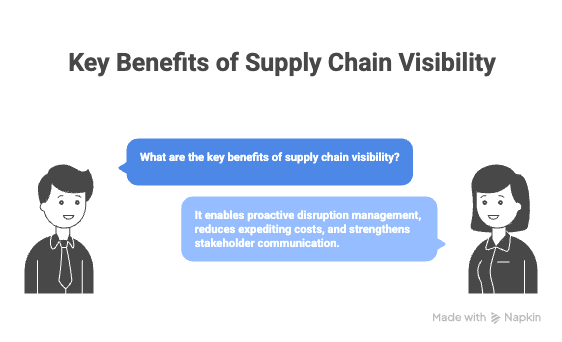
Q4. How does supply chain visibility reduce cost?
By enabling early detection of deviations, giving procurement enough lead time to arrange alternatives without expediting premiums or emergency sourcing costs.
Q5. Can supply chain visibility prevent disruptions?
Not prevent, but significantly reduce their impact. Early alerting gives procurement time to activate contingency options before a disruption reaches operational failure.
Q6. What is predictive visibility?
The application of analytics and AI to supply chain data to forecast delivery outcomes and identify likely disruption risks before they materialize.
References
For further insights into these processes, explore Zycus’ dedicated resources related to Supply Chain Visibility Scv:
- The Why, What & How of Contract Management: Part 3 – Spoke in the Wheel
- The Case for GenAI-Powered Intake Management: A Team Discussion
- Procurement in a Galaxy very very near you: How Yoda’s teachings apply to your procurement processes. (Part 1)
- Analyze Spend Analysis: Supplier and Commodity information as key drivers to spend management
- Procurement Transformation in Action: Success Stories










