



Just-in-Case (JIC) supply chain strategy is an approach in which organizations maintain elevated inventory levels and buffer stock to protect against supply disruptions, demand volatility, or delivery uncertainty. Rather than optimizing for minimal inventory, JIC prioritizes availability and operational continuity. It is a deliberate choice to absorb higher holding costs in exchange for reduced exposure to stockouts and supply failures.
Read more: What is Just-in-Time (JIT) Supply Chain Strategy
Why Just-In-Case (JIC) Supply Chain Strategy Matters in Procurement
Procurement plays a direct role in enabling a JIC strategy. Buying decisions, supplier lead times, contract structures, and order quantities all shape how much buffer the organization can sustain and at what cost. When disruptions occur, organizations running JIC inventories are better positioned to absorb shocks without halting operations. Procurement teams responsible for critical categories must understand when JIC is appropriate and how to structure supplier agreements that support it without creating unmanageable cost burdens.
The Core Process of JIC Supply Chain Strategy
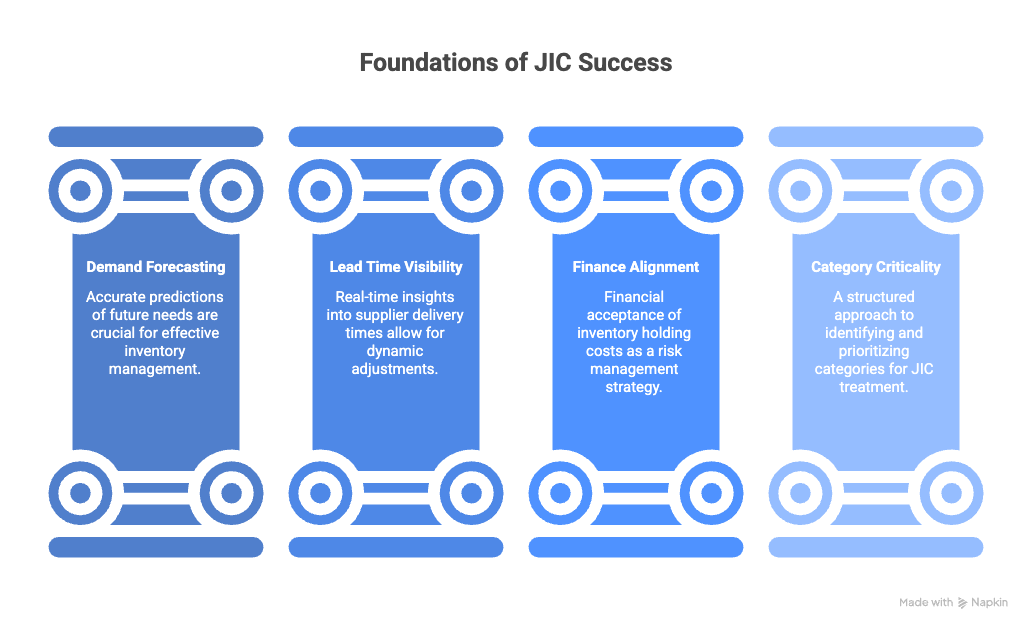
The process begins with a category risk assessment that identifies which goods carry the highest disruption risk. Factors include supplier concentration, geographic exposure, lead time variability, and the operational consequence of a stockout. High-criticality categories are primary candidates for JIC treatment.
Procurement then works with operations and finance to define target inventory levels, including safety stock quantities, reorder points, and maximum holding thresholds. Supplier agreements are structured to support the strategy through vendor-managed inventory arrangements, blanket purchase orders, or priority allocation agreements.
Ongoing management involves monitoring inventory levels against targets, tracking supplier lead time performance, and adjusting buffer quantities as conditions change. When supply markets stabilize or risk profiles improve, JIC parameters can be relaxed to reduce holding costs.
Core Components of JIC Supply Chain Strategy
Safety stock calculation determines the quantity held above expected demand to protect against lead time variability and forecast error. Supplier lead time management ensures replenishment orders arrive before safety stock is depleted. Warehouse and storage capacity planning confirms that elevated inventory levels are physically feasible. Working capital alignment ensures finance stakeholders understand and accept the cost of carrying higher inventory as a calculated risk investment.
Key Benefits of JIC Supply Chain Strategy
- Protects operations from supply disruptions, reducing the risk of production stoppages or service failures due to stockouts.
- Provides a buffer during demand surges, allowing the organization to fulfill requirements without emergency sourcing.
- Reduces dependency on supplier delivery precision, accommodating lead time variability without operational impact.
- Strengthens negotiation position by enabling larger, less-frequent orders at better unit pricing.
Common Pitfalls of JIC Supply Chain Strategy
- Applying JIC uniformly across all categories: Not every category warrants buffer stocking. Applying JIC broadly inflates holding costs without meaningful risk reduction for low-criticality items.
- Setting safety stock once and never reviewing it: Lead times, demand patterns, and supply risks change. Safety stock levels must be recalculated periodically to remain calibrated.
- Ignoring obsolescence risk: Elevated inventory of fast-moving or short-lifecycle products can lead to write-offs if demand shifts or products are superseded.
- Treating JIC and JIT as mutually exclusive: Many organizations apply JIC selectively to critical categories while using JIT principles elsewhere, producing the best overall result.
KPIs of JIC Supply Chain Strategy
| Dimension | Sample KPIs |
| Inventory Coverage | Days of stock on hand, safety stock coverage ratio |
| Disruption Protection | Stockout incidents avoided, service level maintained during disruptions |
| Cost of Carry | Inventory holding cost as % of spend, write-off rate |
| Replenishment Performance | Lead time variance, on-time replenishment rate |
Key Terms in (JIC) Supply Chain Strategy
- Safety Stock: Inventory held above expected demand to protect against lead time variability and forecast uncertainty.
- Reorder Point: The inventory level at which a replenishment order is triggered to avoid stockout before the next delivery arrives.
- Just-in-Time (JIT): A supply chain strategy that synchronizes supply with demand to minimize inventory and holding costs.
- Stockout: A condition in which available inventory is exhausted before replenishment arrives, disrupting operations.
- Holding Cost: The total cost of carrying inventory, including storage, capital, insurance, and obsolescence risk.
- Vendor-Managed Inventory (VMI): An arrangement where the supplier monitors and replenishes inventory at the buyer’s location.
Technology Enablement
Inventory management and demand planning modules within Source-to-Pay and ERP platforms support JIC by automating safety stock calculations, triggering replenishment orders, and tracking inventory against defined thresholds. These tools reduce manual monitoring and help procurement maintain appropriate buffers efficiently.
FAQs
Q1. What is a Just-in-Case supply chain strategy?
JIC maintains elevated inventory buffers to protect against supply disruptions, lead time variability, and demand uncertainty.
Q2. How does JIC differ from Just-in-Time?
JIT minimizes inventory by synchronizing supply with demand. JIC holds excess inventory as insurance against disruptions.
Q3. Which categories should use a JIC approach?
Critical, high-risk, or long-lead-time categories where a stockout would severely impact operations.
Q4. What are the main costs of JIC?
Storage, capital tied up in inventory, insurance, and the risk of obsolescence are the primary cost drivers.
Q5. How is safety stock calculated?
Using average demand, lead time variability, and a desired service level factor, typically expressed as a statistical formula.
Q6. Can JIC and JIT be used together?
Yes. Many organizations apply JIC to critical categories and JIT to stable, low-risk items, creating a tiered strategy.
Q7. How does procurement support a JIC strategy?
Through supplier agreements, lead time monitoring, blanket orders, and safety stock target-setting with operations and finance.
References
For further insights into these processes, explore Zycus’ dedicated resources related to Just In Case Supply Chain Strategy:
- Beyond Knowledge Retrieval: How RAG Enhances Contextual Understanding in Source-to-Pay
- Spendonomics: The science of astute spend management
- RPA in Procure-to-Pay to Transform Your P2P Process: The Ultimate Guide
- Pulse of Procurement 2018: Your Annual Check-up on the Prognosis for Procurement
- Optimize Your Supplier Risk Programs Now










