



Kanban is a visual inventory and production management system that signals when materials need to be replenished by using physical or digital cards to represent a unit of demand. Originating in the Toyota Production System, kanban operates as a pull mechanism — replenishment is triggered by actual consumption rather than forecast demand. In procurement, kanban governs the flow of direct materials from suppliers to production lines, ensuring that components arrive in the right quantity at the right time, without building excess inventory or risking line stoppages from shortages.
Why Kanban Matters in Procurement
Kanban is one of the most effective tools for reducing inventory waste while maintaining supply reliability. Traditional push replenishment orders materials based on forecasts that may prove inaccurate, creating surplus or shortages. Kanban’s pull logic orders only what has been consumed — aligning supply with demonstrated demand. For category managers in lean environments, supplier delivery schedules, batch sizes, and replenishment agreements must all be designed around the kanban parameters the production system uses.
The Core Process of Kanban
- Kanban Parameter Setting: The process begins by calculating the parameters that govern the system: the number of kanban cards in circulation, the quantity each card represents, and the replenishment lead time. These calculations are based on takt time, average daily consumption, supplier lead time, and the desired safety buffer. Accurate parameter setting is the foundation of a well-functioning kanban system.
- Signal and Trigger: As material is consumed in production, kanban cards are released and returned to the replenishment queue — either to the supplier or to an internal store. Each released card is a signal to replenish exactly that quantity. In digital kanban systems, consumption triggers automatic replenishment signals without physical card handling.
- Replenishment Execution: Procurement or the supplier responds to kanban signals by delivering the specified quantity within the agreed lead time. The reliability of this response is critical: a kanban system designed for a two-day supplier lead time fails if actual lead times are variable or longer.
- Continuous Improvement: Kanban parameters are reviewed and adjusted as demand patterns change, supplier lead times improve, and the production system matures. Reducing the number of cards in circulation — and thus the inventory buffer — is a lean improvement target, achievable as supplier reliability increases.
Core Components of Kanban
- Kanban card is the signal unit — physical or digital — that authorizes replenishment of a defined quantity of a specific material. Each card represents one replenishment cycle. The total number of cards in the system determines the maximum inventory level.
- Replenishment lead time is the time from kanban signal to material availability at the point of use. It is the primary driver of the number of cards required — longer lead times require more cards and therefore more inventory to cover the replenishment pipeline.
- Batch size is the quantity each kanban card authorizes. Smaller batches mean more frequent deliveries and lower average inventory; larger batches mean less frequent deliveries and higher average inventory. Batch size is negotiated with suppliers based on their minimum order quantities, delivery costs, and the buyer’s inventory targets.
Key Benefits of Kanban
- Reduces inventory levels by triggering replenishment based on actual consumption rather than forecast-driven push orders.
- Eliminates overproduction and excess stock by capping the maximum inventory in the system at the number of cards in circulation.
- Improves supply reliability by creating a clear, simple signal that tells suppliers exactly what is needed and when — reducing coordination complexity and communication errors.
- Enables continuous improvement by making inventory reduction a measurable, manageable target tied to supplier lead time and delivery reliability improvement.
Common Pitfalls of Kanban
- Setting kanban parameters based on nominal rather than actual lead times: If supplier lead times are variable or longer than assumed, cards will run out before replenishment arrives — causing line stoppages that the system was designed to prevent.
- Failing to recalculate parameters when demand changes: A kanban system calibrated for one takt time will over- or under-buffer when takt time changes. Parameter reviews must be triggered by demand changes, not just scheduled periodically.
- Using kanban for low-volume or highly variable demand items: Kanban works best for items with stable, predictable consumption. For sporadic or highly variable demand, kanban parameters become either over-buffered or unreliable.
- Treating kanban as a static system: The goal of lean is to continuously reduce waste. Kanban card counts should be actively reduced over time as supplier reliability improves — not left unchanged once the initial system is deployed.
KPIs of Kanban
| Dimension | Sample KPIs |
| Inventory Performance | Days of supply at point of use, kanban card count vs. target, inventory turns |
| Supply Reliability | % of kanban replenishments completed within lead time, line stoppages from supply failure |
| System Health | Parameter review frequency, % of items with current kanban settings |
| Improvement Progress | Reduction in card count over time, lead time reduction enabling card reduction |
Key Terms of Kanban
- Kanban Card: The signal unit — physical or digital — that authorizes replenishment of a defined quantity of a specific material.
- Pull System: A replenishment approach triggered by actual consumption rather than forecast-driven push orders.
- Takt Time: The rate at which units must be produced to meet customer demand — the production cadence that determines kanban parameter calculations.
- Two-Bin System: A simplified kanban implementation using two containers — one in use, one in reserve — where the empty container triggers replenishment.
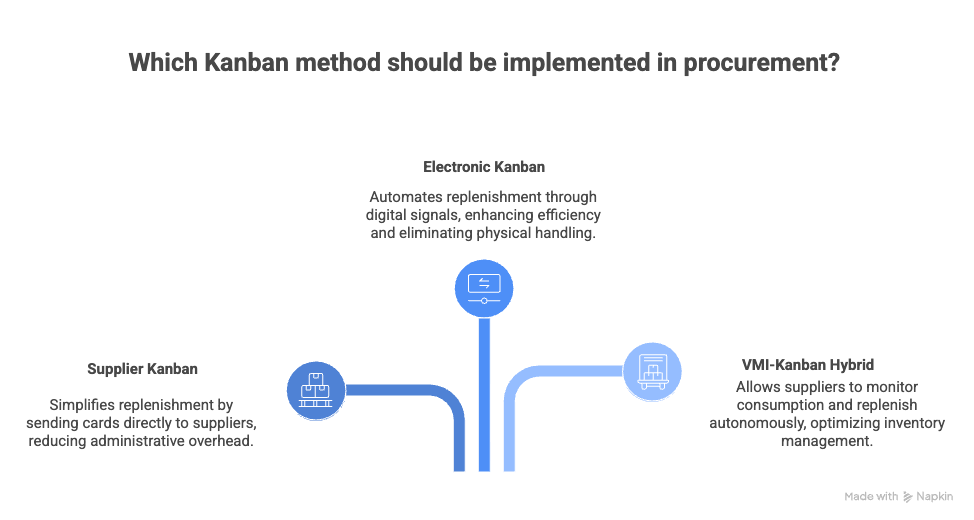
- E-Kanban: A digital kanban system in which consumption signals are transmitted electronically from the production system to the supplier or warehouse.
Technology Enablement
ERP and manufacturing execution systems support kanban through digital signal generation, automatic replenishment order creation, and parameter management tools. Supply chain visibility platforms track kanban replenishment status across the supplier network, alerting procurement when signals are not acknowledged or deliveries are at risk of missing the required lead time.
FAQs
Q1. What is kanban in procurement?
A pull-based replenishment system that triggers material orders based on actual production consumption rather than forecast demand — using cards or digital signals to authorize each replenishment cycle.
Q2. How does kanban reduce inventory?
By capping maximum inventory at the number of cards in circulation and ordering only what has been consumed — eliminating the over-ordering that forecast-driven push systems generate.
Q3. How is kanban card quantity calculated?
Based on average daily consumption, supplier replenishment lead time, desired safety buffer, and batch size — producing the number of cards needed to cover supply while replenishment is in transit.
Q4. When is kanban not appropriate?
For items with low volume, highly variable demand, or very long supplier lead times — where the required inventory buffer makes kanban inefficient compared to planned order approaches.
Q5. What is e-kanban?
A digital version of the kanban system where consumption triggers automatic electronic replenishment signals to suppliers or internal stores, eliminating physical card handling.
References
For further insights into these processes, explore Zycus’ dedicated resources related to Kanban:
- Live Webinar: Key Procurement Trends for 2015
- Leveraging Technology to Resolve Post-War Contract Management Challenges
- Mastering Procurement: Demystifying Source to Contract (S2C) Process
- You’ve Outgrown Your Procurement Tools: Turning Growing Pains to ROI Gains for Mid-Size/High Growth Organizations
- Keep Climbing: Delta’s Competitive Advantage Powered by Supply Chain Excellence










