


WHAT IS PURCHASE PRICE VARIANCE (PPV)?
Purchase Price Variance (PPV) is the difference between the price actually paid for an item and its standard or expected price, multiplied by the quantity purchased. Measured as actual minus standard, a positive variance means the company paid more than planned and a negative variance means it paid less. PPV shows how closely purchase prices track the plan.
WHY IT MATTERS IN PROCUREMENT
Budgets and product costs are built on expected prices. When actual prices drift, margin moves with them, often before anyone notices. PPV puts a number on that drift by item, supplier and category.
It also separates price effects from volume effects. A team can overspend because it bought more or because it paid more per unit. PPV isolates the second cause, which procurement can act on directly through negotiation, sourcing or specification changes.
THE CORE PROCESS / LIFECYCLE
- Setting the Standard Price. Finance and procurement agree a standard price for each item, based on contracts, quotes and market indexes. This is the baseline against which variance is measured.
- Recording the Purchase. Each PO and receipt captures the actual price paid and the quantity. Accurate unit-of-measure and currency data matter at this point.
- Calculating Variance. The system compares actual and standard price on each transaction and multiplies the difference by quantity. Results roll up by item, supplier and category.
- Investigating Causes. Large variances are traced to their drivers, such as market price movement, expedited shipping, off-contract buying, supplier increases or a stale standard.
- Corrective Action. Procurement renegotiates, shifts volume to contracted suppliers or enforces contract pricing. Where the standard itself is out of date, finance resets it.
- Reporting and Review. Variance is reported monthly and reviewed with category managers, so trends are caught early.
CORE COMPONENTS
- Standard price is the planned unit price used as the baseline.
- Actual price is usually the price on the PO at receipt. A later difference between the PO and the invoice is an invoice price variance.
- Quantity is the units purchased in the period. The formula is (Actual price − Standard price) × Quantity.
Some companies report favorable variances as positive and others as negative, so the sign convention should be fixed and documented.
KEY BENEFITS
PPV gives early warning on cost drift, before it reaches the income statement. It shows which suppliers and categories drive the largest price changes, which focuses negotiation effort. It exposes off-contract purchases, where buyers pay more than negotiated rates. It supports fair performance reviews of buyers because it ties results to the standard they were given. And it improves forecast accuracy, because repeated variances show where standards need updating.
COMMON PITFALLS
- Using stale standards. An outdated standard price turns every variance into noise instead of signal.
- Treating all variance as a procurement failure. Market inflation and currency swings sit outside buyer control and should be reported separately.
- Chasing favorable variance. Buying the cheapest unit to show a negative PPV can hurt quality, delivery and total cost.
- Mixing units of measure. Inconsistent units or currencies create false variances and waste investigation time.
WORKED EXAMPLE: CALCULATING AND READING PPV
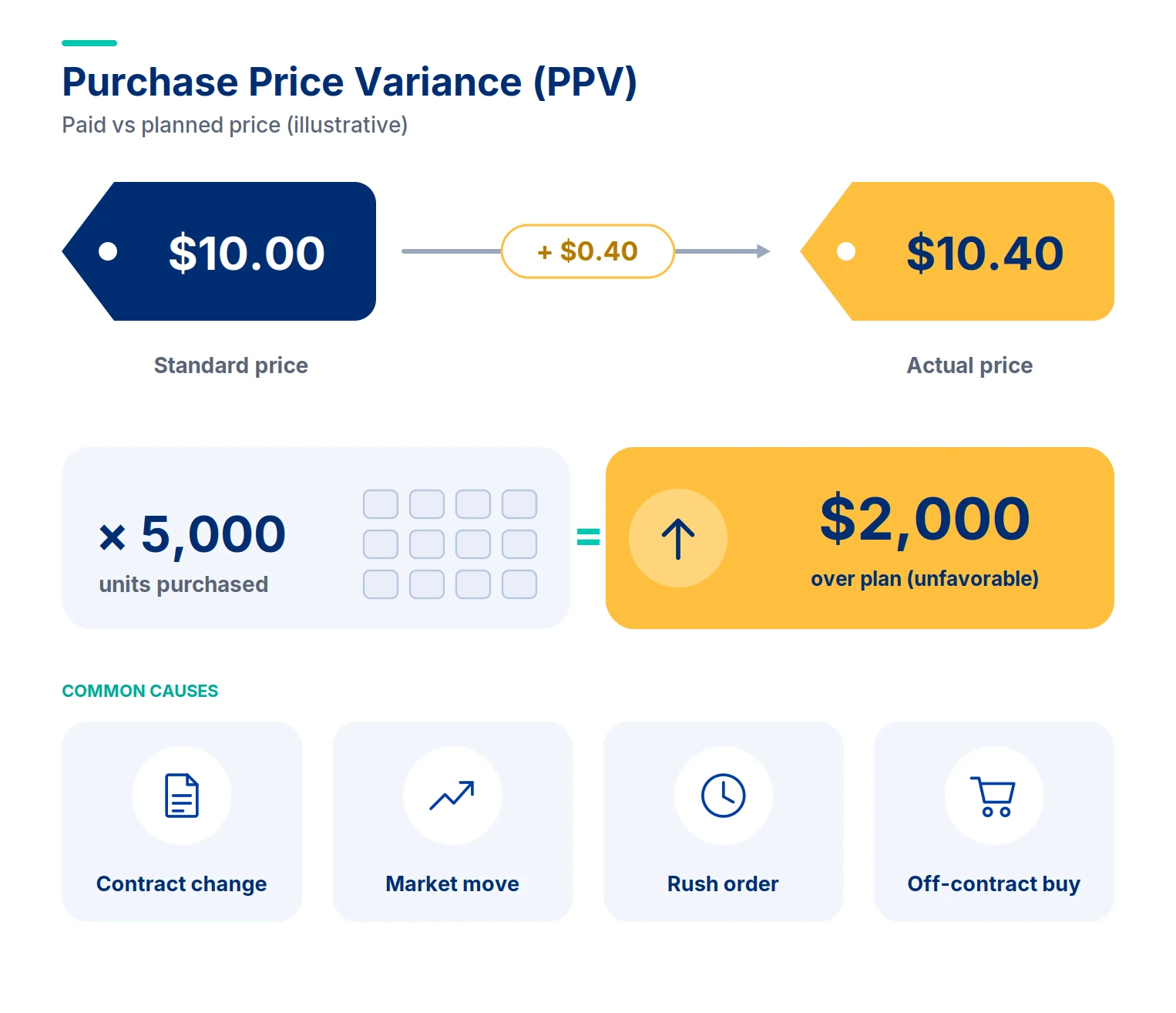
- The inputs. A buyer plans to pay $10.00 per unit. The supplier invoices $10.40 per unit for 5,000 units.
- The calculation. PPV = ($10.40 − $10.00) × 5,000 = $2,000. The company paid $2,000 more than planned.
- Reading the sign. Where actual minus standard is positive, this is an unfavorable variance. Under the opposite convention it would show as negative, so check which one your reports use.
- Finding the cause. Check whether the rise came from a contract change, a market index, a rush order or an off-contract buy. The cause decides the response.
- Taking action. If off-contract buying caused it, enforce contract pricing. If the market moved, update the standard at the next review.
KPIs
| Dimension | Sample KPIs |
| Price performance | PPV by category; PPV as a share of spend |
| Compliance | Spend on contract; off-contract purchase rate |
| Accuracy | Items with a current standard price; variance explained rate |
| Trend | Month-on-month PPV; share of PPV from market movement |
KEY TERMS
- Standard Cost. A predetermined cost per unit used for budgeting and variance analysis.
- Usage Variance. The difference between planned and actual quantities consumed, valued at the standard price.
- Favorable Variance. A result where the actual cost is lower than the standard.
- Unfavorable Variance. A result where the actual cost is higher than the standard.
- Off-Contract Spend. Purchases made outside negotiated contract terms, often at higher prices.
- Landed Cost. The total cost of an item including freight, duties and handling, not just the unit price.
- Price Index. A published measure of price movement used to adjust standards or contract prices.
- Invoice Price Variance. The difference between the price on the purchase order and the price on the invoice, where PPV compares against the standard price instead.
FAQs
1. What is Purchase Price Variance (PPV) in procurement?
Purchase Price Variance (PPV) measures the difference between an item’s actual purchase price and its standard or expected price, multiplied by the quantity purchased. It helps procurement and finance teams identify cost deviations, evaluate supplier pricing, and monitor purchasing performance. A favorable variance indicates lower costs than expected, while an unfavorable variance indicates higher costs. PPV analysis supports cost control, budget management, and sourcing decisions.
2. How do you calculate Purchase Price Variance (PPV)?
Purchase Price Variance is calculated by subtracting the standard price from the actual purchase price and multiplying the difference by the quantity purchased.
PPV Formula = (Actual Price − Standard Price) × Quantity Purchased
For example, if the standard price is $10, the actual price is $10.40, and 5,000 units are purchased, PPV equals $2,000. This represents an unfavorable variance because the company paid more than planned.
3. What is the difference between favorable and unfavorable Purchase Price Variance?
A favorable Purchase Price Variance occurs when the actual purchase price is lower than the standard price, indicating a purchasing cost advantage. An unfavorable variance occurs when the actual price exceeds the standard, resulting in additional costs. Under the actual-minus-standard formula, favorable variances are negative and unfavorable variances are positive. However, organizations may use different reporting conventions, so procurement teams should verify how variances are classified.
4. What are the most common causes of Purchase Price Variance?
Common causes of Purchase Price Variance include supplier price increases, commodity market fluctuations, currency changes, expedited purchases, and off-contract spending. Outdated standard prices, inconsistent units of measurement, and contract pricing discrepancies can also create variances. Procurement teams should investigate whether deviations result from controllable purchasing decisions or external market conditions. Understanding these causes helps organizations improve sourcing strategies, enforce negotiated pricing, and maintain accurate cost forecasts.
5. What is the difference between Purchase Price Variance and Invoice Price Variance?
Purchase Price Variance compares an item’s actual purchasing price against its predefined standard cost. Invoice Price Variance compares the supplier’s invoiced price against the price recorded on the purchase order. PPV helps procurement teams monitor purchasing cost performance, while Invoice Price Variance identifies billing discrepancies. Both metrics support financial accuracy, supplier pricing compliance, and cost control, but they measure differences against separate pricing benchmarks.
6. Is Purchase Price Variance the same as procurement cost savings?
No, Purchase Price Variance and procurement cost savings measure different financial outcomes. PPV compares actual purchasing prices against established standard costs, while procurement savings typically measure reductions against historical prices, negotiated baselines, or alternative sourcing costs. A favorable PPV does not automatically represent realized savings, especially when standard prices are outdated. Organizations should track both metrics separately to accurately evaluate procurement performance and financial benefits.
7. How can procurement teams reduce and manage Purchase Price Variance?
Procurement teams can manage Purchase Price Variance by monitoring supplier pricing, enforcing contract compliance, negotiating better rates, and reducing off-contract purchases. Regular PPV analysis by supplier, category, and product helps identify recurring cost deviations. Finance and procurement should also review standard prices, investigate significant variances, and distinguish market-driven changes from purchasing inefficiencies. Automated purchasing analytics can improve variance visibility and support timely corrective actions.