



Supplier Management- also known as Vendor Management or Supplier Lifecycle Management- is the structured process of onboarding, qualifying, monitoring, and developing suppliers to ensure they meet organizational goals for cost, quality, delivery, innovation, and compliance.
It acts as the connective framework between Sourcing, Procure-to-Pay, and Risk Management, transforming vendors from transactional providers into strategic partners who add measurable value and resilience to the business.
Read more: Supplier Relationship Management: A Comprehensive Guide
Why Supplier Management is Critical?
Modern supply chains are vast, distributed, and interdependent. A single supplier failure, financial, operational, or ethical, can disrupt entire business lines.
Effective Supplier Management ensures:
- Reliable and ethical supply continuity
- Consistent performance and quality
- Compliance with contractual and regulatory standards
- Proactive risk mitigation
- Transparent collaboration and innovation
In short, it turns supplier relationships into a strategic advantage rather than a compliance necessity.
The Complete Supplier Management Framework (At a Glance)
Supplier Management operates as a continuous lifecycle — not a linear checklist. Each phase builds intelligence and control that fuels the next.
| Stage | Objective | Key Activities |
| Supplier Discovery & Pre-Qualification | Identify and screen potential suppliers | Market scouting, RFIs, capability assessment, risk profiling |
| Supplier Onboarding | Capture and verify supplier data | Legal, financial, tax, ESG, and diversity validation; registration approvals |
| Supplier Qualification & Approval | Confirm capability and compliance readiness | Document verification, certifications, audits, scoring |
| Supplier Information Management (SIM) | Maintain accurate master data and documentation | Central repository for profiles, certificates, and communication |
| Supplier Performance Management (SPM) | Measure and improve delivery, quality, and responsiveness | KPIs, OTIF, scorecards, CAPA workflows |
| Supplier Risk Management (SRM) | Monitor risk across financial, operational, cyber, and ESG domains | Real-time alerts, mitigation tracking |
| Supplier Development & Collaboration | Strengthen capability and partnership | Improvement plans, training, innovation workshops |
| Supplier Offboarding & Transition | Manage exits or replacements smoothly | Contract closure, documentation, risk transfer, lessons learned |
Core Components of Supplier Management
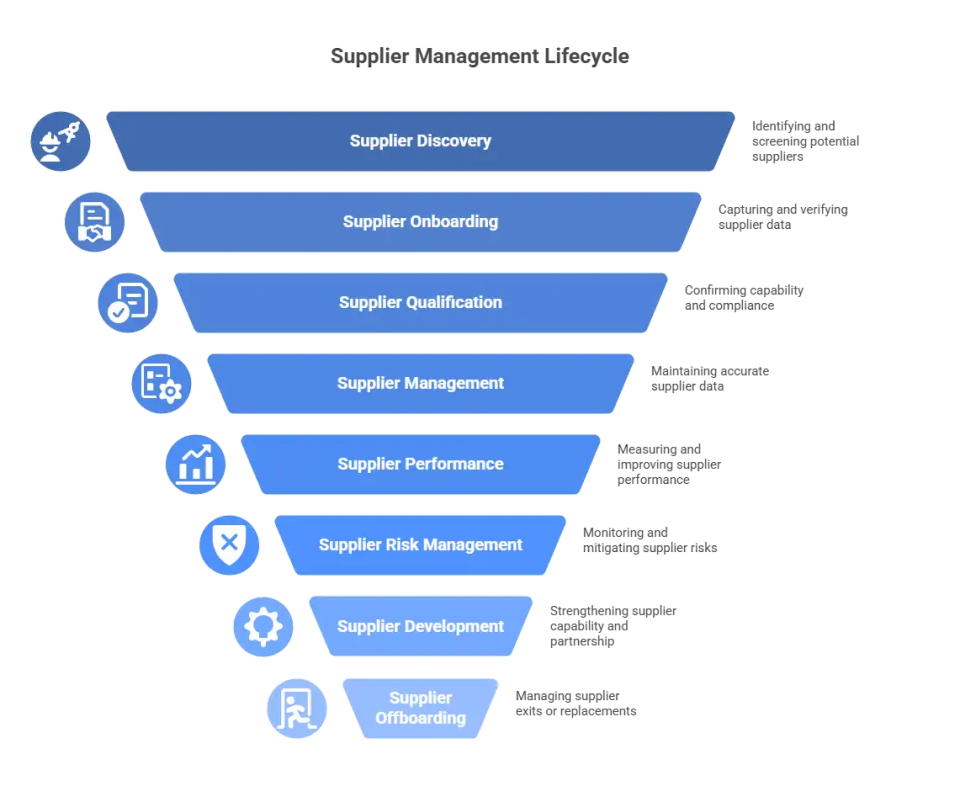
The Core Supplier Management Flow
1. Supplier Information Management (SIM)
Supplier data forms the foundation of every procurement process.
Legal, financial, tax, and ESG information is captured through automated onboarding workflows or supplier self-service portals.
Data validation ensures accuracy, completeness, and compliance before approval.
Download Whitepaper: Procurement SIMplified with Supplier Information Management System
Zycus Supplier Management centralizes these profiles into a single master record, keeping information consistent across sourcing, contracts, and P2P systems.
2. Supplier Qualification and Approval
- Qualification confirms a supplier’s capability and credibility before they enter active use.
- AI-based scoring evaluates financial health, certifications, operational readiness, and risk indicators.
- Depth of assessment varies by tier, strategic suppliers undergo detailed audits; transactional ones pass lighter checks.
Zycus automates this qualification flow, linking supplier approval directly with sourcing eligibility.
3. Supplier Performance Management (SPM)
- Performance evaluation ensures suppliers deliver on commitments for quality, cost, and timeliness.
- KPIs such as OTIF %, defect rates, and responsiveness are tracked continuously through dashboards and scorecards.
- Qualitative inputs — buyer feedback, surveys, and audit outcomes — complete the view.
Zycus SPM ties performance insights back into sourcing and renewal decisions, driving data-backed supplier retention or replacement.
4. Supplier Risk and Compliance Management
- Risk and compliance monitoring run in real time, covering financial, operational, cyber, and ESG dimensions.
- Alerts trigger on critical events such as credit downgrades, data breaches, or policy violations.
- Certificates, audits, and attestations are auto-tracked for validity and renewal.
Merlin Risk Radar strengthens this layer by integrating external data (sanctions, media, ESG disclosures), ensuring risk signals are detected early and managed effectively.
5. Supplier Collaboration and Development
Collaboration transforms oversight into partnership.
Suppliers access a shared portal for PO visibility, invoice tracking, and performance feedback.
Joint improvement plans and innovation programs strengthen capabilities and build trust.
Zycus Collaboration Hub facilitates two-way communication, issue resolution, and supplier-driven innovation — improving both compliance and engagement.
6. Supplier Segmentation and ESG Integration
Suppliers are managed by criticality — Tier A (strategic) monitored continuously, Tier B reviewed quarterly, Tier C validated annually.
Diversity and ESG tracking ensure supplier portfolios reflect ethical and sustainable practices.
Metrics include ownership attributes, carbon footprint, labor standards, and governance compliance.
Zycus automates tier-based cadences and embeds ESG metrics within supplier profiles, aligning procurement decisions with corporate sustainability goals.
7. Unified Control and Visibility
Together, these components form a single supplier ecosystem, where data, performance, risk, and collaboration connect seamlessly.
Within Zycus Supplier Management, every supplier record evolves dynamically, from onboarding to offboarding, creating a transparent, traceable, and resilient supplier network.
The Supplier Management Data Model
A robust system connects all data streams into a unified model:
| Data Type | Examples | Used For |
| Master Data | Legal name, tax ID, DUNS, address | Supplier identification and ERP sync |
| Financial Data | Revenue, credit rating, payment terms | Risk scoring and assessment |
| Compliance Data | Certificates, policies, audits | Assurance and governance |
| Performance Data | OTIF, quality, responsiveness | Supplier evaluation |
| ESG Data | Energy, emissions, diversity metrics | Sustainability and CSR tracking |
| Transactional Data | POs, invoices, GRNs | Process and operational insight |
| External Data | Sanctions, news, market signals | Real-time risk enrichment |
KPIs & Data (Make It Provable)
| Dimension | Sample KPIs |
| Performance | OTIF %, defect rate, service-level adherence |
| Compliance | Certificate freshness %, audit completion %, policy adherence |
| Risk | High-risk supplier %, incident resolution time, mitigation closure rate |
| Efficiency | Onboarding cycle time, data completeness %, portal adoption rate |
| Collaboration | QBR participation %, supplier satisfaction index |
| Sustainability | ESG disclosure %, diverse supplier ratio, emission reduction % |
Integration Across Source-to-Pay
Supplier Management integrates with every module of the S2P ecosystem:
- Sourcing: Pre-qualification and performance-based supplier selection
- Contract Management: Linking compliance data and renewals
- Procure-to-Pay: Streamlined supplier onboarding for invoicing and payments
- Risk & Analytics: Shared data feeds for predictive insights
- Zycus Ecosystem: A single supplier record that updates across all systems in real time
Advanced Concepts in Supplier Management
| Concept | Description |
| Supplier Lifecycle Management (SLM) | Manages all supplier stages — from discovery to exit — in a single flow |
| Supplier Experience Management (SXM) | Enhances usability, communication, and transparency for suppliers |
| Supplier 360° View | Unified profile combining financial, performance, and risk insights |
| Cognitive Supplier Scoring | AI-based scoring model using internal and external signals |
| Predictive Risk Modeling | Anticipates supplier disruptions before they occur |
| Supplier Collaboration Hub | Unified workspace for document exchange and QBRs |
| Automated Audit Trails | Tracks every supplier change for full accountability |
| Agentic AI in Supplier Management | Autonomous agents identify anomalies and missing documentation |
Key Terms in Supplier Management
- Supplier Lifecycle Management (SLM): The end-to-end process of managing suppliers, from discovery and onboarding to performance, risk, and offboarding, ensuring continuous value creation and compliance.
- Supplier Information Management (SIM): Centralized control of supplier master data, certificates, and profiles across sourcing, contracting, and payment systems.
- Supplier Performance Management (SPM): Systematic tracking and improvement of supplier KPIs like OTIF%, quality score, and responsiveness through dashboards and scorecards.
- Supplier Risk Management (SRM): Identification, monitoring, and mitigation of financial, operational, cyber, and ESG risks across the supplier base.
- Supplier Collaboration Hub: A digital workspace that enables two-way communication, document exchange, and innovation between buyers and suppliers.
- Supplier Segmentation: Categorization of suppliers by criticality, spend, and strategic impact (e.g., Tier A strategic, Tier B tactical, Tier C transactional).
FAQs
Q1. What is supplier management?
It is the structured process of onboarding, evaluating, and monitoring suppliers to ensure consistent performance, compliance, and collaboration across the supply chain.
Q2. What is the difference between supplier management and vendor management?
Supplier management takes a strategic, lifecycle-based view — focusing on risk, performance, and development — while vendor management is often transactional, centered on purchase execution and service delivery.
Q3. What are the benefits of a supplier management system?
It improves visibility, ensures compliance, reduces risk, and enhances collaboration through centralized data, automated workflows, and continuous supplier performance tracking.
References
For further insights into these processes, explore Zycus’ dedicated resources related to Supplier Management:
- Expert Access: Supply Risk – Could Supplier Management be a Remedy?
- Supplier Management – Innovation is the need of the hour
- The Path to Supplier Management Excellence
- Supplier Risk And Performance Management: Best Practices For KPI Creation
- Essential Components of a World-Class Supplier Performance Management Tool: A MENA Perspective
- The Why, What And How of the supplier management in procurement










